
Stick-on blinds fix with adhesive rather than screws, which makes them the no-drill option for frames you can't or won't put a drill into: a rented flat, a UPVC door, a window with a shallow recess. Interest picks up in spring, when lighter mornings send people looking for bedroom blackout and decorating season gets under way, and for renters the question comes up whenever a tenancy starts. This guide explains what stick-on actually means, how it differs from perfect-fit, and what to check before you order. It then compares three stick-on picks: a voile for sliding doors, a cellular blackout range and a real wood venetian. It covers made-to-measure ranges sold explicitly as stick-on, not every no-drill blind.
What "stick-on" actually means
"No-drill" is an umbrella term. It covers any blind that goes up without screws, and within it sit two quite different fixing methods that are easily confused.
A stick-on blind uses adhesive fixings. The fixings bond to the window or door with adhesive rather than screws, and the blind mounts onto them. The blind itself is ordinary: our picks include a voile, a cellular blackout and a wooden venetian. What differs is how it holds to the window. Because adhesive relies on the surface it sticks to, retailers specify where their fixings can go and how to prepare the surface, so read the fitting instructions rather than assuming any frame will do. How cleanly the fixings come away later depends on the product and the surface, and the retailer's guidance is the only reliable source on that.
A perfect-fit blind is the other common no-drill route. Instead of adhesive, a slim frame grips the rubber gasket that seals the glass into a UPVC (PVC-U) double-glazed window. There are no screws and no sticky pads, and the frame comes out without trace. The catch is that it only works on UPVC windows with gaskets and a recess deep enough for the frame; it doesn't fit wooden or aluminium windows the same way. If your windows are UPVC, our perfect-fit guide is worth reading alongside this one, and the Cosibloc range below is sold in both fittings.
The practical difference is where each can go. Perfect-fit is limited to UPVC glazing but needs no adhesive. Stick-on depends on a suitable surface but isn't tied to one window material, which is why it's the route to look at where the frame isn't UPVC. For the wider picture, including no-drill options beyond these two methods, see our no-drill blinds guide.
What to look for
The surface you're fixing to. This matters more for a stick-on blind than any other decision. The retailer will say which surfaces its fixings are designed for and how to clean and prepare them. If your frame is UPVC with a rubber gasket, you also have the perfect-fit option, which avoids adhesive altogether. If it isn't UPVC, stick-on is likely to be the no-drill route left open to you, subject to that surface guidance.
Weight. Adhesive fixings are designed around a certain load, which is one reason retailers set maximum sizes per product. Real wood slats are heavier than faux wood or fabric, so a wide stick-on wooden venetian is a bigger ask than a stick-on voile of the same size. Treat the retailer's size limits as hard limits.
What you need the blind to do. Stick-on describes the fixing, not the fabric, and our picks span the opacity range. A voile diffuses light and softens the view but is decorative rather than functional where light control is concerned. A blackout fabric is opaque against a backlight test, though light still leaks around the edges of any blind, so real darkness also depends on how closely the blind sits to the glass. A venetian sits between the two: tilting the slats controls glare without raising the blind, and closing them fully gives effective blackout where the slats overlap.
Thermal performance. If part of the appeal is a warmer room, look for cellular (honeycomb) construction. The sealed air pockets between the fabric layers give the best insulation of any blind type, measurably more than a single layer of blackout fabric. Among our picks, only the Cosibloc range offers it. Our cellular blinds guide covers the type in more depth.
Doors versus windows. The attraction of fixing a blind to a sliding door panel is that the blind moves with the door rather than hanging across the opening. Check that it clears the handle and that the panel surface suits the fixing. Width matters too: patio doors are wide, and one blind per panel is a different thing from one blind across the whole opening. Measure the glass or panel you intend to cover, not the doorway.
The room. Real wood warps and discolours in humid rooms, so a stick-on wooden venetian belongs in a bedroom, living room or office rather than a bathroom. Polyester fabrics are more tolerant of steam. Dust real wood dry and use a damp cloth only sparingly; fabric blinds take a vacuum brush and a spot-clean with mild soap.
Cord safety. UK regulation (BS EN 13120, in force since 2014) requires domestic blinds to be cord-safe by design, through cordless or wand operation, breakaway connectors or cord cleats. If the blind is going in a child's room, cordless or wand operation is the standard recommendation, and the retailer should supply a safety device with any corded version.
Our picks
Three ranges from three retailers, each chosen because it does one job well rather than because it does everything. The voile is for a door you want to soften rather than darken, the Cosibloc is for a bedroom where blackout and warmth both matter, and the wooden venetian is for anyone who wants adjustable light and a wood finish without drilling.

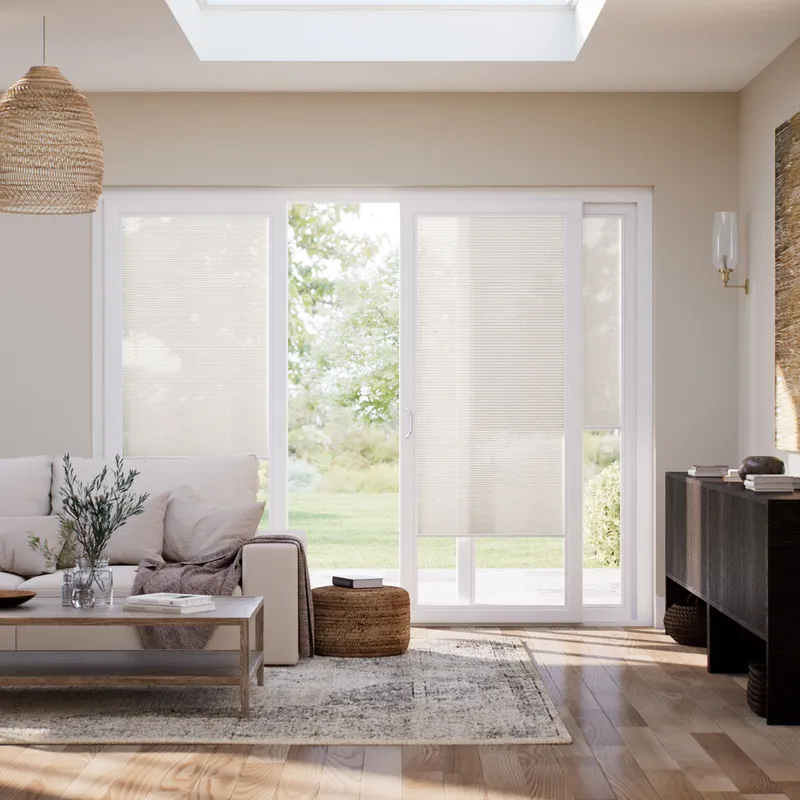
Sliding Door Roller Blinds
at Blinds 2go
Sliding Door: a stick-on roller from Blinds 2go.

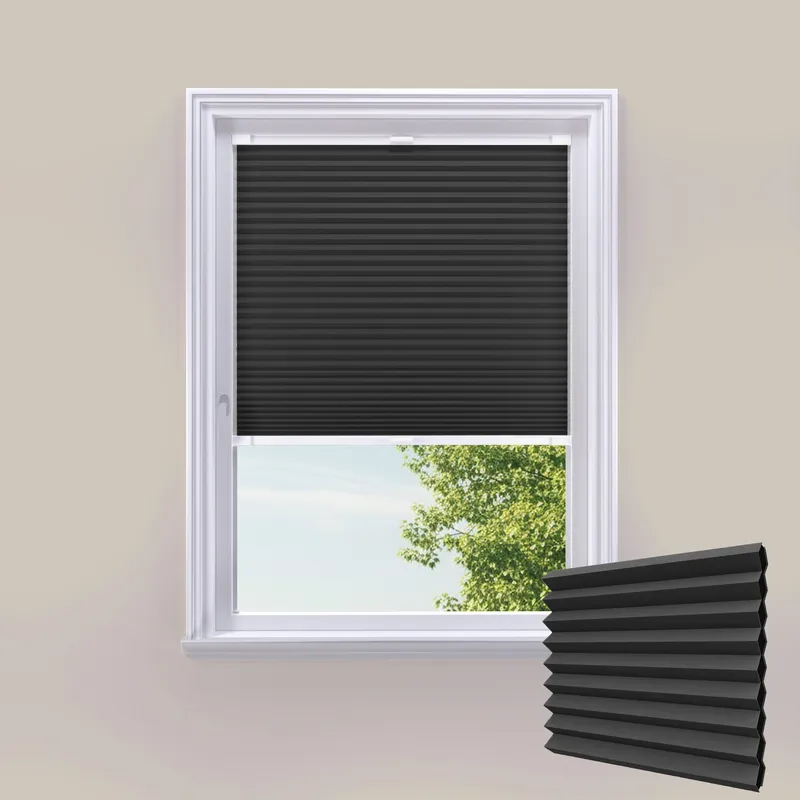
Cosibloc Roller Blinds
at New Blinds
Cosibloc: a perfect-fit, blackout roller from New Blinds with a broad palette.

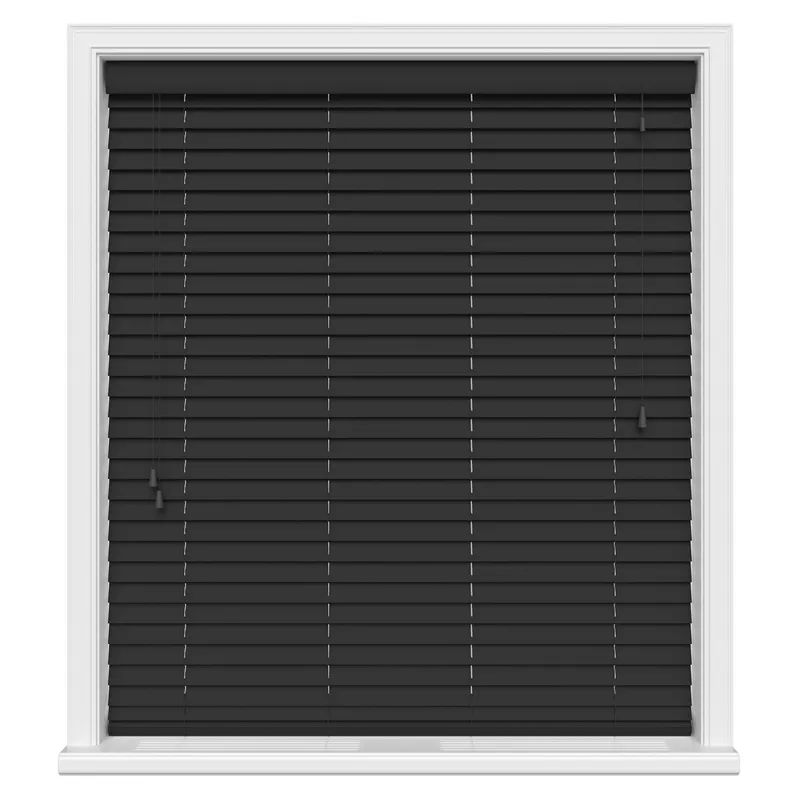
Wooden Venetian 50mm Blinds
at Blinds By Post
Wooden Venetian 50mm: a stick-on venetian from Blinds By Post with a broad palette.
Pick details
Best for doors: Stick On Voile Sliding Door Blind (Blinds 2go)
Sliding Door Roller Blinds
at Blinds 2go
Sliding Door: a stick-on roller from Blinds 2go.
The editor's steer is simple: a stick-on roller from Blinds 2go made for sliding doors. The fabric is a voile, and that is the point. On a patio or sliding door the problem is rarely darkness. It's the bare expanse of glass, the glare off a paved area in summer, and a view you'd rather soften than block. A voile diffuses the light and softens the view without turning the room dim, and because the blind fixes to the door panel itself, it travels with the door rather than hanging across the opening.
It's also the most specialised of our three picks. Where the Cosibloc and the venetian are general-purpose blinds that come with stick-on fixings, this one is designed around a door. That specialisation is why it heads the doors category and why it won't suit a bedroom: a voile is decorative rather than functional where light control is concerned, and it offers no blackout at all. If you want darkness on a door, this isn't the answer.
The palette is compact and neutral: whites, a parchment and several greys including Soft Grey, Graphite Grey and Charcoal Grey, all chosen to sit quietly against a door frame. The from-price is £28.00, and because door panels are wide, the price at your actual panel size will matter far more than that starting figure.
Best cellular: Cosibloc Blackout Blinds (New Blinds)
Cosibloc Roller Blinds
at New Blinds
Cosibloc: a perfect-fit, blackout roller from New Blinds with a broad palette.
The Cosibloc range from New Blinds is the editor's pick where blackout and insulation both matter, and it's the one range here sold in more than one no-drill fitting. The finish list splits into stick-on blackout and stick-on cellular blackout versions, plus perfect-fit honeycomb versions for UPVC windows with rubber gaskets. That gives you a decision within the decision: on a UPVC window with gaskets, the perfect-fit version avoids adhesive and comes out without trace; on anything else, the stick-on version is the route.
The retailer describes the whole range as blackout, and we take that as its claim rather than a test we've carried out. What sets the cellular versions apart is construction rather than fabric: the honeycomb structure traps a sealed pocket of air between the layers, and that gives better insulation than any other blind type. For a bedroom that's cold in winter and bright before five on a summer morning, that combination is the one to look at. A blackout fabric alone leaves light leaking around the edges; a perfect-fit frame sits the blind close to the glass and reduces that leak, which is another argument for the perfect-fit version where the window allows it.
The palette is broad for a functional blind: ivory, white, black and greys, plus navy, taupe, sand, dune and brown. It carries the highest from-price of the three picks at £70.98, which is what you'd expect for a cellular blackout construction against a voile or a venetian. Of the three it's also the only one we'd point at a bedroom without qualification.
Best for choice: Koa Real Wood 50mm Wooden Venetian (Blinds By Post)
Wooden Venetian 50mm Blinds
at Blinds By Post
Wooden Venetian 50mm: a stick-on venetian from Blinds By Post with a broad palette.
The editor describes this as a 50mm stick-on wooden venetian from Blinds By Post with a broad palette, and the palette is the reason it's here. The range runs from Polar Off White, Pure White and Perla Cream, through oaks including Honey Oak, Tuscan Oak and Narra Oak, to Fired Walnut, Khol Anthracite and Carbon Black, with greys such as Kalm Grey and Ash Grey in between. Alongside the real wood finishes sits a set labelled Eco-wood, and a number of those are offered with tapes. If you want a particular wood tone to match flooring or furniture, this is the pick with the room to find it.
The venetian format brings something neither of the other picks has: tilt. Slats rotate to admit light at an angle, which is the most useful kind of control in a living room or home office where you want to cut glare off a screen without losing the daylight. Closed fully, overlapping 50mm slats give effective blackout, though as with any blind some light will come round the edges. That makes it the most flexible of the three in daily use and the one that suits the widest spread of rooms, with one firm exception.
The exception is humidity. Real wood warps and discolours in bathrooms and steamy kitchens, so this stays in dry rooms. Care is dry dusting, with a damp cloth used only sparingly. Weight is the other thing to keep in mind: real wood slats are heavier than faux wood or fabric, so on a stick-on fitting the retailer's maximum sizes deserve more respect than usual. The from-price is £10.93, and as with every made-to-measure blind the figure climbs with width and drop, so the price at your window size is the one that counts.
Choosing between the three
Start with the opening you're covering. If it's a sliding door, the Blinds 2go voile is the only one of the three built for it, and the question is simply whether a fabric that softens rather than blocks does what you need. If you need darkness on a door, none of these three is the answer.
If it's a window, the choice is between the Cosibloc and the venetian, and it comes down to what you value more: darkness and warmth, or adjustable light and a wood look. A bedroom that needs blackout points to the Cosibloc, and to one of the cellular versions if the room runs cold. A living room, study or home office points to the venetian, where tilting the slats does more for screen glare and daytime comfort than a blind that is either up or down.
Window material cuts across that. On UPVC with gaskets, the Cosibloc's perfect-fit versions avoid adhesive entirely, which is a real advantage for a renter or anyone who would rather not stick anything to the frame. The voile and the venetian are stick-on, so the retailer's surface guidance decides whether they're an option at all. None of the three is a wet-room blind: the venetian because real wood and humidity don't mix, the fabric picks because moisture resistance isn't what either is chosen for.
What we didn't include
We kept to made-to-measure ranges sold explicitly as stick-on. Perfect-fit blinds are the other common no-drill route and many ranges come in that fitting alone, but because perfect-fit fixes with a clip-in frame rather than adhesive and suits only UPVC windows with gaskets, it is a different buying decision. It appears here only where a range, like the Cosibloc, offers both fittings side by side.
We also left out ready-made blinds that come in fixed widths for cutting down at home. They're cheaper, but a stick-on blind on a door or an unusual frame has little tolerance for an approximate fit, and all three picks here are cut to your measurements. We haven't covered motorised operation either; the price step-up puts it in a different decision from the manual blinds compared above.
Price by your window
Made-to-measure prices depend on width and drop, so a from-price tells you where a range starts rather than what your blind will cost. For a sliding door the gap is especially marked, since door panels are far wider than the smallest size a from-price reflects. Each pick's page carries a price-by-size table, so measure the glass or recess you're covering first, then compare the three at that size rather than at the starting figure.