
Fitting a blind without drilling is a genuine practical constraint for a lot of UK households - renters who can't put holes in the wall, flat owners with UPVC frames they don't want to touch, or anyone who moves frequently and wants to take their blinds with them. The two main no-drill approaches work quite differently, and the right one depends less on taste than on what type of window you have. This guide covers three made-to-measure ranges that solve the problem without screws, and explains the difference between the approaches before you order. If you are renting specifically, our roundup of the best blinds for renters focuses on the deposit-safe, take-it-with-you angle.
What "no-drill" actually means
The phrase covers two distinct fitting methods that are often bundled together in retail search results, and confusing them is the most common ordering mistake.
Tension and adhesive fittings use either spring-loaded side tensions (pressing against the inside of the recess) or adhesive pads that bond to a smooth wall surface. Tension fittings are the most common type sold under the "no-drill" label for roman and roller blinds. The blind's top bar sits in a bracket that grips the inside of the recess by pressure alone. They work well for standard recess depths and flat recess surfaces; they are not designed for outside-recess (face) fitting, and they won't grip reliably if the recess surface is textured or angled.
Perfect-fit frames are a separate category entirely. A slim aluminium or plastic frame clips directly into the rubber gasket of a UPVC double-glazed window - the gasket that runs around the edge of the glass unit. The blind then clips into that frame. No contact with the wall, no adhesive, no pressure fitting against plaster. The system was specifically developed for UPVC windows and is the cleanest solution for that window type: it leaves no mark when removed. The limitation is that it requires a UPVC window with a compatible gasket channel and a recess deep enough to accommodate the frame - typically around 30mm or more.
Roman and roller blinds sold as "no-drill" are almost always using the tension or adhesive bracket approach. Perfect-fit blinds are their own product category with a different blind mechanism - typically a roller enclosed within the frame.
Understanding which type your window suits matters before you browse. UPVC double-glazing: consider a perfect-fit first. Older windows with timber or aluminium frames, or windows without deep gaskets: a tension-fitted roman or roller is the more practical route.
What to look for
Window type first. A perfect-fit frame only works on UPVC windows with an appropriate rubber gasket channel. If your windows are timber-framed or aluminium, or if the UPVC profile is an unusual shape, a tension-fitted no-drill blind is a safer choice. If you are unsure, most retailers publish fitting guides that include photographs of compatible frame types.
Recess depth. Both fitting types need adequate recess depth. For tension-fitted romans and rollers, you typically need enough depth for the mechanism's depth plus a small clearance (the blind should hang freely without touching the glass). For perfect-fit frames, the frame itself adds depth in front of the glass, so a shallower recess may not accommodate it. Measure your recess depth before ordering rather than after.
Fabric weight and the no-drill load limit. Tension brackets work against the weight of the blind. A heavy fabric - lined roman, or a wider blind at a long drop - puts more load on the mounting. Most retailers impose a maximum width for their no-drill option, and some specify that roman blinds in no-drill fitting should be ordered narrower than you might choose for a drilled roman. If your window is wide, check the retailer's no-drill width limit before choosing fabric.
Light control. Roman blinds in a no-drill fitting are fabric-led - they block light according to the fabric's opacity, not the fitting type. A standard roman fabric is typically light-filtering to dimout; if you need blackout, you either need a lined roman or a different product. Perfect-fit rollers, by contrast, are commonly offered in blackout fabric because the frame sits tight against the window's own edges, significantly reducing the edge-light bleed you'd get from a conventional roller.
Pattern scale and drop. With roman blinds, the fabric folds up when the blind is raised. A large repeat pattern may not show cleanly at every drop position. The picks here include ranges with both small-scale and larger repeat prints; if pattern presentation matters to you, check the fold-stack behaviour for your chosen fabric.
Can you take it with you? Both fitting types are removable without leaving marks in the plaster or on the UPVC frame, which is the renter-friendly claim. Tension fittings are typically removed by releasing the bracket; perfect-fit frames unclip from the gasket. Both systems can be reinstalled at a new address provided the new windows are compatible with the same fitting type.
Our picks

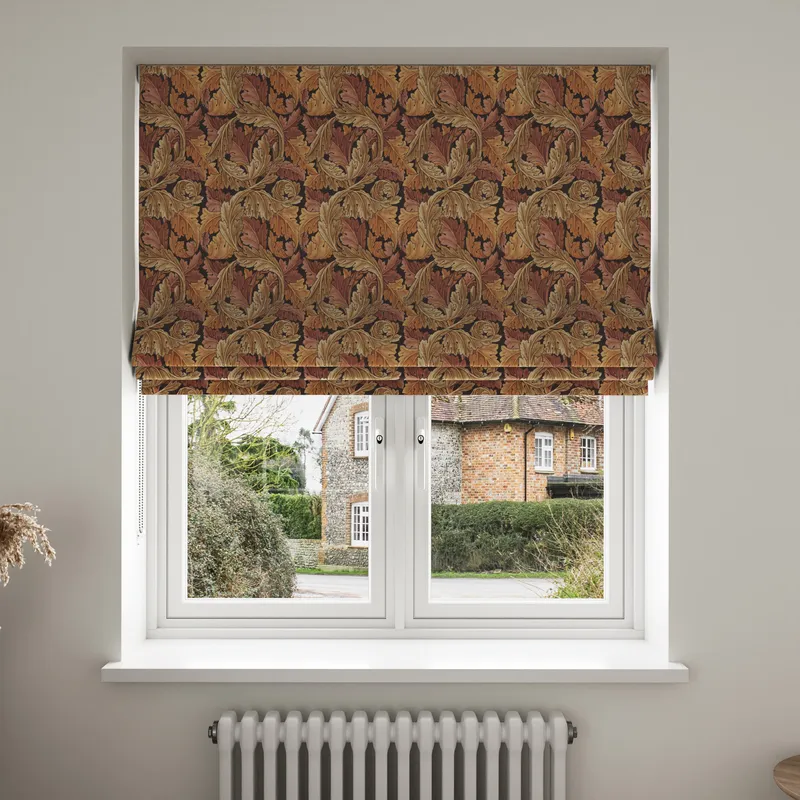
William Morris At Home Roman Blinds
at Blinds By Post
William Morris archive prints in a no-drill roman from Blinds By Post.

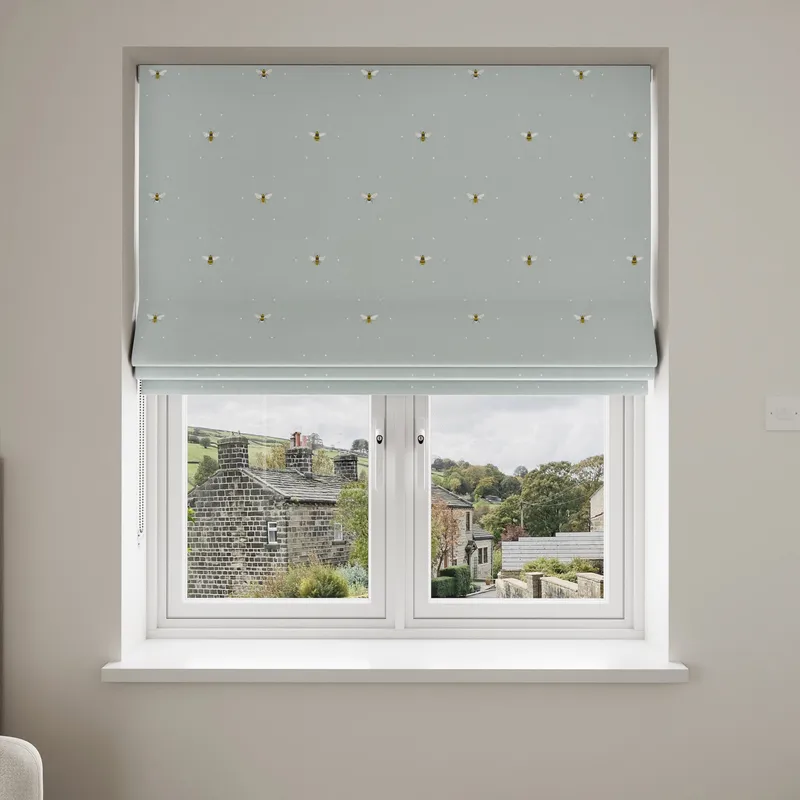
Sophie Allport Roman Blinds
at Blinds By Post
Sophie Allport country prints in a no-drill roman from Blinds By Post.


Amor Roller Blinds
at Make My Blinds
A clip-in perfect-fit roller from Make My Blinds that needs no screws.
Pick details
William Morris At Home Roman Blinds
at Blinds By Post
William Morris archive prints in a no-drill roman from Blinds By Post.
The William Morris At Home range from Blinds By Post brings archive print designs to a no-drill roman fitting - the first reason to consider it over a plain fabric is simply that the prints are distinctive in a way most mass-market roman fabrics are not. Morris archive designs have a clear visual identity - detailed botanical and bird motifs in muted, earthy colourways - and this range carries 106 variants across the core collection.
The range splits between standard and premium variants. Standard fabrics start from around £23 and include prints such as Acorn, Bower, Double Bough, and Iris. The 71 premium variants - which include velvet and woven fabric options - are priced above the standard entry point. If you are drawn to prints like Brother Rabbit Woven or Bird and Anemone, those are the premium tier. The colour spread runs to beige, cream, blue, grey, green, brown, red, purple, yellow, and white base tones, so there is a print family for most room palettes.
As a roman blind, this is a soft-folded window treatment rather than a flat roller. The stacking behaviour at the top when raised is worth noting: a wider, longer roman folds visibly when up, which is part of the aesthetic for some rooms and a practical consideration for others. Made-to-measure sizing means you specify your recess dimensions; Blinds By Post's no-drill fitting uses tension brackets rather than adhesive, sitting inside the recess.
Where this pick sits against the other two in this guide: it is the decorative, character-led option. If you want a window treatment that draws the eye and works with a room already leaning toward traditional or Arts and Crafts style, this range offers considerably more variety than a plain fabric roller. The Sophie Allport pick also uses a roman fitting, but is aimed at a different print register - country motifs rather than archive botanical - and carries fewer finishes. The Amor perfect-fit pick is a roller in a UPVC frame; it solves a different problem and sits in a different room context.
Sophie Allport Roman Blinds
at Blinds By Post
Sophie Allport country prints in a no-drill roman from Blinds By Post.
The Sophie Allport range at Blinds By Post covers 19 finishes across the brand's characteristic country and nature-print designs. The collection includes motifs such as Bee, Dragonfly, Hare, Sheep, and Hearts - prints that work particularly well in kitchens, informal dining rooms, and children's bedrooms. The base tones run to sky, sand, linen, teal, grey, sage, blush, duckegg, and others, keeping the palette in the soft, natural register that characterises the Allport brand.
The entry price of around £20 makes this the most accessible starting point of the three picks in this guide, though actual pricing will depend on your dimensions and the specific finish chosen - the retailer does not currently publish a full price grid, so use the entry price as an indicative floor. The no-drill fitting is the same tension-bracket system as the William Morris range from the same retailer.
The narrower finish count - 19 versus 106 for the William Morris range - reflects a more tightly edited collection rather than a limitation. If you are choosing between these two roman blind picks, the practical split is one of aesthetic register: Morris for deep botanical archive prints in a wider colour range, Allport for lighter, motif-led country designs. Both are made-to-measure romans from the same retailer with the same fitting approach, so the lead time and order process are equivalent.
One note for rooms with young children: the Bears, Fairground Ponies, and Woof prints in this range are well suited to children's rooms. Roman blinds are operated by cord as standard; check with the retailer about cord-safe operation options (such as a cord cleat or cordless mechanism) before ordering for a child's bedroom - UK cord-safety regulations require blinds to be supplied with compliant cord management.
Amor Roller Blinds
at Make My Blinds
A clip-in perfect-fit roller from Make My Blinds that needs no screws.
The Amor range from Make My Blinds is a perfect-fit blackout roller - a different product type from the two roman blind picks above, and chosen here specifically for UPVC windows. The mechanism clips into the rubber gasket channel of the window rather than gripping the recess by pressure or adhering to the wall, making it the most secure no-drill option for that window type and the easiest to remove cleanly when you leave.
The blackout claim here refers to the fabric rather than edge exclusion. A perfect-fit frame sits tightly at the edges of the glass unit, which reduces the light bleed around the sides that a conventional roller cannot prevent. Combined with a blackout fabric, the result is noticeably darker than a standard roller with blackout fabric fixed above the recess. This makes perfect-fit rollers particularly relevant for bedrooms.
The Amor range carries 28 finishes. The majority are labelled as blackout; one finish (Soft Grey) is listed as a standard roller rather than blackout - if light control is the priority, check which version you are ordering. The colour range runs from neutrals (pearl, cloud grey, beige, oyster mushroom) through pastels (lavender breeze, soft peach, duck egg, dried sage) to bolder options (cobalt, midnight, electric lime, vibrant pink). Starting at around £27, this is the mid-price entry point across the three picks.
The important caveat on perfect-fit fitting is compatibility. The frame requires a UPVC window with a rubber gasket channel of compatible depth and profile. Make My Blinds provides a fitting guide and specifies the compatibility requirements; measure your window's bead depth before ordering. Timber and aluminium windows are not compatible with perfect-fit frames. If your windows are UPVC but non-standard in profile, contact the retailer before purchasing. For UPVC double-glazing in standard UK residential properties, compatibility is generally straightforward.
Compared to the two roman picks: the Amor is a purpose-built solution to a specific fitting problem, not a decorative choice in the way the Morris or Allport ranges are. If your windows are UPVC and your priority is blackout performance with zero wall damage, this is the pick to shortlist. If your windows are not UPVC, start with one of the tension-fitted roman options instead.
What we didn't include
This guide focuses on made-to-measure no-drill blinds available as a standard product line. A few categories are worth naming as out of scope here.
Cordless and tension-fitted ready-made blinds are widely available at lower price points from high-street retailers, sold in fixed standard widths. They solve the same no-drill problem but require you to trim the blind yourself or accept an imprecise fit; we focused on made-to-measure options where the blind is cut to your exact dimensions.
Electric and motorised blinds can be fitted without drilling in some configurations, but the price step is significant enough to represent a separate buying decision - the fitting method is a secondary consideration for buyers at that price point, not the primary one.
Cellular and pleated blinds in no-drill fitting exist and perform well thermally, but no ranges in the picks we cover satisfy both the no-drill criterion and the fabric depth of the roman options here. Cellular blinds are better addressed where insulation is the organising question - see are blinds good for insulation.
This guide does not cover Velux or other roof-window blinds, which require manufacturer-specific fittings and are a specialist category.