
Perfect fit blinds clip into the rubber seal of a uPVC double-glazed window, so they need no drilling and come out again without leaving a trace. That makes them the natural choice for renters, for anyone who doesn't want screw holes in a plastic frame, and for bedrooms and kitchens where a blind sitting flush against the glass does a better job of controlling light at the edges. Purple is a narrow slot within that market. Of the perfect fit ranges we cover, it usually appears as one or two shades inside an otherwise neutral palette rather than as a colour family of its own. This guide compares three picks, one roller, one venetian and one pleated, and explains how to choose between them rather than simply listing what's available.
What "perfect fit" actually means, and why purple narrows the field
Perfect Fit is a specific fitting method rather than a general promise that a blind will fit well. The blind sits in a slim frame that grips the rubber seal of a uPVC double-glazed window. Nothing is drilled, screwed or glued to the window, and the whole assembly comes out again without leaving a mark if you move house or change your mind. Of the no-drill approaches on the market it is the cleanest, and it's the one we'd steer most owners of uPVC windows towards before anything else. Our broader no-drill guide covers the alternatives for windows that can't take it.
The limits matter as much as the benefits. Perfect fit works only on uPVC windows with a rubber gasket and a recess deep enough for the frame. It does not work on timber or aluminium frames in the same way. If you're unsure whether your windows qualify, our guide to checking whether perfect fit blinds will fit your windows explains what to look for before you measure anything.
Purple sits differently in this market from grey or white. Across the perfect fit ranges we cover, the neutrals tend to run to several variants apiece, while purple is usually a single shade, occasionally two, with names like Lavender, Lilac, Iris or Amethyst. That has a practical consequence. Shortlisting by colour first and blind type second gets the decision backwards, because the type of blind sets how it controls light, how it cleans and how it copes with a steamy kitchen or bathroom. Choose the type, then look at which purple that type offers. The three picks below are organised that way.
What to look for
Blind type comes first. A roller is a single sheet of fabric that is either up or down, with everything in between set by how far you lower it. A venetian tilts its slats, so you can cut glare while keeping a view, and closing the slats fully gives the most complete light block of the three types here. A pleated blind concertinas into neat folds as it rises and suits awkward windows well, but pleated fabrics tend to be lighter and less varied than roller fabrics. If you want to angle light rather than block it, only the venetian does that.
The shade, not just the colour. A pastel purple and a deep one do very different things to a room, and a colour name on a website is a steer rather than a measurement. Screens render purple poorly, so look closely at the retailer's own imagery and, where samples are offered, order one before committing to a made-to-measure order.
Opacity is not stated in these range names. None of the three range names includes a word like blackout or dimout, so treat these as light control rather than guaranteed darkness until you've read the retailer's fabric description. Perfect fit does help regardless: because the frame sits against the glass, less light leaks around the edges than with a blind hung in front of the recess. It won't turn a translucent fabric into a blackout one, though.
Room dictates material. Steam and grease rule out real wood and natural fibres, which leaves wipe-clean slats or coated fabrics for kitchens and bathrooms. Living rooms and bedrooms are more forgiving, and there the choice comes down to look and light control rather than durability.
Cleaning effort differs. Roller and pleated fabrics want a monthly vacuum with the brush attachment and a damp cloth on marks. Venetian slats wipe clean easily, but every slat needs doing, which becomes tedious on a wide window.
Child safety applies to all of them. UK regulation BS EN 13120, in force since 2014, requires blinds sold for domestic use to be cord-safe by design, whether through cordless operation, a wand, breakaway connectors or supplied cord cleats. Check how each range is operated if the blind is going in a child's room.
Our picks


Palette Fr Roller Blinds
at So Easy Blinds
Palette Fr: a perfect-fit roller from So Easy Blinds with a broad palette.
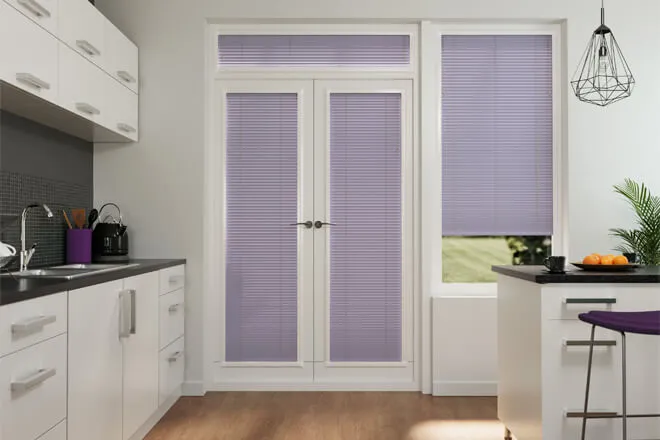
Precision Venetian Blinds
at Unbeatable Blinds
Precision: a perfect-fit venetian from Unbeatable Blinds with a broad palette.

Kana Pleated Blinds
at So Easy Blinds
Kana: a perfect-fit pleated from So Easy Blinds.
Pick details
Best roller: Palette Fr Perfect Fit Roller Blinds
Palette Fr Roller Blinds
at So Easy Blinds
Palette Fr: a perfect-fit roller from So Easy Blinds with a broad palette.
The Palette Fr from So Easy Blinds earns the roller slot on the breadth of its palette. It carries a broad range of plain finishes, and the ones that answer a purple search, going by the names, are Baby Lavender and Iris. Around them sit the neutrals you'd expect from a range built for matching across a house, from Bright White and Pearl through Pale Grey, Stone Grey and Charcoal to Black, plus a scatter of stronger accents such as Redcurrant, Teal, Denim, Dijon and Copper. If you want a purple blind in one room and a toning grey or cream next door from the same retailer, this is the pick that makes that straightforward.
As a roller, it is the simplest of the three to live with. The fabric lies flat against the glass inside the perfect fit frame, there are no slats to dust, and operation is a matter of up or down. The trade-off is that a roller has no angle control, so on a bright afternoon the choice is glare or a lowered blind. The range name doesn't tell us the fabric's opacity, so if you need a dark bedroom, check the fabric description before assuming blackout.
Its from-price is £76.05. Against the Kana pleated blind from the same retailer, the two from-prices sit close enough that your window dimensions, rather than the headline figure, will decide which costs more for you.
Best venetian: Precision 25mm Slat Venetian Perfect Fit Blind
Precision Venetian Blinds
at Unbeatable Blinds
Precision: a perfect-fit venetian from Unbeatable Blinds with a broad palette.
The Precision from Unbeatable Blinds has the widest palette of the three by some distance, and it lists both Lavender and Lilac, so you have two closely related purples to choose between rather than one. The rest of the colour list runs through blues, greens, browns and greys in several steps each, along with gloss and metallic options going by the finish names. That depth makes it the easiest of the three to match to an existing scheme, and it's where we'd send anyone who finds another retailer's purple a touch too cool or too warm.
The slats are 25mm, the width most associated with aluminium venetians. The range name doesn't state the material, so check that before assuming it. If it is aluminium, as 25mm slats usually are, this becomes the natural choice of the three for a kitchen or bathroom, where fabric and real wood both struggle with moisture. Even in a dry room, a venetian offers something neither fabric pick can: tilt. You can angle the slats to take glare off a screen while keeping daylight and a view, then close them fully at night for the most complete light block of the three.
The cost of that flexibility is cleaning. Each slat needs a wipe, and on a wide window that adds up. Slats can also dent if knocked, which matters more above a worktop than in a bedroom. Its from-price is £6.79, which starts well below either fabric pick, though a from-price only describes the smallest size in a range and the gap at your dimensions may look different.
Best pleated: Kana Perfect Fit Pleated Blinds
Kana Pleated Blinds
at So Easy Blinds
Kana: a perfect-fit pleated from So Easy Blinds.
The Kana from So Easy Blinds takes the opposite approach to the Precision. Its palette is short and, going by the names, leans dark: Amethyst is the shade that answers a purple search, and the rest of the list is Merlot, Terra, Chocolate, Navy Blue and Obsidian Black, with Perla White the one exception. Where the roller and the venetian name their purples Baby Lavender, Lavender and Lilac, Kana's is Amethyst, and if the names are a fair guide that puts it at the deeper end of the scale.
A pleated blind folds into neat horizontal pleats as it rises and stacks compactly when raised, which suits a perfect fit frame well: the whole thing stays slim and tidy within the window rather than adding bulk in front of it. Pleated blinds also cope well with awkward window shapes. The honest downside is fabric. Pleated fabrics tend to be lighter and less varied than roller fabrics, and the pleats can show wear over years of use. Note too that this is a pleated blind, not a honeycomb or cellular one. The range name makes no thermal claim, and we wouldn't assume the insulating performance that cellular blinds are known for.
Its from-price is £120.93. Against the Palette Fr roller from the same retailer, the from-prices are close enough that the decision should rest on whether you prefer pleats or a flat roll, and on what each costs at your actual window size.
What we didn't include
We kept to one pick per blind type rather than several near-identical rollers in slightly different purples. The decision that most affects how a blind works day to day is roller against venetian against pleated, and a longer list of rollers wouldn't help with that choice. Within each type we chose the range whose palette best served a purple search while still offering neutrals to match it elsewhere in the house.
Nothing here is a blackout pick. None of the three range names makes an opacity claim, and we won't make one on the retailers' behalf. If genuine darkness is the priority, look for a perfect fit range whose fabric is explicitly described as blackout and treat the colour as secondary. The combination of a blackout fabric and the reduced edge-leak of a perfect fit frame is a strong one for bedrooms, but it narrows the purple options further still. Patterned fabrics with purple in the print are a different search again and aren't covered here.
Perfect fit itself excludes some readers. Timber and aluminium frames can't take the clip-in frame, and neither can uPVC windows with too shallow a recess. For those windows the no-drill route is different, and the guide linked earlier covers it. If purple turns out not to be the colour after all, our general perfect fit guide compares ranges across the full palette.
Price by your window
From-prices describe the smallest size each range is sold in, so they are a starting point rather than a comparison. Perfect fit blinds are made-to-measure, quoted as width by drop in millimetres, and the price moves with both dimensions. Each pick's page shows its price by window size, so put your measurements into each and compare the three at your actual size, which is the only like-for-like figure that matters. Measure in the way the retailer specifies for perfect fit, since the frame has to grip the rubber seal rather than fill a recess, and the retailer will tell you whether to add or subtract a fitting allowance.