
A blackout pleated blind is a concertina-folded fabric blind made from an opaque fabric, so it stacks into a slim band when raised and blocks light through the material when lowered. Pleated blinds have long been the go-to for awkward windows, conservatories and roof glazing, and a blackout version makes them a credible bedroom option as well. Demand for blackout blinds in the UK climbs from late March, when the clocks go forward and dawn starts arriving before most people want it, and it stays high through the summer. This guide explains what blackout means in a pleated blind, where honeycomb blinds fit in, and what to weigh up before you buy. It then compares our three picks - a best overall, a thermal choice and a no-drill option - and says plainly what we left out.
What a blackout pleated blind actually is
A pleated blind uses fabric folded into regular horizontal pleats that concertina together. Raise it and the pleats stack on top of each other into a compact band; lower it and the fabric opens out flat across the glass. That neat stack and the way the fabric is held across the opening make pleated blinds a common choice for awkward shapes, including some non-rectangular windows that would defeat a roller.
A honeycomb blind, also sold as a cellular blind, is a structural cousin. Two layers of pleated fabric are joined so that each pleat forms a sealed air pocket. Those pockets trap air against the glass and give honeycomb blinds the best insulation of any blind type. One of our picks is sold as a honeycomb; another is sold as thermal without the name spelling out how the thermal layer is built. We cover the category in its own right in our guide to cellular blinds.
Blackout, meanwhile, describes the fabric rather than the structure. A blackout fabric is opaque: hold it up to a bright light and you should see no glow through it. Dimout fabrics cut light substantially but still let some through, which is often what you want in a living room or a home office. Retailers can be loose with the word, and some use blackout for heavy dimout fabrics that are not strictly opaque. All three ranges here are labelled blackout by the retailer that sells them; we treat that as the retailer's claim rather than an independent test.
One more distinction matters. A blackout fabric does not on its own give you a dark room, because light finds its way around the edges of the blind. A face-fitted blind that overlaps the recess, a frame that holds the fabric against the glass, side channels, or curtains layered over the top will each cut that edge leak. If total darkness is the goal, the fitting is as important as the fabric.
What to look for
Construction: single pleat or honeycomb. A single-layer pleated blind in a blackout fabric gives you the light control and the neat stack. A honeycomb adds the sealed air pockets and the insulation that comes with them. If the window is a cold spot in winter or an overheating one in summer, the honeycomb is worth the step up; if the room is already well insulated, a single pleat does the blackout job with less fabric.
How it is fitted. Most pleated blinds fit inside the recess, which needs enough depth for the mechanism, or on the face of the frame or the wall above it. Face fitting covers the opening entirely and blocks more light around the edges. No-drill systems avoid screws altogether and come into their own in rented homes or on frames you would rather not drill. Check which frame types a no-drill fitting suits before ordering; they are not universal.
How it is operated. UK regulations in force since 2014 (BS EN 13120) require domestic blinds to be cord-safe by design, so any compliant retailer will supply a safety device or cord management. For a child's bedroom, cordless or wand operation is the standard recommendation because there is no loose cord at all. Where a range is sold as cordless, we say so below; where it is not, ask the retailer which controls are offered.
The palette, and how it is priced. Pleated fabrics tend to be lighter and less varied than roller or Roman fabrics, so a wide colour range is worth having. Watch for finishes tagged premium: the headline from-price usually applies to a smaller set of standard colours, and the shade you actually want may sit above it.
Stack, wear and care. A pleated blind stacks at the top when raised and takes a little of the window with it, though the stack is compact. Pleats can show wear over time. Care is simple: vacuum with a brush attachment, spot-clean marks with a damp cloth and mild soap, and follow the retailer's care label rather than soaking the fabric.
Our picks

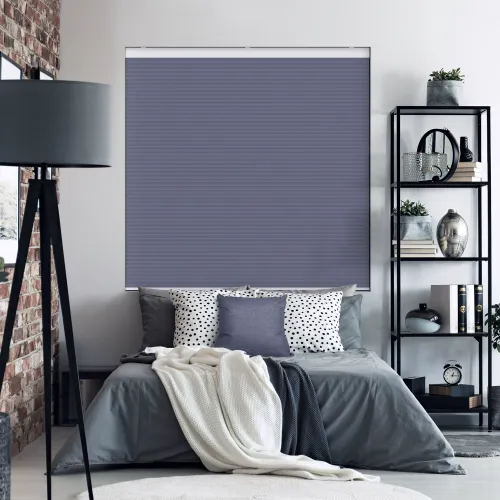
Maven Blue Cordless Honeycomb Pleated Blinds
at Lifestyle Blinds
Maven Blue Cordless Honeycomb: a blackout pleated from Lifestyle Blinds with a broad palette.


Click2shade Complete Thermal Pleated Blinds
at Blinds 2go
Click2shade Complete Thermal: a blackout, thermal pleated from Blinds 2go.

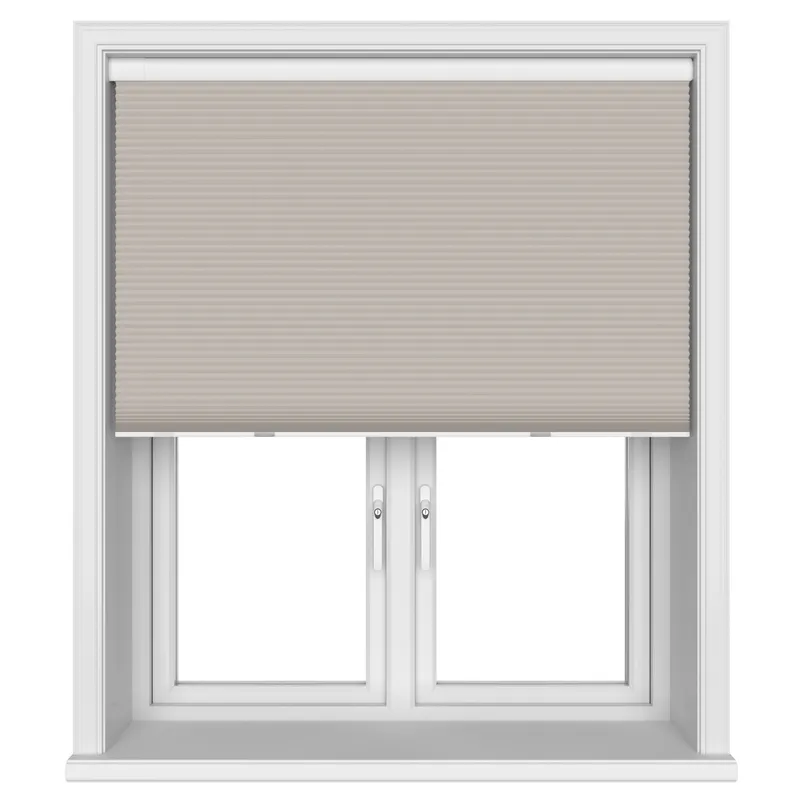
Blackout Pleated Blinds
at Blinds By Post
Blackout: a no-drill, blackout pleated from Blinds By Post.
Three ranges, each taking a different route to a dark room: a cordless honeycomb for the best all-round balance, a thermal blackout with a very wide palette, and a no-drill option for frames you cannot or would rather not drill.
Pick details
Best overall: Maven Blue Blackout Cordless Honeycomb Pleated Blind (Lifestyle Blinds)
Maven Blue Cordless Honeycomb Pleated Blinds
at Lifestyle Blinds
Maven Blue Cordless Honeycomb: a blackout pleated from Lifestyle Blinds with a broad palette.
Our best overall pick does three things at once. It is a honeycomb, so you get the sealed-cell insulation as well as the blackout fabric. It is cordless, which answers the child-safety question before it is asked and suits any bedroom where a dangling cord would be in the way. And it comes in a broad palette, from the Maven Blue that heads the range through neutrals such as Sable Tuscan Beige, Vesso Cream and Tenso Polar White to darker options like Velto Slate and Maven Ebony Earth. A blackout pleated with a broad palette is the short description; the honeycomb construction and the cordless control are what lift it to best overall.
The cost of that combination is a from-price of £80.64, which is noticeably above the thermal pick's entry point. Against the no-drill pick the from-prices sit closer together, and which one costs less for your window will depend on the size you need. For a bedroom where darkness and insulation both matter, the Maven is the one we would price first.
It is also the pick we would steer parents towards. Cordless operation removes the loose cord entirely rather than managing it with a cleat or breakaway connector, and a blackout honeycomb addresses the two complaints most often heard about a child's room: too much light at dawn in summer, and a cold window in winter.
Best thermal: Click2shade Complete Blackout Thermal Blind (Blinds 2go)
Click2shade Complete Thermal Pleated Blinds
at Blinds 2go
Click2shade Complete Thermal: a blackout, thermal pleated from Blinds 2go.
Blinds 2go sells the Click2shade Complete as a blackout thermal blind, and it is the pick for anyone whose first question is about heat rather than light. Its from-price of £19.54 is the lowest entry point of the three by a wide margin, which makes it the most practical way to put a thermal blackout pleated on several windows at once. That matters for the thermal case: insulating one window in a cold room does less than treating all of them.
The palette is the widest of the three in reach, running from neutrals such as Chalk, Ivory and Mushroom through Nickel Grey, Gainsboro Grey and Anthracite to Slate Blue, Pink Blush, Plume and Chocolate. The catch is in the tags. Only Limoncello and Blue Haze are standard finishes; every other colour is marked premium and will sit above the from-price. If you have your heart set on a particular grey, price that specific finish rather than the headline figure.
The name tells you it is blackout and thermal; it does not tell you whether that insulation comes from a cellular structure or from a thermal backing on a single pleat. The difference affects how it compares with the Maven's honeycomb, so if heat retention is your whole reason for buying, confirm the construction with Blinds 2go before you order. Control type is also worth confirming for a child's room; the standard cord-safety device will be supplied either way.
Best no-drill: Twistfit Blackout (Blinds By Post)
Blackout Pleated Blinds
at Blinds By Post
Blackout: a no-drill, blackout pleated from Blinds By Post.
The Twistfit Blackout from Blinds By Post is sold as a no-drill fitting, and that single fact decides who it is for: tenants, anyone who would rather not put screws into a frame or wall, and anyone who wants a blind they can take down later without filling holes. The other two picks assume a conventional fitting; this one does not. For the broader no-drill picture, including perfect-fit frames for UPVC windows, see our guide to no-drill blinds.
What you give up is choice. The palette is the smallest of the three: Natural Beige, Sky Blue, Carbon Black, Pebble Grey, Slate Grey, Stone Grey and Soft White. That is enough to cover most bedrooms, with several greys to choose between, but there is nothing here to match the Maven's or the Click2shade's reach. The from-price is £47.57, well above the thermal pick's entry point and close enough to the Maven's that only a price for your actual window size will settle which is dearer.
Because no-drill systems depend on the window frame, check Blinds By Post's fitting instructions against your own windows before ordering. The retailer's fitting guide should tell you which frame types the Twistfit suits, and a no-drill blind that does not match your frame is no bargain at any price. How tightly it sits to the glass, and therefore how much light leaks around the edges, is also something to confirm with the retailer rather than assume.
How the three compare
Start with the fitting, because it removes options fastest. If you cannot drill, the Twistfit is the pick and the comparison is over. If you can, the choice is between the Maven and the Click2shade.
Between those two the question is what you are paying for. The Maven is a cordless honeycomb: the insulation is built into the structure, and the cordless control makes it the obvious choice for a child's room or any bedroom where you want no loose cord. The Click2shade is sold as thermal and blackout, has the widest palette of the three and a far lower from-price, with the caveat that nearly all of its colours are premium-tagged and will cost more than the headline figure. If you want a honeycomb specifically, the Maven is the one described as such. If you want to cover several windows and the exact construction matters less than the colour and the budget, the Click2shade is the stronger fit.
On the blackout claim itself, the three are level: each retailer describes its fabric as blackout, and none of that is independently tested here. The darkness you actually get will come down to the fit. A face-fitted blind that overlaps the recess, a frame that holds the fabric against the glass, or curtains layered over the top will do more for a dark room than the difference between any two of these fabrics.
What we didn't include
We left out motorised and smart pleated blinds as a category. The price step-up and the wiring or charging questions make them a different buying decision from a manual blackout blind, even where the same fabric is sold in both forms. We also left out conservatory roof blinds. They are pleated and often blackout or thermal, but they are shaped and fitted to glazed roofs and priced accordingly, and comparing them with a bedroom blind would mislead more than it helped.
We also kept dimout and light-filtering pleated fabrics out of the picks. They are the better choice for a living room or home office where you want daytime visibility, but they do not answer the question someone searching for blackout pleated blinds is asking. This guide is about made-to-measure ranges sold as blackout by the retailers we list.
Price by your window
Pleated blinds are quoted as width by drop in millimetres, and a from-price is the lowest point in a range rather than what a typical window will cost. Each pick's page sets out prices across a standard set of common sizes, so once you have measured you can see what your own window would cost in each range and compare like with like. If you are unsure whether to measure the recess or the wall around it, our measuring guide walks through both.