
Search for William Morris blinds and you will find the same archive prints - Strawberry Thief, Willow Bough, Acanthus and the rest - sold by several UK retailers. The designs are shared, drawn from the same licensed archive; what differs is how each retailer makes and fits them, and what they charge. One weaves the design into the cloth as a jacquard; another prints it onto a no-drill fabric. The print can be the same Strawberry Thief in both, yet the blinds are not interchangeable. This guide is about that difference - construction, fitting and price - because that, not the print, is where the real choice sits.
The same prints, made different ways
Because the designs come from the same licensed archive, "which retailer has the best Morris print" is rarely the useful question - the print is largely the same wherever you look. The differences are in the cloth and the fitting:
Woven or printed. Some ranges weave the design into the fabric as a jacquard, so the pattern carries a slight texture and depth; others print it onto a flat woven base. Woven reads richer and more like a furnishing textile; printed renders the colours crisper and flatter. Neither is better - it is a question of the look you want and, often, of price.
Drilled or no-drill. A conventional roman or roller is screwed into the recess or onto the wall face. A no-drill version clips into a UPVC frame without screws, which is the choice for renters or new-build windows under warranty. The no-drill fitting usually carries a small premium over the drilled version of the same print.
Price. The same print can sit at quite different from-prices depending on construction and retailer. As a rule the woven jacquards start a little lower than the printed no-drill versions, but check each pick's own page for the price at your window size, since width and drop move it more than the construction does.
One practical check before you commit: confirm your chosen print is offered in the colourway you want at the retailer you are leaning towards. The archive of designs is shared, but each range curates its own selection of recolours, so a heritage Strawberry Thief and a cooler recolour of it may not both appear in the same place. Settle on the print and colour first, then let construction, fitting and price decide which range to buy from.
So the print is yours to choose, and these designs are shared widely; the picks below are about how the blind is made and fitted, and where each sits on price.
What "William Morris" means on a blind
The patterns come from the textile and wallpaper designs Morris produced in the late nineteenth century, now widely licensed and reproduced. On a blind, that means a densely-detailed botanical print - acanthus leaves, fruit, willow boughs, birds - usually in the muted, slightly smoky colourways of the originals, though many ranges also offer brighter or cooler recolours.
What matters for choosing is that these are large-repeat, detailed designs. They reward a window with enough width to show a full motif, and they suit a blind that lets the pattern read clearly. A dense print can look cramped on a narrow window or lost in a heavily-folded blind, so the pairing of print and format is not incidental - it shapes how good the result looks.
What to look for
A few things decide which William Morris blind is right for your window.
Construction. Woven into the cloth as a jacquard, or printed onto a flat base. The woven versions carry a textile depth that suits the heritage character of the prints; the printed versions are crisper and usually keener on price. The same design is available both ways depending on the retailer.
Fitting. If you can drill and you own the property, a conventional roman or roller fits in the recess or on the wall face. If you are renting, or your windows are new-build UPVC under warranty, a no-drill clip-in fitting avoids marking the frame - worth seeking out for that situation specifically.
Format. A roman blind gives a soft, gathered fold that flatters the traditional feel of the prints; a roller renders them flat and clean, suiting a more contemporary room. The print can be similar across both - the format sets the mood.
Window proportions. Large-repeat prints need room to breathe. A wide living-room window shows a Morris design at its best; a narrow window crops it. On a small window, choose a smaller-scale design or accept that the pattern will read partially.
Room suitability. These are furnishing fabrics, not wipe-clean coatings, so all the options here are for dry rooms - living rooms, bedrooms, dining rooms. None suits a steamy kitchen or bathroom.
Colourway. The heritage colourways keep the muted original tones and suit period rooms; the recolours lift the designs into lighter, cooler schemes for contemporary spaces. Decide which way your room leans before choosing a print.
Our picks


William Morris Roman Blinds
at Blinds 2go
The archive prints woven as a jacquard roman from Blinds 2go, the keenest entry price of the three.


William Morris Roller Blinds
at Blinds 2go
The same woven prints on a flat roller, for a cleaner and more contemporary hang.

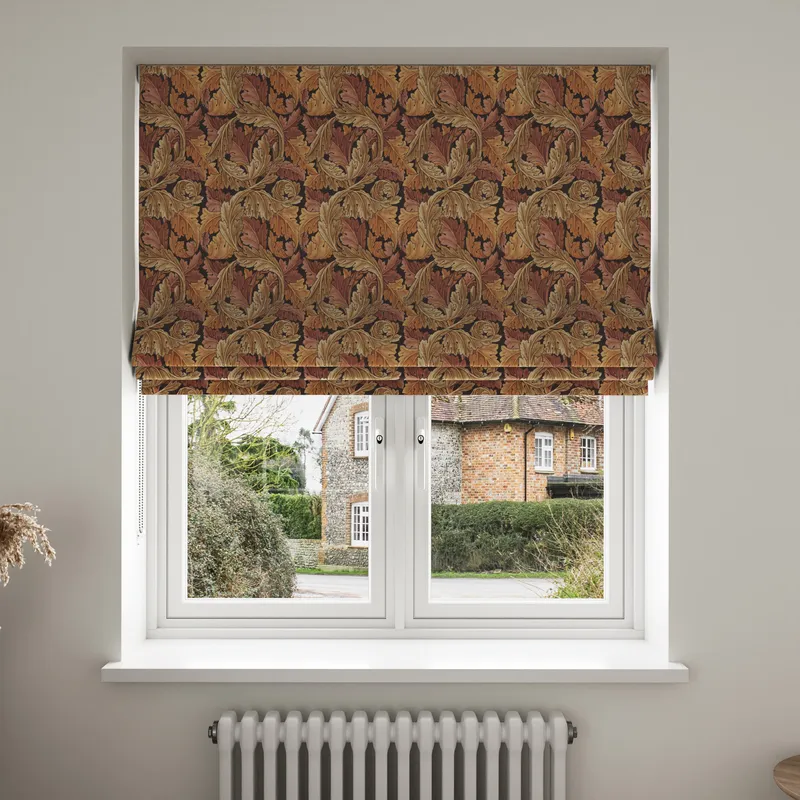
William Morris At Home Roman Blinds
at Blinds By Post
The prints on a no-drill roman from Blinds By Post, for UPVC windows you would rather not drill.
Pick details
Woven roman
William Morris Roman Blinds
at Blinds 2go
The archive prints woven as a jacquard roman from Blinds 2go, the keenest entry price of the three.
The Blinds 2go William Morris roman weaves the archive prints into a jacquard cloth, and it carries the keenest entry price of the three picks here. The soft fold of a roman flatters the dense botanical prints - the gathered pleats read as a textile, which suits the heritage character of designs like Willow Bough and Acanthus - and the woven construction adds a depth a flat print does not have. The range is broad, covering both the muted original colourways and lighter recolours, so you can take it period or contemporary.
It is the most decorative of the three formats here, and the most traditional. Choose it for a living room or bedroom that is dressed rather than minimal, on a window wide enough to show a full motif. Remember a roman stacks at the top when raised, so it covers a little glass even when up - no issue on a tall window.
Woven roller
William Morris Roller Blinds
at Blinds 2go
The same woven prints on a flat roller, for a cleaner and more contemporary hang.
The Blinds 2go William Morris roller takes the same woven prints onto a flat panel, which suits a more contemporary room or a window where a roman's fold would feel fussy. Strawberry Thief in particular reads well flat, and the range includes it in several colourways. A roller also stacks away completely onto its tube when raised, so it keeps the whole window - the more practical choice on a short or small window. It is typically the lowest entry price of the three.
The trade against the roman is mood: the roller is cleaner and more modern but lacks the soft, dressed drape. Where the roman suits a period sitting room, the roller suits a contemporary one, or a room where you want the pattern without the formality.
Printed, no-drill
William Morris At Home Roman Blinds
at Blinds By Post
The prints on a no-drill roman from Blinds By Post, for UPVC windows you would rather not drill.
The Blinds By Post William Morris no-drill roman prints the same archive designs onto its "At Home" cloth and clips into the UPVC frame without screws - the pick for windows you can't or would rather not drill, whether rentals, new-builds under warranty, or simply a reluctance to make holes. It removes without a trace. The range is unusually deep, and includes velvet and woven finishes of the Morris motifs alongside the standard prints, which adds a tactile option the woven jacquard ranges handle differently - though those finishes sit at a premium, and the no-drill fitting itself adds a little over a drilled version.
Confirm the clip system suits your window profile before ordering, as it is designed around the UPVC bead. And measure to the retailer's no-drill guidance rather than standard recess instructions, since the fitting differs.
What we didn't include
We have kept this to three picks - woven roman, woven roller, and printed no-drill - rather than listing every William Morris blind on the market, or every retailer that carries the prints. A few things we left out, and why.
We have not included a venetian or a vertical in a Morris print, because the designs are made for fabric blinds - a roman or roller shows a botanical print as it was meant to be seen, where a slatted blind would fracture it. The constructions and formats here are the ones that do the prints justice.
We have also not tried to rank the prints themselves. Which Morris design suits you - Strawberry Thief or Willow Bough, heritage colourway or recolour - is a question of your room and taste, not something a guide can settle, and the same designs appear across the ranges. The picks above are about construction, format and fitting; the print is yours to choose within each.
Price by your window
The from-prices shown are starting points; a made-to-measure blind's price depends on your window's width and drop. Each pick's own page carries a price-by-dimensions tool - enter your measurements there for the price at your size before deciding between them. Across the three, the woven roller tends to start lowest, the woven roman a little above it, and the printed no-drill - with its premium velvet and woven finishes - the dearest. But the gap between constructions is usually smaller than the gap your window size makes, so price your actual window before letting cost decide.
See our full William Morris blinds guide - every pattern, with live prices →