
Patterned roller blinds put a print on the simplest blind format there is: a single flat sheet of fabric that winds onto a tube and hangs straight when down. That flatness is the point for pattern. A floral, a geometric or a paisley shows as one uninterrupted panel rather than being broken into folds or slats. In a UK winter the blind is down from mid-afternoon until morning, so the fabric is part of the room for more waking hours than at any other time of year, and that is often what starts the search. This guide compares three ranges we have picked - a floral, a geometric and a multi-designer collection - and sets out how to choose between them. It covers rollers only, not patterned Romans or pleated blinds.
What a pattern does and doesn't tell you
A pattern is a surface decision. It says nothing about how much light the fabric lets through, and the two are easy to conflate when a dense, busy swatch looks heavy on a screen. Roller fabrics run from sheer, through light-filtering and dimout, up to blackout, and a print can sit on any of them. The practical test is a backlight: a blackout fabric shows no glow when held up to a window, while a dimout darkens the room but still lets light through the weave. Retailers use these words loosely, so treat a blackout label as the retailer's description rather than an independent measurement, and treat the absence of a label as a reason to ask before you order.
Most patterned roller fabrics are polyester with a stiffening or coated backing, which is what lets a printed design hang flat and square in the drop. Care follows from that: a vacuum with the brush attachment, spot-cleaning with a damp cloth and mild soap, and no soaking.
The other thing a pattern commits you to is being seen. A roller is either up or down, with no slat angle to play with, so a large-scale design is seen whole when the blind is closed and cut off at an arbitrary line when it is half raised. Smaller, denser designs are more forgiving of a blind that lives at half-mast; bolder ones suit a window where the blind is usually fully down or fully up.
What to look for
Decide on opacity before you fall for a print. Bedrooms usually want blackout, living rooms often prefer dimout to keep some daytime light, and a home office wants glare control in a lighter colour rather than darkness. Pin that down first, then look for finishes labelled to match. Even a true blackout fabric leaks light around the edges, so for real darkness pair it with an outside-recess fit or a frame that sits tight within the window; our blackout blinds guide goes into the options.
Match the scale to the window. A small, high window that is mostly covered suits a bold print; a tall window that spends the day half raised suits a smaller design that still reads well when only part of the drop is showing. Order swatches and look at them from across the room rather than judging from a screen.
Check how it fixes to the window. An inside-recess fit sits within the opening and needs enough recess depth for the mechanism; an outside fit screws to the wall above and covers the edges for better light blocking. No-drill frames avoid screws altogether, but the perfect-fit type is designed for UPVC windows with a rubber gasket, so confirm your frames qualify before settling on a no-drill pick.
Think about the room's moisture. Kitchens and bathrooms call for wipe-clean surfaces, and the usual advice is PVC roller fabric or an aluminium or faux-wood venetian. None of the picks below is described as a PVC or wipe-clean fabric, so for a steamy bathroom check the retailer's care notes before committing a printed fabric to it.
If it is for a child's room, sort the cord out first. UK regulations require domestic blinds to be cord-safe by design, and the standard recommendation for children's rooms is cordless or wand operation. Retailers must supply a child-safety device or cord management with a corded blind; our cord safety guide explains what to ask for.
Our picks


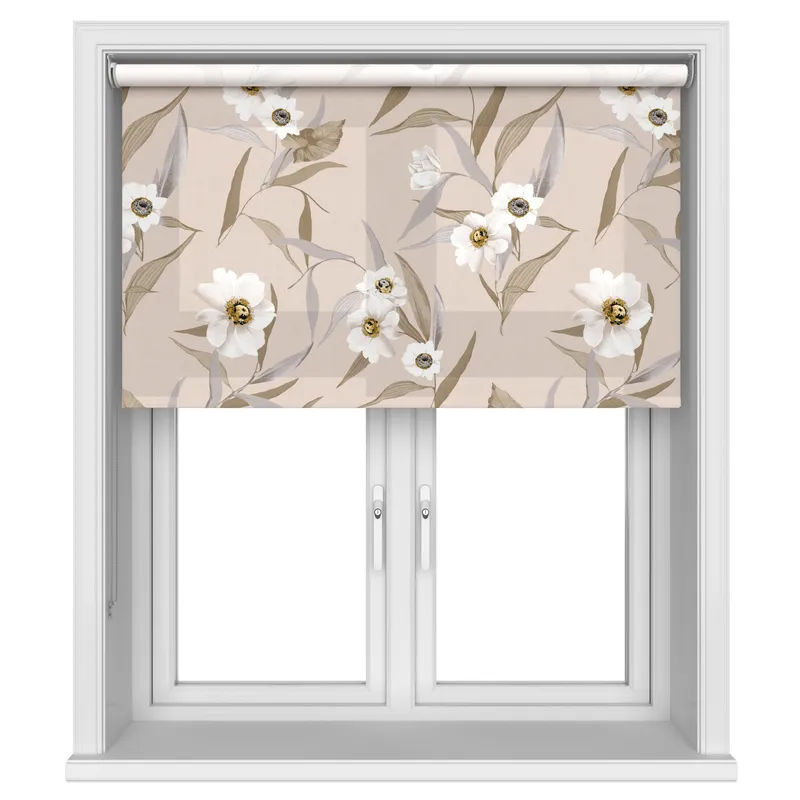
Botanic Rust Roller Blinds
at So Easy Blinds
Botanic Rust: a no-drill roller from So Easy Blinds with a broad palette.

Ted Baker Roller Blinds
at Blinds By Post
Ted Baker: a roller from Blinds By Post with a broad palette.

Cath Kidston Paisley Multi Designer Roller Blinds
at Unbeatable Blinds
Cath Kidston Paisley Multi Designer: a roller from Unbeatable Blinds with a broad palette.
Pick details
Best floral: Botanic Rust Grip Fit Roller Blinds
Botanic Rust Roller Blinds
at So Easy Blinds
Botanic Rust: a no-drill roller from So Easy Blinds with a broad palette.
The floral pick is a no-drill roller. So Easy Blinds sells the Botanic Rust design within its grip fit roller range, with a broad palette of other finishes alongside it. Grip fit is the retailer's own term for the fitting, and the blind is sold as a no-drill system, so the first question is whether your windows suit it. The no-drill frames we know best, perfect-fit systems, are designed for UPVC windows with a rubber gasket to grip; we would check with the retailer whether grip fit has similar requirements before ordering, and our no-drill blinds guide sets out the broader trade-offs.
The palette is where this range earns its category. Botanic Rust is the headline finish with Botanic Violet alongside it, and the rest of the finish list runs from Sprigs Lilac, Mabel Olive and Gracie Sunshine through Molly Coral, Verona Jade and Ocean Crimson to the Jax, Foss and Felix groups. The retailer tags a good number of finishes as blackout: the Shona colourways in Brick, Ecru, Iron, Licorice, Moss, Mustard, Midnight and Teal, the Monte finishes in Grotto, Iron and Praline, and Rumie Rainbow, Topsy Rainbow, Rupert Jungle, Tree Of Life Teal, Magical Ocean Blue, Dreamy Pastel, Elsie Sage and Maverick Mushroom among them. Botanic Rust itself is not labelled that way, so if you want this particular print in a bedroom, read the opacity on the retailer's listing carefully rather than assuming.
Its from-price of £120.82 is the highest of the three picks by a wide margin. Part of that will be the fitting system: you are buying a blind and a frame together rather than a bare roller and a pair of brackets, so it is not a like-for-like comparison with the other two. Whether the gap is worth paying comes down to whether drilling is off the table - in a rented flat, say, or on UPVC frames you would rather not put screws into - or whether you would simply prefer never to fit a bracket.
Best geometric: Ted Baker rollers from Blinds By Post
Ted Baker Roller Blinds
at Blinds By Post
Ted Baker: a roller from Blinds By Post with a broad palette.
The geometric pick is the Ted Baker roller collection sold by Blinds By Post, again with a broad palette. The finish names give you the shape of it: Palm Geo in Crimson, Navy, Green and Gold; Rhapsody in Celadon, Navy, Linen and Green; Landscape in Navy and Linen; Vietnm in Navy, Linen / Grey, Pink and Gold; Cabana Natural; Wild Iris in Black and in Pink / Charcoal; Midnight Garden in Blue and Terracotta; and Opal Floral in Sage, Navy, Linen and Pink. We list them because the names are as close as you will get to the designs without swatches in hand. Not every name reads as geometric, so take the category as a steer towards the collection's strongest thread rather than a description of every design in it.
The colourways repeat across designs - Navy, Linen, Green, Pink and Gold each appear on several - which helps if you are weighing one pattern against another and want to hold the room's palette steady while you do. It also makes this the easiest of the three picks to run across several windows: two designs sharing the same Navy will sit together more comfortably than two from unrelated collections.
No finish in the collection carries a blackout label, so for a bedroom treat opacity as an open question and ask the retailer directly before ordering. Nothing about the range is sold as no-drill either, so plan on a conventional bracket fitting inside or outside the recess. Against the floral pick, that makes it the simpler and far less expensive buy, with a from-price of £22.33; against the designer collection below, it is the tighter edit, with a smaller palette and a single name on it. Choose it if you want a recognisably coordinated set of designs and have no objection to drilling.
Also worth a look: Cath Kidston Paisley Multi and the designer rollers from Unbeatable Blinds
Cath Kidston Paisley Multi Designer Roller Blinds
at Unbeatable Blinds
Cath Kidston Paisley Multi Designer: a roller from Unbeatable Blinds with a broad palette.
The third pick is harder to file under one pattern type, which is why it sits as also worth a look rather than winning a category of its own. Unbeatable Blinds sells Cath Kidston Paisley Multi as the headline design of a designer roller range that carries several names - Cath Kidston, Emily Bond, Sara Miller and Sophie Allport all appear in the finish list - and the palette is the broadest of the three picks by a wide margin. Beyond the paisley, the Cath Kidston finishes include Spitalfields Border Navy and Cups And Vases Cream. Emily Bond's include George Stripe, Oscar Stripe, Peggy, Yew Tree, Tynesfield, Marley, Fred and St Maws in colourways such as Sage, Fern, Linen, Smoke and Coal. Sara Miller's include Birds Of Paradise, Birds & Trellis, Birds & Gate, Heron, Hummingbird, Dragonfly, Underwater, Wisteria, Bamboo, Butterflies & Trellis and Small Palm Tree. Sophie Allport's include Bee, Hearts, Sheep, Stamford Stripe, Bears & Balloons, Elephant, Zebra and Dragonfly.
That breadth is the point. If you are browsing patterned rollers without a fixed idea of what you want, this is the range most likely to have something close to it, and its from-price of £13.59 is the lowest of the three picks. The trade-off is coherence: a collection that spans several designers does not hang together the way a single-name edit does, so if you are dressing more than one window in a room you may find it easier to stay within one designer's finishes than to mix across them.
As with the Ted Baker collection, no finish here carries a blackout label and nothing is sold as no-drill, so bedroom buyers should ask about opacity and everyone should plan on brackets. Where it competes most directly is with the geometric pick: both are conventional rollers with from-prices well below the floral pick, and the choice between them is breadth against focus. Go broad if you have a particular designer in mind or want to see as many prints as possible before deciding; go narrow if you want a coordinated look with less deliberation.
What we didn't include
This is a roller guide, so patterned Roman blinds and pleated blinds are not here even though both carry pattern in their own way. A Roman folds the fabric into horizontal pleats as it rises, which suits a soft decorative fabric but breaks a print into bands and stacks it at the top of the window; a pleated blind does something similar at a smaller scale. Venetians and verticals are out because their appeal is light control through slat and vane angle rather than a printed surface, and a print is the whole premise here.
We also left out licensed character prints for children's rooms. They are patterned rollers in the strict sense, typically a standard polyester roller fabric under a printed design, but choosing one is driven by the character and by cord safety rather than by colour and scale, and we have kept this guide to prints chosen on their own merits. Motorised rollers are absent for a similar reason: the step up in price moves them into a different buying decision from the three ranges here.
Price by your window
All three picks are made-to-measure, so the from-price is a starting point rather than what most windows will cost. Blinds are quoted as width by drop in millimetres, and the first decision is whether you are fitting inside the recess, in which case you measure the recess itself, or outside it, in which case you measure the area you want covered, including any overlap onto the wall. Each pick's own page carries a price by dimensions so you can see roughly what your window would cost before going to the retailer, and the retailer will tell you whether to add or subtract a fitting allowance for its particular blind. For the grip fit pick in particular, use the retailer's own measuring guidance rather than a generic recess measurement, since a no-drill frame has its own requirements.
Independent. We have no affiliate relationships with any retailer mentioned here. How we work.