
Orla Kiely's Stem print is one of the most recognisable patterns in modern British design - a clean, repeating leaf-and-stem motif at the heart of a mid-century-leaning aesthetic. Search for it on blinds and you will find the same Stem designs sold by several UK retailers, almost always as a roman, at prices that sit close together. The print is shared; what differs between retailers is how wide a choice of scale and colourway they carry, and whether they offer a no-drill fitting. This guide covers two picks and how to choose between them.
The same prints, different retailers
Because the Stem motifs are a shared licensed design, the print on the blind is much the same wherever you buy it, and the from-prices cluster closely - this is not a case where one retailer is markedly cheaper for the same thing. The choice comes down to two things:
Breadth of choice. Some ranges carry the Stem at its full spread of scales - Tiny, Linear, Solid, Jumbo - and across the whole palette, from soft duck-egg to bold tomato; others carry a tighter, curated edit. A wide range helps if you want an exact scale in an exact colour; a focused edit is easier to navigate if a large catalogue feels daunting.
Fitting. A conventional roman fits the recess or wall face if you can drill. A no-drill version clips into a UPVC frame without screws - the choice for rentals or warranty-sensitive windows. Where a retailer offers both, the no-drill usually carries a small premium.
The two picks below sit at the two ends of that: the broadest range, and the no-drill edit. A third retailer carries the same Stem romans too, at a similar price, so if neither pick has your exact colourway it is worth a look across the range pages.
It is worth being clear about why the prices cluster. Because the design is the thing being licensed and the made-to-measure roman behind it is much the same blind from one retailer to the next, there is little room for one shop to undercut another on the same Stem print without cutting the same corners. That is good news for a buyer: it means you can choose on the things that actually differ - the exact scale and colour you can get, and whether you need a no-drill fitting - rather than chasing a lower price for the same design that mostly is not there to be found. Where a genuine price gap does open up, it is usually because the colourway or scale differs, or because one is a no-drill version and the other is not, so compare like for like before reading anything into it.
Two prints worth knowing as you compare ranges: the Multi Stem, which sets several stem scales together for a busier, more decorative result, and the Solid Stem, where the motif is filled rather than outlined for a bolder block of colour. Not every range carries both, so if one of those is the look you are after, check it is actually stocked before settling on a retailer.
What "Orla Kiely" means on a blind
The look is built around the Stem motif, rendered at several scales - Tiny Stem, Linear Stem, Solid Stem, Jumbo Stem - plus a few related designs like Multi Stem and the occasional floral. The palette is flat colour and confident: duck-egg and seagrass at the soft end, bubblegum, tomato and persimmon at the bold. It is a deliberately contemporary, retro-modern aesthetic, quite different from the botanical heritage of William Morris or the country florals of Laura Ashley.
On a blind, the Stem is almost always a fabric design - it suits a roman's soft fold, which keeps the graphic edge from feeling clinical. The key choices are scale (how large the motif reads) and colourway (calm or bold), with the fitting - conventional or no-drill - the practical layer on top.
Because the motif is geometric and regular, it rewards a window with enough width to show its rhythm. A large Jumbo Stem can look cropped on a narrow window; a Tiny Stem sits better there.
What to look for
Scale of the motif. Tiny Stem is the most restrained and flexible; Jumbo Stem is the boldest. Match the scale to the window and to how much you want the pattern to lead - a big motif on a small window crops awkwardly.
Colourway. The same Stem reads as calm in duck-egg or pebble and as a strong accent in tomato or sunflower. Decide whether the blind should be a quiet nod to the brand or the room's main event - and check which retailer carries your chosen colour, since the spread varies.
Fitting. A conventional roman fits the recess or wall face if you can drill. A no-drill version clips into UPVC frames without screws - the choice for rentals or warranty-sensitive windows. Confirm the clip suits your frame, and measure to the no-drill guidance.
Room. These are furnishing fabrics, for dry rooms - living rooms, bedrooms, studies. The graphic look suits contemporary and mid-century-leaning interiors particularly well. Not for kitchens or bathrooms.
Our picks


Orla Kiely Roman Blinds
at Swift Direct Blinds
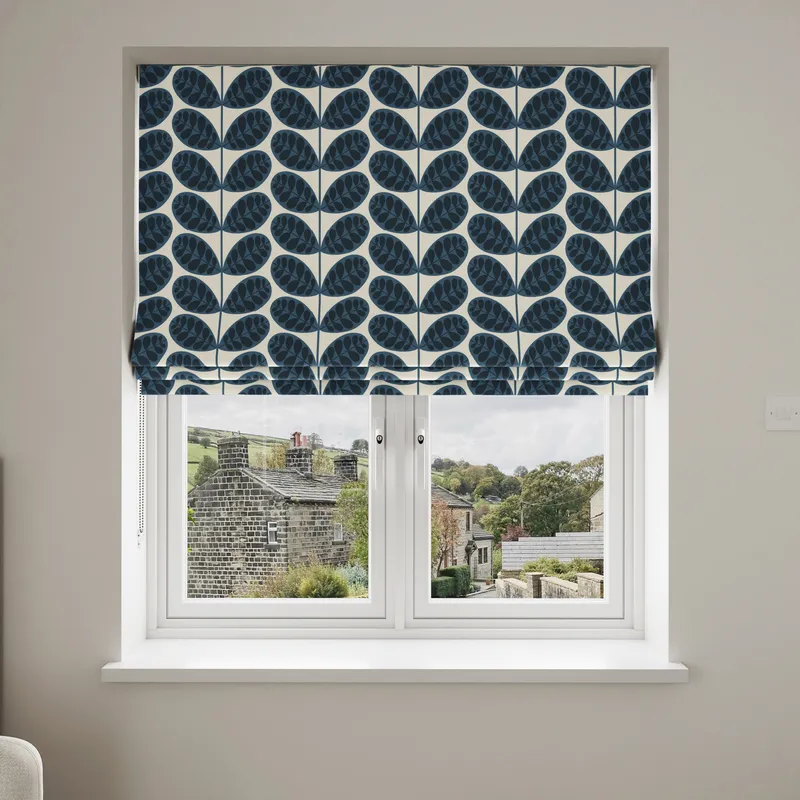
The Stem prints in their fullest spread of scales and colourways, in a roman from Swift Direct Blinds.
Orla Kiely Roman Blinds
at Blinds By Post
A focused edit of the same prints on a no-drill roman from Blinds By Post, for UPVC windows.
Pick details
Widest range
Orla Kiely Roman Blinds
at Swift Direct Blinds
The Stem prints in their fullest spread of scales and colourways, in a roman from Swift Direct Blinds.
The Swift Direct Blinds Orla Kiely roman is the broadest of the options, covering the Stem in its full range of scales and a wide spread of colourways - from soft duck-egg and seagrass through to bubblegum, persimmon and tomato. The roman's fold softens the graphic motif just enough to keep it warm rather than clinical, which suits a contemporary or retro living room, bedroom or study.
With the most colourways and scales, it is the pick if you want choice - to find exactly the right size of Stem in exactly the right colour. Choose a brighter colourway if the blind is to be the room's main pattern; a Tiny Stem in a soft tone if you want the brand's look as a gentler accent. As a roman, it stacks a little at the top when raised, which is no issue on a taller window.
As a rough guide to scale: a Tiny or Linear Stem suits a kitchen-diner window or a narrower opening where a larger motif would crop, while a Jumbo or Solid Stem wants the width of a living-room or bay window to show its full rhythm. If the blind is competing with other pattern in the room - a papered wall, a patterned sofa - the smaller scales sit more comfortably; in a plainer room a bold Stem can carry the whole scheme on its own.
No-drill
Orla Kiely Roman Blinds
at Blinds By Post
A focused edit of the same prints on a no-drill roman from Blinds By Post, for UPVC windows.
The Blinds By Post Orla Kiely no-drill roman carries the same Stem prints and clips into the UPVC frame without screws - the pick for windows you can't or would rather not drill, which makes it right for rentals and new-build windows under warranty. It removes without a trace. The selection is a tighter edit than the Swift range - the core Stem motifs in a focused set of scales and colourways - which is an advantage if a large catalogue feels daunting, and a limitation only if you wanted an obscure specific colourway you can find elsewhere.
Confirm the clip system suits your window profile before ordering, and measure to the retailer's no-drill guidance. Within the edit, the smaller-scale designs and softer colourways (pebble, warm grey, powder blue) are the understated choices; Sunflower and the Multi designs are the bold ones.
What we didn't include
We have kept this to two picks - the widest range and the no-drill edit - rather than listing every retailer that carries the Stem prints. A note on what is not here.
We have not included a roller or a slatted blind. The Stem is a fabric design that suits a roman's soft fold; a slatted venetian or vertical would break the motif up, and where rollers carry the print they render it flatter and a little less forgiving than the roman fold. The roman is the format that does the design justice, which is why both picks share it.
We have also not ranked the colourways or scales against each other. Whether a Tiny Stem in duck-egg or a Jumbo Stem in tomato suits you is a question of your room and how bold you want the window, and the same designs appear across the ranges - it is a choice within each, not between them. The picks are about range breadth and fitting; the print and scale are yours.
Price by your window
The from-prices shown are starting points; the made-to-measure price depends on your window's width and drop. Each pick's page carries a price-by-dimensions tool - enter your measurements for the price at your size. Because the Stem prints sit at similar prices across the retailers that carry them, the choice between these two rests on the fitting (drilled or no-drill) and the breadth of colourway you want, rather than on cost. Price your actual window on each page before deciding.
See our full Orla Kiely blinds guide - every pattern, with live prices →