
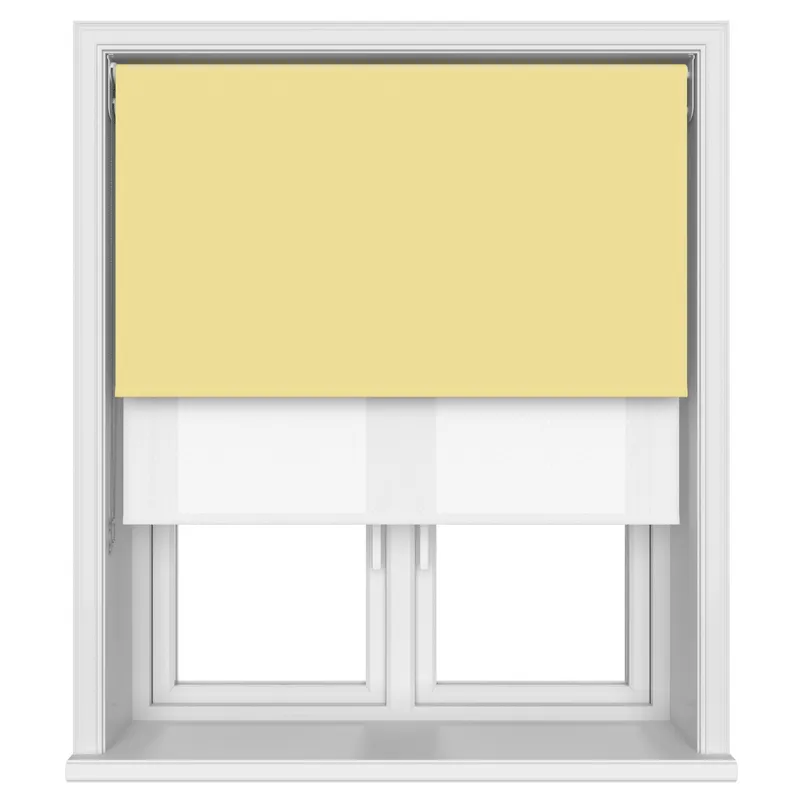
A double roller blind puts two blinds on one bracket: a sheer or voile layer for the daytime, and a dimout or blackout layer for when you actually want the room dark. Each rolls independently, so you can run the sheer alone for softened light and privacy, drop the solid layer at night, or use both together. It is the window treatment for rooms that live two lives - and because both layers are plain rollers underneath, it stays neater and shallower than a curtain-plus-blind build.
Double roller or day and night?
The two get confused constantly, and retailers do not help by naming them loosely. A day and night blind (also sold as zebra or vision) is a single fabric woven in alternating sheer and solid bands; you align the bands to tune the light, but the fabric is one piece, and its "dark" setting is banded rather than solid. A double roller is genuinely two fabrics on two tubes. The practical consequences: a double roller's solid layer can be a true blackout, which a zebra fabric cannot match; and the two layers can be different colours, which a zebra fabric cannot do at all. If your priority is a stylish light-filtering effect for a living space, the day and night look may well suit you better - our day and night guide covers it. If the brief is "see out by day, dark by night," the double roller is the honest answer.
What to look for
The solid layer's opacity. This is the whole point of the format. Check whether the shading layer is dimout or true blackout - for a bedroom, insist on blackout, and remember any recess-mounted blind leaks a little light at the edges regardless of fabric.
The sheer's density. Voiles vary from barely-there to a definite screen. A denser sheer gives more daytime privacy but dims the room; a lighter one keeps the view and the brightness. Ranges that name their sheer options are telling you they take this seriously.
Colour pairing. The two layers show together - the sheer in front of or behind the solid, depending on the mechanism - so the pairing matters. Some ranges fix the pairs; others let you choose each layer, which is more flexible but easier to get wrong. Neutral-on-neutral is the safe play.
Bracket depth and the stack. Two tubes need more depth than one. Measure your recess depth before ordering - a shallow recess may force a face-fix mount, which most ranges support but which changes the look.
Operation. Two layers mean two controls as standard - typically twin chains. Check which side they land and whether a motorised option exists if the window is tall or awkward; in a child's room, specify cord-safe operation as you would for any blind.
Room by room
Bedrooms are the format's home ground. The sheer keeps the room private and bright through the day - useful in terraces and flats where the window faces a street - and the blackout layer takes over at night. If dark mornings are the whole reason you are here, make sure the solid layer is listed as blackout rather than dimout before ordering.
Living rooms use the layers the other way round: the sheer runs most of the time, softening glare and stopping the goldfish-bowl effect after dark with lamps on, while the solid layer earns its keep for afternoon films and screen glare. In a bay or a wide run, keep the pairing identical across every window - two-layer blinds multiply any mismatch.
Home offices get the most from a denser sheer: enough screening to kill monitor glare while keeping daylight, with the solid layer as the heavy artillery for a low winter sun. If the office doubles as a spare room, the blackout layer covers the guest-room brief too.
Kitchens and bathrooms are the weak case. Two layers of fabric near steam and splash is one layer too many; a wipeable single roller or a metal venetian suits those rooms better.
Fitting and measuring
Measure as for any roller - width and drop, inside or outside the recess - but check two extras. First, bracket depth: the twin-tube headrail needs more room than a single, so a shallow recess may push you to a face-fix mount; the range's measuring notes state the minimum. Second, clearance: handles and window keys that a single roller clears can catch the rear layer of a double, so check the deepest point of the window furniture against the bracket's projection. Neither is difficult; both are cheaper to know before the blind is cut, and both are covered in each range's own measuring guide, which is worth the five minutes it takes.
How we chose
Three picks from three retailers, each answering a different brief: the widest choice of layer pairings, the biggest colour count with an upgrade path, and the mainstream option from the UK's biggest made-to-measure name. All three are true two-layer double rollers, not zebra fabrics, and each pick links to its full made-to-measure price table so you can compare the same window across all three.
Our picks


Rimini Double Roller Blinds
at 247 Blinds
247 Blinds' Rimini pairs each shading fabric with a named sheer - the widest run of layer combinations in this guide.

Bella Double Roller Blinds
at Blinds By Post
Blinds By Post's Bella double roller carries the biggest colour count here and a motorised upgrade path.

Atom Beach Double Roller Blinds
at Blinds 2go
Blinds 2go's Atom Beach double roller - the big-retailer take, in a soft coastal palette.
Pick details
Rimini Double Roller Blinds
at 247 Blinds
247 Blinds' Rimini pairs each shading fabric with a named sheer - the widest run of layer combinations in this guide.
The Rimini at 247 Blinds is our pick for the palette - not just the number of colours, but the way the range names its pairings. The colourways read as fabric duets (a shading tone matched to a named sheer), which takes the guesswork out of the pairing decision: you are choosing a combination someone has already balanced, rather than assembling one blind from two lists and hoping. The tones stay in the liveable neutral band - creams, sands, mochas - which is exactly where a two-layer blind wants to be, since both layers show.
Entry pricing sits at the accessible end for the format, and the range's breadth means the same combination can repeat across several windows in a room without the scheme feeling flat. For a first double roller in a living room or bedroom, this is the default choice here.
Bella Double Roller Blinds
at Blinds By Post
Blinds By Post's Bella double roller carries the biggest colour count here and a motorised upgrade path.
Blinds By Post's Bella double roller is the options pick. It carries the biggest colour count in this guide, drawn from the same Bella palette that runs across the retailer's singles - so if you already have Bella rollers or verticals elsewhere in the house, the double can match them - and it is the one pick here with a motorised upgrade path, which matters on tall windows or anywhere a twin-chain arrangement would be a nuisance.
Bella is also one of the most widely stocked cloths in the UK trade, so the fabric itself has a track record. Our Bella double roller comparison sets this version against the same fabric elsewhere; the price of the same window can differ meaningfully between shops, and that check takes a minute.
Atom Beach Double Roller Blinds
at Blinds 2go
Blinds 2go's Atom Beach double roller - the big-retailer take, in a soft coastal palette.
The Atom Beach double at Blinds 2go is the mainstream route: the format from the UK's biggest made-to-measure retailer, in a soft coastal palette - vanilla, sable, fossil, mallow - that leans calm rather than dramatic. It is the pick when you want the two-layer function with the reassurance of a large retailer's process, samples and delivery machinery around it.
The palette's softness is worth taking seriously as a design choice: a double roller shows more fabric than a single (two layers, and often both visible), so the quiet tones earn their keep in small rooms where a bolder pairing would dominate. Compare its price at your sizes against the Rimini - the gap varies by window and the cheaper option is not always the same range twice.
Living with one
A fortnight in, the twin controls stop being a novelty and become a rhythm: the sheer stays down more or less permanently, and the solid layer does a twice-daily commute. It is worth setting the blind up for that reality - hang the solid layer's control on the side nearest the bed or the door, so the frequent action is the convenient one. Cleaning is the same discipline as any roller, twice: a soft brush or vacuum head down each layer, and marks lifted with a barely damp cloth. The sheer earns most of the attention, since it faces the room and the window both.
One habit worth forming: raise the solid layer fully rather than leaving it half-dropped behind the sheer. A half-height dark band behind a voile reads as a smudge from across the room, and the fabrics wear their creases longest where they are left folded against each other.
What we didn't include
We have not included day and night (zebra) blinds here - they solve a different problem and have their own guide. We also have not made a separate pick of electric doubles: motorisation is an option on some ranges (the Bella above among them) rather than a distinct product. And if what you actually want is maximum darkness with no daytime layer at all, a single blackout roller does that job for less - see the blackout guide.