
A day and night blind - also sold as a zebra, vision or duo blind - is a roller with a clever twist: two layers of fabric in alternating sheer and solid horizontal stripes. Slide one layer past the other and the stripes line up for shade and privacy, or stagger so the sheer sections let daylight through. It is a single blind that gives a range of light settings, which is the whole appeal. This guide covers how it works, where it suits, and two picks.
What a day and night blind is
The mechanism is a double layer of striped fabric on a roller. Each layer alternates a translucent (sheer) stripe with an opaque (solid) one. As you operate the blind, the layers shift relative to each other: align the solid stripes over the sheer ones and the blind shades and screens the room; offset them so sheer meets sheer and daylight passes through in soft bands while the view in stays obscured. Anywhere between gives a gradient of light.
That adjustability is the point. Where a plain roller is simply up or down, a day and night blind lets you dial daytime light and privacy without raising the blind at all - useful in a room you occupy through changing light, like a living room, kitchen or home office.
The honest limitation is darkness. Even with the solid stripes fully aligned, a day and night blind is not a true blackout - a little light passes at the stripe joins, and like any roller it leaks around the edges. For a bedroom that needs to go genuinely dark, a blackout roller or a lined roman is the better tool. The day and night blind's strength is adjustable daytime light, not night-time blackout.
What to look for
Be clear on what it does. It filters and screens beautifully; it does not black out. If you want it for a living space to manage daytime light and privacy, it is well-suited. If you want a dark bedroom, look at a blackout option instead.
Fabric tone and opacity. The solid stripes vary in opacity between ranges and colours; darker, denser solids screen more. Check the fabric if maximum daytime shade matters.
Colour. Day and night ranges tend toward practical neutrals, since the blind earns its place on function. A neutral suits most rooms; some ranges offer warmer tones or wood-effects if you want the blind to add a little character.
Room. Living rooms, kitchens and home offices are the natural homes - rooms used across the day where adjustable light helps. For a wet room, check the fabric's moisture suitability.
Operation. A chain or cord shifts the layers. In a child's room, choose a cord-safe option in line with UK requirements.
Our picks


Enjoy Day and Night Blinds
at Blinds 2go
A zebra-stripe roller from Blinds 2go giving sheer-to-opaque control.

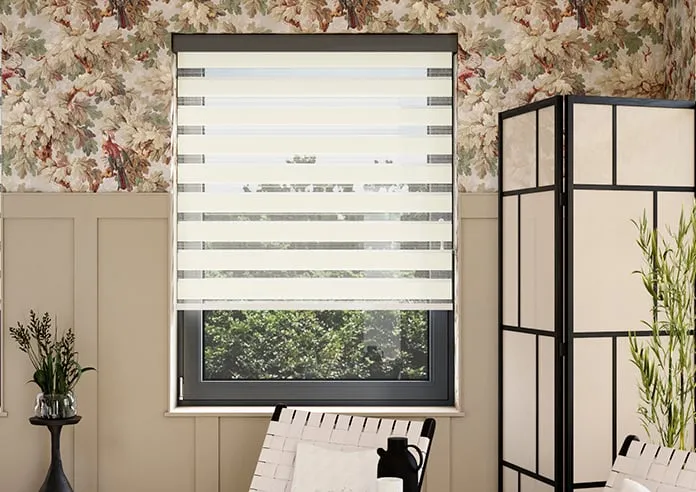
Origin Day Night Day and Night Blinds
at 247 Blinds
A day-night blind from 247 Blinds at a lower entry price.
Pick details
Best overall
Enjoy Day and Night Blinds
at Blinds 2go
A zebra-stripe roller from Blinds 2go giving sheer-to-opaque control.
For an all-round day and night blind, the Enjoy range from Blinds 2go is our pick, on the strength of an unusually broad palette. Where most zebra blinds stick to a handful of neutrals, Enjoy adds blues, warmer tones and even wood-effect finishes - so the blind can match a room's character rather than just doing a job in plain grey. The dual-layer mechanism gives the full sheer-to-screened range.
It suits a living room, kitchen or home office where you want to vary daytime light and still coordinate with the room. As with any day and night blind, it is not a blackout - keep that in mind for bedrooms - but for adjustable daytime light with real colour choice, it is the stronger pick.
Best value
Origin Day Night Day and Night Blinds
at 247 Blinds
A day-night blind from 247 Blinds at a lower entry price.
For the same function at a lower entry price, the Origin day and night blind from 247 Blinds is our value pick. It keeps to a tight set of six practical neutrals - warm creams through to cool dark greys - which is all most rooms need, and it has live price grids so you can cost it at your size now. The dual-layer mechanism works just as the dearer ranges do.
It is the choice where function and price lead and a plain neutral suits the room. You give up the broader, warmer palette of the Enjoy range, but for a straightforward day and night blind in a sensible colour, it does the job for less.
What we didn't include
We have kept this to two picks, since the day and night blind is a fairly self-contained category - the mechanism is much the same across ranges, so the meaningful differences are palette and price, which these two picks bracket. A note on the gaps.
We have not included a blackout blind here, even though people sometimes arrive at day and night blinds hoping for darkness. That would be the wrong category - a day and night blind filters rather than blocks light, and pretending otherwise would mislead. If darkness is the real need, a blackout roller or a lined roman is the honest answer, and that is a different search.
We have also not included a perfect-fit or no-drill version. Some day and night fabrics are offered in those fittings, which is worth looking for if you have UPVC windows you'd rather not drill - but it is a fitting option to seek within a range rather than a separate pick.
Price by your window
The from-prices shown are starting points; the made-to-measure price depends on your window's width and drop. Each pick's page carries a price-by-dimensions tool - enter your measurements for the price at your size. The Origin value pick is priced live now and is the more affordable; Enjoy sits a little above it for its broader palette.