
Pleated blinds occupy a specific niche in the UK market: they stack far more neatly than a Roman blind when raised, fit more window shapes than a roller, and suit spaces where you want something tidier than a vertical blind but less bulky than a honeycomb. If you're searching for one now, you're probably dealing with an awkward window, a bifold door, or a bedroom that needs genuine darkness - and a standard roller isn't quite fitting the bill. This guide covers three curated picks across those use cases: blackout, bifold doors, and best value.
What pleated blinds actually are
A pleated blind is made from accordion-folded fabric - the same concertina structure you'd see in a paper fan. When you raise the blind, those folds compress into a tight stack at the top of the window. When lowered, the fabric spreads evenly across the pane with a regular horizontal ridge pattern.
The structure sets them apart from their close relative, the honeycomb (or cellular) blind. A honeycomb blind uses the same accordion fold but seals two layers of fabric together to form air pockets. Those air pockets give cellular blinds their standout thermal performance. A standard pleated blind is a single layer of folded fabric, which means it can be lighter, slimmer when stacked, and cheaper - but it won't match a cellular blind for insulation. If your main reason for buying is energy saving, a cellular blind is the more honest recommendation. If your priorities are light control, fit, and appearance, a pleated blind is well worth considering.
The fabric itself matters quite a bit. Pleated fabrics range from open-weave translucents that filter light without blocking it, through midweight dimouts, all the way to coated blackout fabrics that block light transmission through the material. The pleated format means the opacity comes entirely from the fabric's own construction - the accordion fold doesn't add meaningful light-blocking on its own.
One further distinction: a pleated blind closes with a flat vertical face across the window, so it behaves more like a roller than a Roman when it comes to light sealing at the edges. That means edge-leak is still a factor if you need genuine darkness. A fabric that the retailer describes as blackout won't eliminate room light entirely unless the fitting also controls the gaps at the sides and top.
What to look for
Fabric opacity. This is the most consequential decision. Translucent fabrics look soft and let ambient light through - good for living rooms and kitchens where privacy matters but darkness doesn't. Blackout fabrics are essential for shift workers, young children, and anyone in a room that catches early morning sun. The pleated format handles all of these; you're choosing the fabric, not just the blind type.
Fitting method. Standard pleated blinds fix to the window recess or wall with brackets, same as rollers. Some pleated blinds are designed specifically for doors - particularly bifold and French doors - where the panel needs to move with the door rather than stay fixed to the frame. A standard bracket fitting won't work on a door that opens. If you're covering a bifold door, look specifically for a door-compatible fitting (often a clip or click system that attaches to the door itself).
Stack height. Because the fabric compresses into a tight concertina rather than rolling onto a tube, pleated blinds can stack more visibly than roller blinds in the same space. For a very shallow recess or a window where you want maximum daylight when the blind is up, measure how much clearance you have at the top. A slimmer fabric with a tighter pleat will stack shorter; a heavier fabric takes more room.
Colour palette. Pleated fabric ranges tend to have narrower colour selections than roller blind ranges - you're choosing from a curated palette of solid or lightly textured fabrics rather than printed designs. If you need a pattern, pleated is unlikely to be the right format. If you need a neutral that coordinates across a room, the available palettes typically cover that well.
Cord safety. UK regulations require blinds sold for domestic use to be cord-safe by design. For children's rooms in particular, look for cordless or wand-operated options. Both of these exist in the pleated format; if cord safety is a requirement, confirm the operating mechanism before ordering.
Made-to-measure sizing. Blinds are measured and quoted as width x drop (horizontal x vertical dimension), in millimetres. Every range in this guide is made-to-measure, meaning you provide your window dimensions and the blind is cut to match. Measure the recess width if you're fitting inside the recess, or your desired covering width if fitting outside. The retailer's product pages will specify whether to add or subtract a fitting allowance.
Our picks


Totalshade Complete Thermal Pleated Blinds
at Blinds 2go
A complete-blackout thermal pleated blind from Blinds 2go.

Bifold Clickfit Pleated Blinds
at Blinds 2go
A click-fit pleated blind from Blinds 2go made for bifold and French doors.

Clic-Stick-Fit Pleated Blinds
at Swift Direct Blinds
A no-drill pleated blind from Swift Direct Blinds at a lower entry price.
Pick details
Totalshade Complete Thermal Pleated Blinds
at Blinds 2go
A complete-blackout thermal pleated blind from Blinds 2go.
Totalshade Complete Blackout Thermal Blind - Best blackout
The Totalshade Complete Blackout Thermal Blind from Blinds 2go earns its place here on two combined properties: the retailer describes it as a complete blackout fabric, and the "thermal" label indicates a backing designed to reduce heat loss as well as block light. Blinds 2go's own description positions this as a blackout pleated option, which narrows the field considerably - most pleated ranges lean translucent or dimout rather than full blackout.
The range covers 19 colour finishes, which is one of the broader palettes in the pleated blackout segment. The selection runs from cooler neutrals - Frost White, Turtle Dove, Cliffside Grey, Elephant Grey - through warmer tones like Ecru, Mink, and Toffee, and into greens (Sage, Olive, Forest, Pistachio) and a Duck Egg blue. That spread makes it more flexible as a decorating choice than a lot of blackout pleated ranges, which tend to default to white and grey. Forest or Olive would work in a room with botanical styling; Sherbet or Peach suit a softer palette.
From a practical standpoint, this is the pick for a bedroom that needs genuine darkness, or for any room where you want the thermal backing as an additional layer between you and a cold pane in winter. Bear in mind the caveats about edge-leak: a blackout fabric controls light transmission through the material, but gaps at the sides and top of the fitting will still let light in. If complete darkness is the target, consider pairing with a recess-fill fitting or curtains at the sides.
The Totalshade sits at a higher price point than the Pleated Fit from Swift Direct Blinds - entry pricing is from £26.86 - reflecting the blackout and thermal specification rather than just the pleated format. If you don't need blackout, one of the other picks may suit better.
Bifold Clickfit Pleated Blinds
at Blinds 2go
A click-fit pleated blind from Blinds 2go made for bifold and French doors.
Bifold Clickfit Pleated Blind - Best for bifold doors
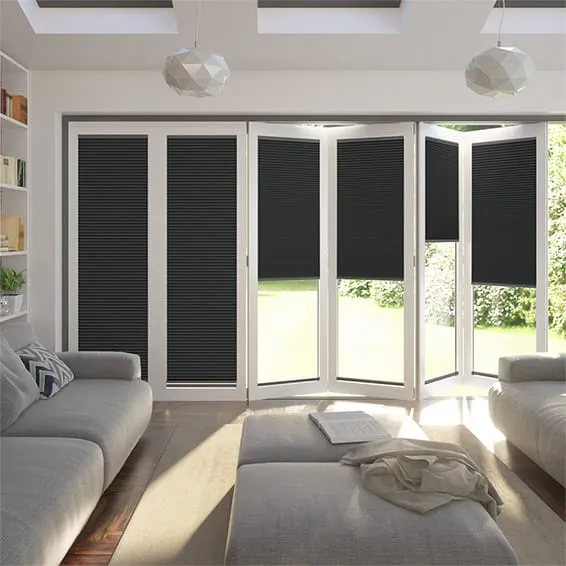
The Bifold Clickfit Pleated Blind from Blinds 2go solves a problem the other picks in this guide don't address: how to hang a blind on a door that opens and folds. A standard pleated blind fixed to the window surround would either block the door from opening or be caught by it. The Clickfit system is designed to mount directly on the door panel itself, so the blind travels with the door rather than staying fixed to the frame.
That door-specific fitting is the defining feature here. It's designed for bifold and French doors - the two most common configurations where a standard blind won't work. If you have sliding patio doors or a single hinged door, the fitting geometry may differ and it's worth checking product compatibility before ordering.
The range comes in 13 finishes, all at a neutral end of the palette: creams, oatmeal, greys from Palest Grey through Dove Grey and Storm Grey to Charcoal and Slate Grey, plus a Royal Blue as the single colour accent, and two white-adjacent options in Pure White and Bone White. That's a sensible selection for doors, where the blind is often framing an outdoor view rather than anchoring a decorating scheme. Charcoal or Storm Grey would suit a contemporary aluminium bifold; Oatmeal or Cream would work with a more traditional painted door.
Entry pricing is from £17.96, which makes it the most accessible starting point of the three picks here, though door widths and drops will push the price up from that base. Compared with the Totalshade, the Bifold Clickfit doesn't offer a blackout specification - if you need darkness on a bifold door (a utility room that doubles as a home office, for example), that's a limitation to factor in.
Clic-Stick-Fit Pleated Blinds
at Swift Direct Blinds
A no-drill pleated blind from Swift Direct Blinds at a lower entry price.
Pleated Fit - Best value
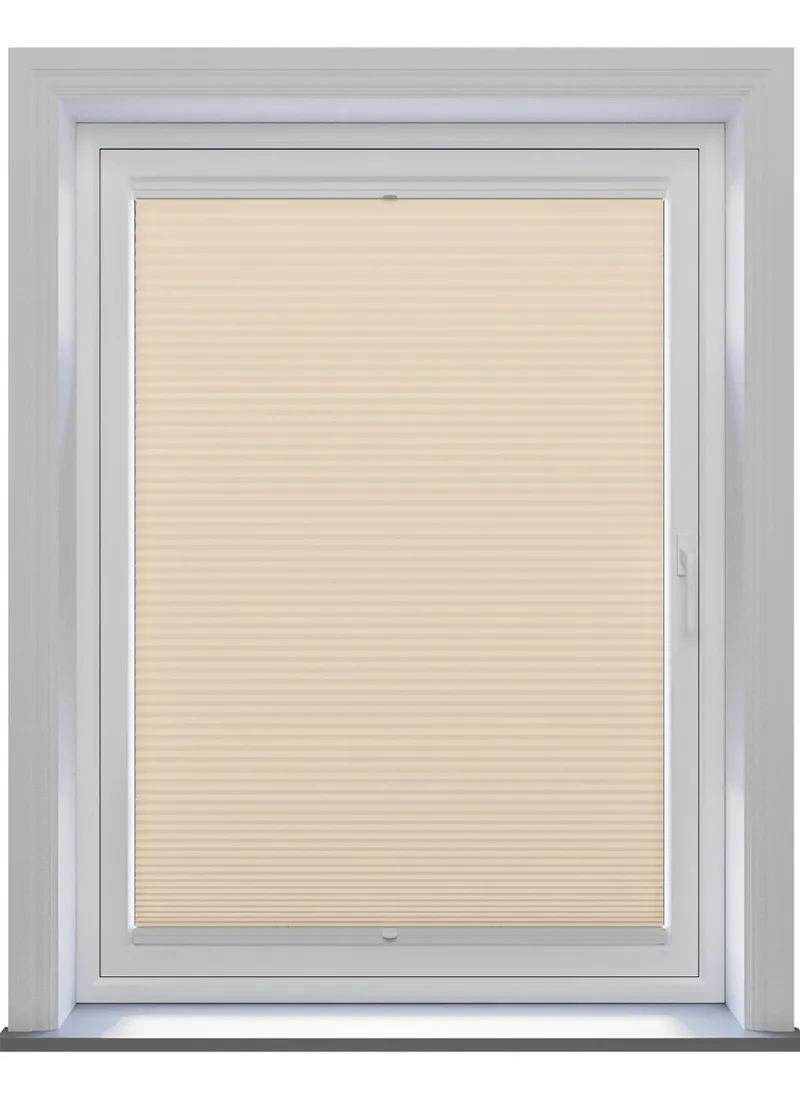
The Pleated Fit from Swift Direct Blinds comes in at the lowest entry price of the three picks, starting from £23.59, and covers a 14-finish palette that takes in beiges, blues, creams, greens, greys, a red, and a yellow - a broader colour spread than you typically see at this price range.
The finish names are worth noting: several finishes appear in both "Clic" and "Stick" variants - for example, Beige Stick and Nude Clic, or Blue Clic and Blue Stick. The naming indicates two different no-drill fixing systems. Both eliminate the need to drill into the window frame or wall, which makes the Pleated Fit a relevant option for renters or for anyone with UPVC windows they'd rather not touch with a screwdriver. The distinction between the two systems matters for installation, so it's worth checking Swift Direct Blinds' fitting guidance to confirm which variant suits your window type before ordering.
At this price point, the Pleated Fit is a straightforward pleated blind without the blackout specification of the Totalshade or the door-specific fitting of the Bifold Clickfit. It suits rooms where you want a neat, neutral blind that controls privacy and diffuses light without requiring darkness - a home office, a kitchen, or a living room with a window that gets afternoon sun. The no-drill fitting also means it's removable without leaving marks, which adds some flexibility in how it's installed and repositioned.
The 14 finishes include some options you won't find in the other two picks: yellow and red sit outside the neutral range that dominates most pleated palettes and give the Pleated Fit a slightly more playful scope. For a children's bedroom where full blackout isn't needed, or a study that could use some colour, those options extend what's possible.
What we didn't include
Motorised pleated blinds are available from some UK retailers but sit in a substantially different price bracket. The buying decision for a motorised blind involves different considerations - compatibility with smart home systems, power supply to the window, and a significant cost step-up - that don't overlap cleanly with the budget and installation questions driving most pleated blind searches. They're not included here.
Honeycomb or cellular blinds are technically a cousin of the pleated blind, built on the same accordion-fold principle but with a sealed dual-layer structure that gives them genuinely strong thermal performance. They're the better recommendation for anyone primarily motivated by energy saving. Pleated and cellular are separate enough as categories that conflating them in a single guide would obscure the real distinction between them.
Ready-made pleated blinds in fixed sizes exist and are cheaper than made-to-measure, but the trade-off in fit is significant - an off-the-shelf blind in a standard width may need trimming and is unlikely to sit cleanly in the recess. The three picks in this guide are all made-to-measure, which is the approach we've focused on.