
Vertical blinds are the standard answer for patio doors, wide windows and conservatories, but they carry a reputation for a plain, office-like look. A patterned vertical does the same job - a row of fabric vanes that rotate for light and slide aside to clear the glass - while giving a large run of window something to look at. Interest in them tends to lift at the start of spring, when decorating season begins and garden-facing rooms come back into daily use. This guide covers our picks for patterned verticals: a subtle tone-on-tone option, a bold stripe, and a range chosen for the breadth of its palette. We explain how a pattern behaves on vanes that turn and slide, what to check before you order, and where each pick fits. It does not cover plain verticals or blackout options, which are different decisions.
What "patterned" means on a vertical blind
A vertical blind is a line of fabric vanes, typically 89mm or 127mm wide, hung from a top track. The vanes rotate together to control light and slide to one side to open. That mechanical fact shapes how a pattern looks. On a roller blind the fabric is one flat sheet, so a print reads exactly as it was designed. On a vertical, the design is cut into strips, each vane carries its own slice, and the gaps and overlaps between vanes become part of the picture. Rotate the vanes halfway and every strip is seen at an angle, foreshortened and partly hidden by its neighbour.
Two kinds of pattern cope well with this. The first is a small-scale, tone-on-tone design - a texture or shadowed effect in a colour close to the base fabric. With no large motif to interrupt, it reads as a surface finish rather than an image, and it looks much the same whether the vanes are open, closed or half-turned. The second is a vertical stripe. Stripes run the same way as the vanes, so the joins between vanes sit inside the rhythm of the pattern rather than cutting across it.
Large motifs are the hardest to carry off. A floral or geometric repeat wider than a vane can never show whole, and the design fragments as soon as the blind is turned. None of our picks takes that route, and we would approach any range that does with caution.
A word on light control. Verticals rotate to block light rather than relying on an opaque sheet, and even fully closed vanes leave small overlaps that admit a little daylight. Two of our picks are labelled light-filtering or "daylight" by their retailers; none is sold as blackout. That suits living rooms, home offices and conservatories, where the aim is to soften glare and gain privacy rather than darken the room. If you need genuine darkness, a blackout roller or roman fitted with side channels or a perfect-fit frame is a better starting point - see our blackout blinds guide.
What to look for
Pattern scale against vane width. Vanes are usually 89mm or 127mm. Anything wider than a vane will never appear complete, so favour stripes and small textures over large motifs. Where a retailer offers both widths, the wider vane shows more of each repeat but there are fewer vanes across the window, which gives the blind a heavier, more commercial look.
Opacity and room. Patterned vertical fabrics are mostly light-filtering or dimout. That is right for a living room, study or conservatory and wrong for a bedroom that needs to be dark. In a conservatory, lean towards the paler colourways: light fabrics reflect more summer heat than dark ones. None of our three picks is sold as a PVC or wipe-clean range, so for a kitchen or bathroom you would look elsewhere.
Weights and draughts. Vanes swing in moving air unless they are weighted at the bottom and linked by a chain. Most made-to-measure verticals include both, but on a patio door that is opened and closed all summer it is worth confirming before you order.
Stack and clearance. When the blind is open, the vanes bunch at one end of the track, or at both ends if the blind splits in the middle. Decide which side the stack should sit on so that it clears the door handle and the path through the opening, and allow for it when choosing the overall width.
Fitting position. Patio doors often leave little recess to work with, so an outside fit with the track fixed to the wall above the frame is common. Standard windows with a decent recess can take an inside fit for a tidier finish. Either way, blinds are quoted as width by drop in millimetres - our measuring guide walks through both cases.
Care. Fabric vanes take a monthly vacuum with the brush attachment and a spot-clean with a damp cloth for marks. Some retailers sell vane sets that can be removed for washing; check the retailer's listing. A pattern tends to hide the odd mark better than a plain pale fabric, which is one practical argument for choosing one on a busy patio door.
Cord safety. UK regulations (BS EN 13120, in force since 2014) require blinds sold for domestic use to be cord-safe by design. Verticals typically use a cord or chain to draw the vanes and a chain or wand to rotate them, so expect the retailer to supply a cleat or breakaway connector, and look for wand control if there are small children in the house.
Our picks


Excel Vertical Blinds
at So Easy Blinds
Excel: a vertical from So Easy Blinds with a broad palette.

Ana Beige Shadow Pattern Vertical Blinds
at Unbeatable Blinds
Ana Beige Shadow Pattern: a vertical from Unbeatable Blinds with a broad palette.

Candy Stripe Onyx Daylight Vertical Blinds
at Order Blinds
Candy Stripe Onyx Daylight: a vertical from Order Blinds with a broad palette.
Pick details
Best for choice: Excel Scope Light Filtering Vertical Blinds
Excel Vertical Blinds
at So Easy Blinds
Excel: a vertical from So Easy Blinds with a broad palette.
So Easy Blinds sells the Excel range as a light-filtering vertical with a broad palette, and that breadth is why it heads the list. Where our other two picks are each built around a single idea - a neutral shadow pattern in one case, stripes in the other - Excel is not tied to one look. The finish names are mood words rather than colours: Balance, Bare, Drama, Harbour, Harmony, Impact, Nomad, Sense, Space and Tranquil. Some of those suggest calm and others something more assertive, but names are marketing, and only a swatch will tell you what each one looks like on the vane.
"Light filtering" is the retailer's description, and it places the range where most verticals sit: softening glare and giving daytime privacy without darkening the room. That makes it a fit for a living room or home office with a wide window, and for a conservatory if you pick one of the lighter finishes.
The from-price is £29.59. Set that against £5.94 for the Ana Beige range and £9.80 for Candy Stripe, remembering that a from-price reflects the smallest size on offer, and a patio door will cost considerably more in every case. Choose Excel if you have not yet decided whether you want subtle or bold and would rather pick from a range that spans both.
Best subtle pattern: Ana Beige Shadow Pattern Vertical Blind
Ana Beige Shadow Pattern Vertical Blinds
at Unbeatable Blinds
Ana Beige Shadow Pattern: a vertical from Unbeatable Blinds with a broad palette.
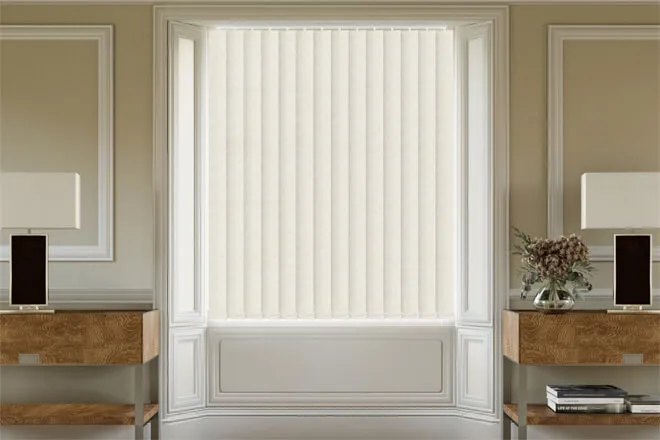
Unbeatable Blinds groups this fabric under its "shadow pattern" label, and the name suggests what a subtle vertical pattern should do: sit close enough in tone to the base colour that it reads as texture from across the room and only reveals itself up close. That is the kind of design that survives being cut into vanes and rotated, because there is no motif for the joins to interrupt.
The palette is narrow in hue and broad in shade. Every finish is a neutral - white, cream, ivory, chalk, beige or grey - paired with a design name, so Ana comes in Beige and White, Isabelle in Beige, Grey and White, Paige in Cream, Light Grey, Ivory and White, and so on through Camilla, Emily, Grace, Hayley, Jessica, Lucy, Madeline, Mila, Olivia and Taylor. In practice you choose a design, then a shade of it. That structure is useful if you have more than one window to dress: the same pattern in white for a north-facing room and cream for a sunny one keeps a house coherent without being identical.
The retailer does not call this range blackout and the range name gives no opacity class, so treat it as a light-filtering or dimout fabric until you have checked the product page or a swatch. The from-price is £5.94.
Compared with Candy Stripe, this is the pick for anyone who wants the blind to be the backdrop rather than the feature. Compared with Excel, it offers less variety of character and more variety of shade. For a rented house, or a room whose colour scheme is likely to change, that restraint is the point.
Best bold pattern: Candy Stripe Onyx 89mm Daylight Vertical Blind
Candy Stripe Onyx Daylight Vertical Blinds
at Order Blinds
Candy Stripe Onyx Daylight: a vertical from Order Blinds with a broad palette.
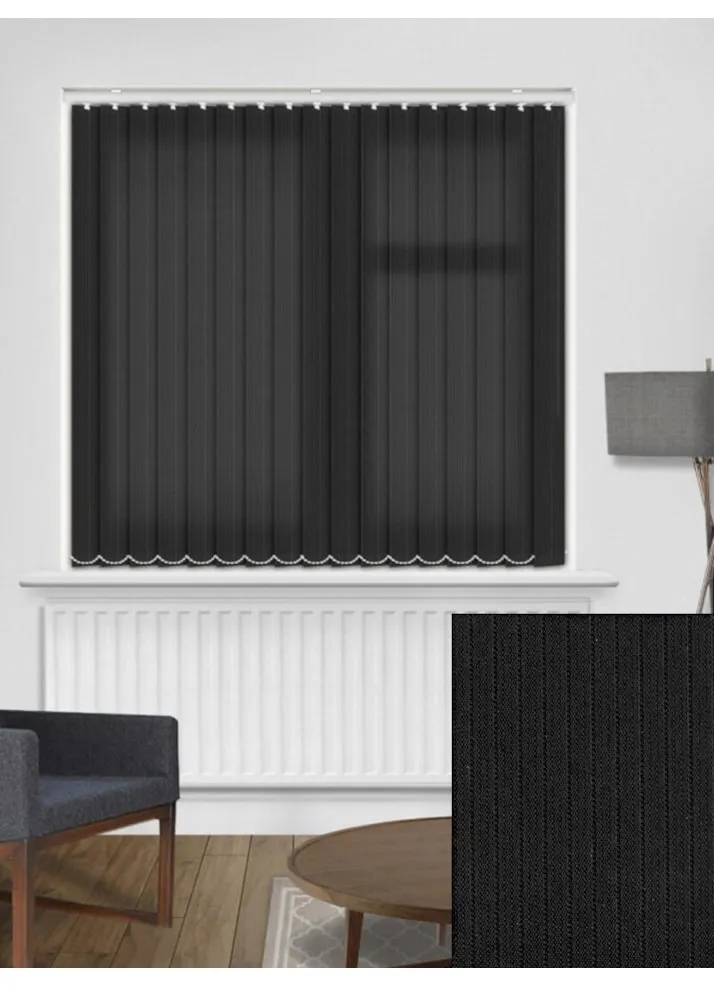
Order Blinds sells Candy Stripe in Onyx, Cream, Graphite and Frost colourways, and a stripe is the most forgiving bold pattern you can put on a vertical. The stripes run with the vanes, so the joins between them become another line in the pattern rather than a break in it. Turn the vanes to let light in and the stripes compress; turn them closed and they widen back out. Few other bold designs survive that treatment.
The title specifies 89mm vanes, the narrower of the two common widths. That means more vanes across a given window and more joins, which is exactly where a stripe earns its keep over a large motif. "Daylight" is the retailer's term for the fabric, and it is not sold as blackout, so this is a living-room, office or conservatory blind rather than a bedroom one. For a conservatory, the Cream and White options in the range will reflect more summer heat than the darker colourways.
The stripe is the headline, but the range carries a set of companion designs under names such as Foliage, Hedera, Salix, Gridlock, Hopscotch, Rope, Pearls, Crystalline, Mirage, Tidal, Zyon and Dior, most in Cream and White, with Foliage also offered in Black and Graphite. The names are suggestive, but we would check a swatch before reading too much into them. Order Blinds also appears to list several of these designs as roller fabrics, which could be useful if you have a narrow window beside the patio door and want it to match. Confirm that on the product pages rather than taking it on trust.
The from-price is £9.80. Against Ana Beige this is the opposite choice: a blind that is meant to be noticed. Against Excel it is more decisive, with the stripe as a clear starting point and the companion prints as alternatives if you decide stripes are too much.
What we didn't include
The guide stops at patterned fabric verticals, and that rules out several neighbouring categories on purpose. Plain verticals are a different decision, driven by colour and opacity rather than design, and they have their own guide. PVC and wipe-clean verticals for kitchens and bathrooms are chosen for moisture resistance first, and pattern is rarely the deciding factor there. Blackout verticals are omitted because none of our picks is sold as blackout, and because the overlaps between vanes mean a vertical is rarely the best route to a dark room.
We also left out large-motif prints as a category. A floral or geometric design wider than a vane fragments when the blind is rotated, and most of the time it looks better on a roller or roman blind where the fabric hangs as one sheet. The three picks here are the kinds of pattern that work with the mechanics of a vertical rather than against them.
Price by your window
A from-price tells you where a range starts, which for a vertical blind is usually a modest window rather than the patio door most buyers have in mind. Each pick's page carries a price grid by width and drop, so measure your opening in millimetres, decide between an inside and an outside fit, and read off the figure for the size you actually need. Comparing the three picks at your own dimensions is more useful than comparing their from-prices, because the gap between ranges can widen or narrow as the blind gets bigger.