
As the days lengthen through spring and early summer, the nursery window becomes one of the most urgent decorating problems in the house. A room that was serviceable in December can flood with light by five in the morning, wrecking nap schedules and shortening nights. This guide covers three different approaches - a blackout roller for absolute darkness, an illustrated roman for rooms where the blind is part of the decor, and a day-and-night roller for parents who want flexibility rather than an on/off switch. We focus on made-to-measure ranges that can be fitted to a specific window; we haven't included ready-made cut-down blinds.
What blackout actually means in a nursery
"Blackout" is used loosely by retailers. Strictly, a blackout fabric is opaque to a backlight test - you hold it to a bright light and see no glow through the material itself. Most fabric sold as blackout in the UK meets this test. The problem is that a blackout fabric doesn't produce a dark room on its own, because light leaks around the edges of the blind wherever there's a gap between the fabric and the window recess.
In a nursery, edge leak matters more than in a bedroom you share as an adult - babies and toddlers are more sensitive to residual brightness, and a thin bar of morning light on the ceiling is often enough to end a nap. The practical options for reducing edge leak are: fitting outside the recess so the blind overlaps the wall on all sides; using a perfect-fit frame on UPVC windows (the blind clips into a frame that presses against the window's rubber seal, eliminating gaps at the sides); or pairing a blackout blind with blackout curtains that cover the surround. None of these is a complete solution on its own - the best outcomes usually combine a blackout fabric with an outside-recess fit or curtain overlay.
Blackout fabric is also heavier than standard roller fabric and hangs flat without draping or sagging, which matters in a room where the blind will be raised and lowered multiple times a day.
Cord safety: the non-negotiable
Any blind going into a nursery or child's bedroom must be cord-safe. UK regulations (BS EN 13120) have required cord-safe design for domestic blinds since 2014. In practice, this means the blind should operate without a free-hanging looped cord within reach of a child. The common solutions are cordless operation - where the blind is pushed up or pulled down by hand - wand control, where a rigid wand replaces the dangling cord, or motorised operation with no cord at all.
When ordering, confirm the cord-safety mechanism explicitly rather than assuming it. Reputable retailers include a child-safety device as standard or allow you to choose a cordless or wand option at the product level. If a listing doesn't mention cord safety, ask before ordering.
What to look for
Blackout versus adjustable. The nursery blind decision often comes down to whether you want full darkness at all times or the ability to let some light in during the day. A blackout roller gives you a clear on/off - fully down blocks the light, fully up lets it in. A day-and-night roller gives you a middle state: striped alternating sheer and opaque bands that you can align for privacy-with-light or stagger for near-darkness. Neither is better in the abstract; it depends on your sleep routine and how the room is used during the day.
Roman blinds for decor-conscious rooms. A roman blind stacks in neat horizontal folds at the top of the window when raised, giving a softer, more finished look than a roller in the same position. The trade-off is that roman blinds stack at the top, reducing the visible window area when fully raised, and they're generally more expensive than rollers of equivalent width. In a nursery where the fabric pattern is part of the room's visual identity, that extra cost can be worth it.
Colour palette and longevity. Nursery blinds have a short use-life if you choose a strongly themed fabric - character prints and pastel-specific palettes often need replacing as the child grows. Neutrals and illustrated patterns that aren't age-specific tend to last longer. This is a judgment call, but worth making consciously.
Measuring. Measure the recess width and drop accurately before ordering. For inside-recess fitting, you'll usually need to deduct a few millimetres from the recess width to allow the blind to operate without catching the sides - the retailer will specify the exact deduction. For outside-recess fitting, decide how much overlap you want on each side (typically 5-10cm per side adds meaningfully to light-blocking at the edges).
Care. Polyester roller fabrics can be spot-cleaned with a damp cloth and mild detergent. Roman blinds in natural-fibre fabrics need more careful handling - vacuum with a brush attachment rather than wiping, and follow the retailer's specific care instructions. In a nursery where condensation and milk splashes are a fact of life, a wipe-clean polyester roller is more practical than a dry-clean-only roman.
Our picks


Orion Roller Blinds
at 247 Blinds
A blackout-lined Trinity roller from 247 Blinds for daytime naps.

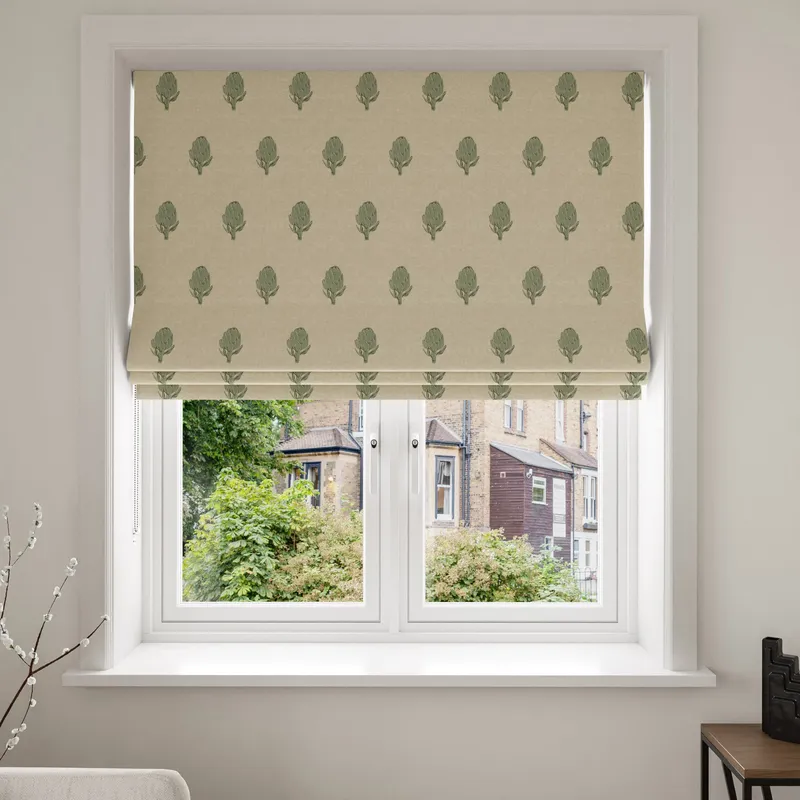
Emily Bond Roman Blinds
at Blinds By Post
Emily Bond illustrated prints in a soft roman from Blinds By Post.


Enjoy Day and Night Blinds
at Blinds 2go
A day-and-night roller from Blinds 2go to ease the room between light and dark.
Pick details
Orion Roller Blinds
at 247 Blinds
A blackout-lined Trinity roller from 247 Blinds for daytime naps.
The Trinity (Blackout) from 247 Blinds is a blackout-rated roller in a wide colour range. The range covers 41 colourways, running from neutral options like Ivory, Oyster Grey, Stone, and Cotton White through to stronger choices including Navy, Teal, Soft Pink, and Cosmic Black. That breadth means you can match an existing nursery palette without compromise, which isn't always possible with blackout-specific ranges that tend to skew neutral.
As a roller blind, it operates via chain mechanism and sits flat against the window when down. For a nursery where the blind is raised and lowered several times a day for naps and bedtimes, that simplicity has practical value - there are no folds to readjust and no vanes that can swing out of alignment. The fabric, described by 247 Blinds as blackout, will block light transmission through the material; combine with an outside-recess fitting or blackout curtains to address edge leak if full darkness is the goal.
The starting price is modest at £9.72, though the final cost depends on your window dimensions - wider and longer windows will cost proportionally more. As with all made-to-measure blinds, quote your actual measurements rather than cutting down a ready-made size.
Emily Bond Roman Blinds
at Blinds By Post
Emily Bond illustrated prints in a soft roman from Blinds By Post.
Emily Bond is a UK illustrator whose work spans botanical, animal, and landscape subjects in a palette that reads as considered rather than childish. The Blinds By Post roman range carries 17 prints and colourways, including globe fern, jaipur pollen, yew tree fern, Fred linen, and peggy smoke - names that indicate prints and patterns rather than plain colour blocks. Three variants are flagged as premium and priced accordingly: George Stripe Linen, George Stripe Indigo, and Oscar Stripe Raspberry.
A roman blind in this context is chosen for rooms where the blind is a visible design element rather than a purely functional one - the folds add texture and the print has presence when the blind is down. The format stacks neatly at the top when raised, though it does reduce the visible window area slightly more than a roller would. Roman blinds are generally heavier to operate than rollers, and the cord or wand mechanism needs to be selected with cord safety in mind for any child's room.
The range is listed as no-drill, which is worth noting for renters or anyone reluctant to fix brackets into a window frame. No-drill fittings typically use tension or adhesive systems; check the fitting method with the retailer for your specific window type before ordering. This is not a blackout range - the fabrics are decorative and will filter rather than block light - so it's best suited to a nursery used primarily during daylight hours, or paired with curtains for darker evenings.
Enjoy Day and Night Blinds
at Blinds 2go
A day-and-night roller from Blinds 2go to ease the room between light and dark.
The Enjoy Roller Blind from Blinds 2go is a day-and-night (also called vision or zebra) blind - a double-layer roller with alternating horizontal bands of sheer and opaque fabric. When the bands are aligned, the opaque stripes overlap and the blind approximates blackout through the material. When staggered, the sheer stripes open and the room gets diffuse natural light with a degree of privacy from outside. The transition between the two states is smooth and can be stopped at any point.
In a nursery, this flexibility suits the transition period when a child starts to use the room during the day for play as well as sleep - full alignment for naps, partial stagger for waking hours. It's a more nuanced tool than a standard blackout roller, though it's worth noting that even fully aligned, the blind won't match the edge-blocking properties of a dedicated blackout fabric with an outside-recess fitting. If complete darkness is the primary goal, the Trinity blackout roller is the stronger choice for that specific function.
The Enjoy range from Blinds 2go covers 19 colourways, ranging from neutral options like Matte White, Soft White, and Cream through mid-tones including Light Grey, Almond, and Sandy Beige to darker choices like Midnight Blue and Dark Wood. Starting from £12.92, it sits in a similar price bracket to the Trinity roller; the specific cost again depends on your window dimensions.
What we didn't include
We focused this guide on three distinct approaches - full blackout, decorative print, and adjustable day-and-night - rather than widening the picks list with further examples of the same types. Motorised nursery blinds exist and are genuinely useful (no cord at all removes the child-safety problem entirely, and remote operation is convenient for a sleeping child's room), but they sit at a noticeably different price point and represent a separate buying decision. We didn't include them here because the price difference is large enough that they need separate consideration rather than inclusion in a comparison that starts under £15.
We also didn't include perfect-fit blinds as a separate pick. Perfect-fit is a fitting method - the blind clips into a frame that grips the rubber seal of a UPVC double-glazed window - rather than a distinct blind type. Any of the roller options above can potentially be ordered with a perfect-fit mechanism if your windows are UPVC with a suitable recess depth; it's worth asking the retailer whether their perfect-fit frame is available for the specific range you're considering.