
Floral blinds sit at the intersection of practical window covering and fabric statement. Whether the appeal is a classic botanical repeat, a country-house print, or an illustrated botanical drawing, the blind carries a room in a way that a plain roller never will. All three picks in this guide are roman blinds - the type that folds into horizontal pleats when raised - because romans are the natural home for decorative fabric: the flat panel when lowered shows off a pattern without distortion, and the structured folds when raised keep things tidy. This guide covers three distinct design languages in that format, all supplied by Blinds By Post.
What makes a roman blind work with pattern
A roman blind is a panel of fabric that folds concertina-style into horizontal pleats as it rises. Unlike a roller, which winds the fabric onto a tube and can compress or misalign a print, a roman keeps the fabric flat when down. That matters for pattern work: a large botanical repeat reads cleanly, a detailed illustration stays legible, and a printed border lands exactly where it was designed to.
The practical trade-off is stack. When a roman is fully raised, the folded fabric sits at the top of the window and takes up some of the glass. The deeper the drop, the more stack you lose to the mechanism. For most rooms this is not a problem - you raise the blind to let in light, and a bit of the top of the window isn't critical. But if you need the entire window clear, a roller gives more of the glass back.
Fabric matters too. Roman blinds commonly use cotton, linen, or cotton-linen blends - heavier and more textured than the polyester typical of roller blinds. These natural and semi-natural fibres suit decorative printing well and give a softer, less commercial look when hanging. The three ranges covered here all use this kind of fabric construction, which is why they're positioned in the decorative end of the market rather than the functional.
No-drill fitting appears across all three picks. Blinds By Post uses a specific no-drill mechanism - the "Aura" system on the Laura Ashley range - that clips the blind to a UPVC window without drilling into the frame. This is distinct from Perfect Fit, which grips the rubber gasket of the window's glazing. No-drill systems typically attach to the face of the frame rather than clipping into the seal, so compatibility depends on your window type. Check the retailer's fitting guide for your specific frames before ordering.
What to look for
Pattern scale and room size. A large repeat looks strong on a wide window but can feel over-scaled on a narrow one. The illustrated ranges in this guide - Emily Bond especially - tend to have smaller, more contained motifs that work across a wider range of window sizes. Laura Ashley's collection spans both large botanicals and smaller geometric-adjacent prints, giving more room to match pattern scale to window.
Colour range. Floral blinds are rarely bought in isolation. You're usually matching or complementing upholstery, wall colour, or curtains already in the room. The Laura Ashley range here runs to nearly 200 colour variants across its full selection - navy, duck egg, sage, rose, and a wide neutral range. Sophie Allport's 19 variants are more restrained and sit mostly in country tones: mustard, teal, duck egg, blush, and sage. Emily Bond's 17 variants lean towards a cooler, more illustrator-influenced palette of indigo, fern, pollen, raspberry, and linen.
Premium variants. Some finishes within these ranges carry an extra charge - marked as premium. Within the Laura Ashley selection, roughly 135 of the 198 finishes carry this premium, meaning the more desirable colourways tend to cost more. Emily Bond's range has three premium variants (the George Stripe finishes and Oscar Stripe Raspberry). Check the specific finish price when ordering.
Light control. Floral fabrics in these ranges are decorative rather than blackout - the fabric weights and constructions are chosen for visual quality, not opacity. If blackout performance is a priority, a separate blackout lining is worth discussing with the retailer. Without a lining, these fabrics will let some light through, which is fine for living rooms and most daytime-use spaces but worth noting for bedrooms.
Sizing. All three ranges are made-to-measure. You measure your window recess width and required drop, and the blind is cut to those dimensions. Standard UK convention is width first, then drop, both in millimetres. If you're fitting inside the recess, measure the recess width precisely. If fitting outside (mounted to the wall above the window), add enough extra to cover the frame and any edge-gap you want to block.
Care. Cotton and linen-blend roman fabrics should be vacuumed with a brush attachment and spot-cleaned rather than soaked. Avoid taking them down to machine wash unless the retailer specifically says the fabric is suitable - most decorative roman fabrics are not.
Our picks

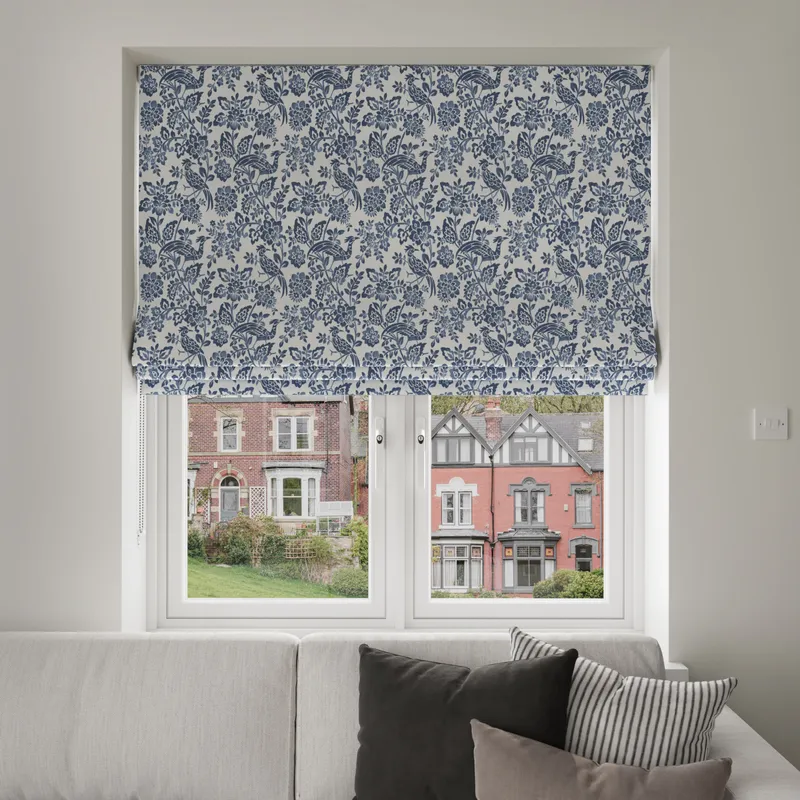
Laura Ashley Roman Blinds
at Blinds By Post
Laura Ashley florals in a no-drill roman from Blinds By Post.
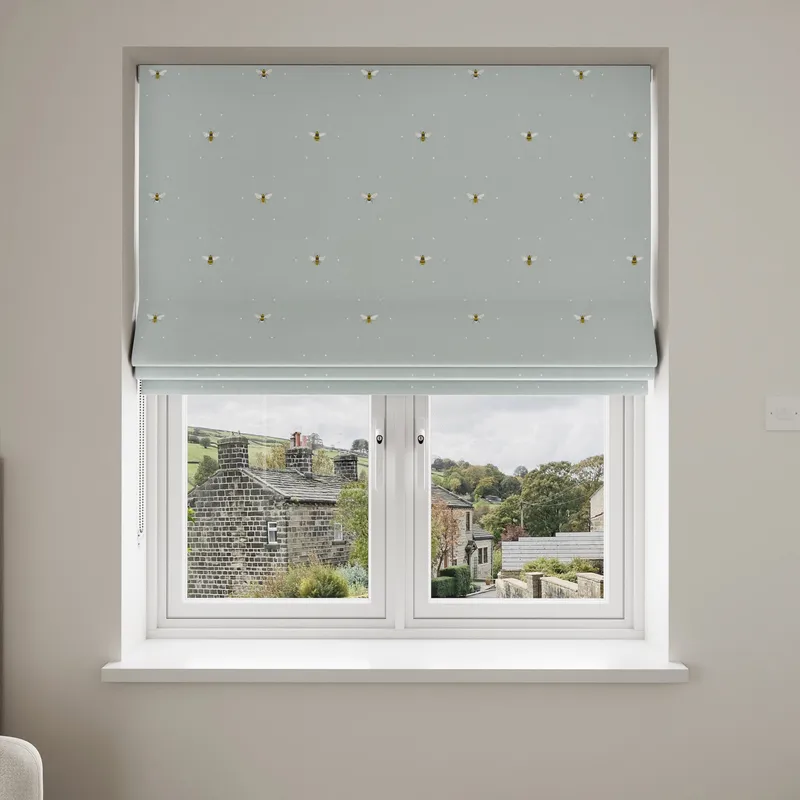
Sophie Allport Roman Blinds
at Blinds By Post
Sophie Allport country florals in a no-drill roman from Blinds By Post.

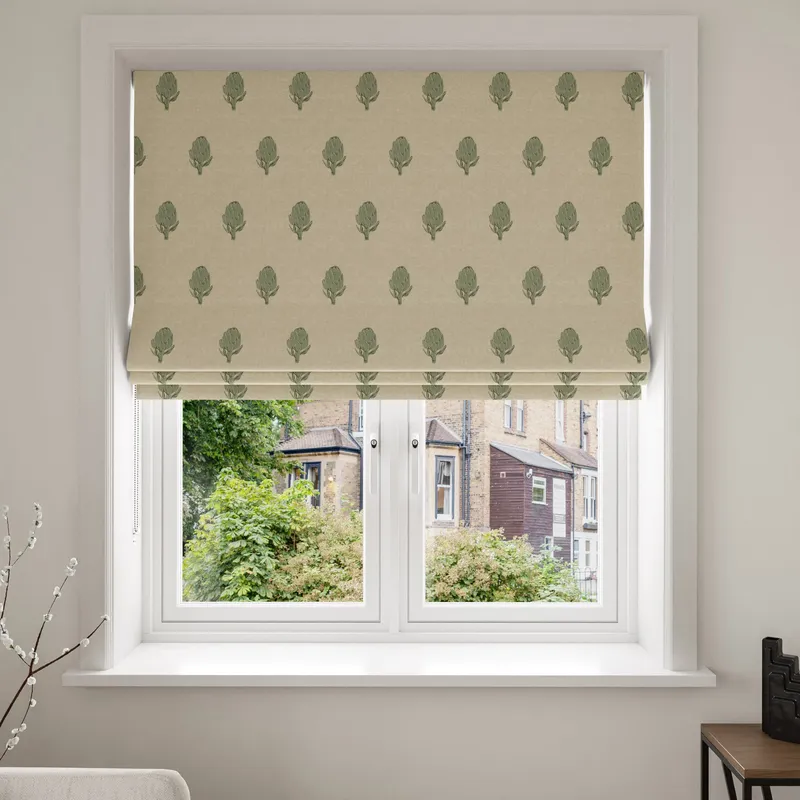
Emily Bond Roman Blinds
at Blinds By Post
Emily Bond illustrated botanicals in a roman from Blinds By Post.
Pick details
Laura Ashley Roman Blinds
at Blinds By Post
Laura Ashley florals in a no-drill roman from Blinds By Post.
The Laura Ashley range at Blinds By Post is the most extensive of the three picks by some margin - nearly 200 colour and pattern variants - and it earns the "Best classic" label because Laura Ashley's botanical and heritage prints represent a long-established design tradition in UK soft furnishings. The prints span several distinct families: botanical florals, paisley and medallion patterns, stripes, and a few geometric-adjacent weaves. Colour coverage is thorough: navy and dark blues, sage and bottle greens, duck egg and teal, neutrals in dove grey and linen, and a solid warm range including rose, coral, and mustard.
The no-drill mechanism here is the Aura system, which is specific to this range. This means the fitting works without drilling into the frame - useful for renters or anyone with UPVC windows they don't want to damage. It's worth comparing the Aura's clip-in mechanism details to your specific frames before ordering.
Compared to the other two picks, the Laura Ashley range is the broadest design scope. Sophie Allport offers a more tightly curated country palette; Emily Bond is the most illustrator-driven and smallest in variant count. If you want to see a large selection before committing, Laura Ashley gives the most options to shortlist from, though that breadth also means more filtering work.
Sophie Allport Roman Blinds
at Blinds By Post
Sophie Allport country florals in a no-drill roman from Blinds By Post.
Sophie Allport's range at Blinds By Post has 19 variants and earns the "Best country" pick because the prints are explicitly country in character: bees, sheep, dragonflies, hares, and fairground ponies, rendered in a style that sits well in farmhouse kitchens, cottage living rooms, and country-house bedrooms. The colour palette is warm and nature-toned - teal, duck egg, mustard, blush, sage, sand, and pebble grey - without straying into anything urban or graphic.
The Sophie Allport range is also no-drill via Blinds By Post's mechanism. With 19 variants, you're choosing within a tighter edit than the Laura Ashley or Emily Bond ranges, but that restraint tends to mean fewer wrong choices: every finish has been selected to work together as a coherent family.
Against the Laura Ashley pick, Sophie Allport is the more specialist choice - if the country-house animal print aesthetic suits your interior, it does the job distinctly. Against Emily Bond, both are illustrator-influenced, but Sophie Allport is warmer and more pastoral while Emily Bond is cooler and more botanical-graphic. Price-from is the same as Laura Ashley (both from £20.57 at time of listing).
Emily Bond Roman Blinds
at Blinds By Post
Emily Bond illustrated botanicals in a roman from Blinds By Post.
Emily Bond's range at Blinds By Post covers 17 variants and is the "Best illustrated" pick. The designs are illustrator-driven botanicals and named characters - Globe Fern, Yew Tree Fern, Jaipur Pollen, Fred Linen, Peggy Smoke - with a palette that pulls towards indigo, fern green, pollen yellow, raspberry, and linen neutrals. Three finishes carry a premium (George Stripe Indigo, George Stripe Linen, Oscar Stripe Raspberry), reflecting the added print complexity of the stripe designs.
The Emily Bond range is the smallest of the three in variant count, which makes it the easiest to review quickly. The designs are more botanical-precise than Sophie Allport's animal motifs and more illustrator-distinct than the heritage florals of Laura Ashley. If you're choosing between a statement botanical that reads as art-influenced and a pattern that reads as more traditional, Emily Bond sits clearly in the former.
Price-from here is slightly higher than the other two (from £21.94 versus £20.57), reflecting the premium on certain finishes. No-drill fitting applies as with the other Blinds By Post picks in this guide.
What we didn't include
All three picks are roman blinds from Blinds By Post. Roller blinds also carry printed florals - there are ranges across several UK retailers with botanical and garden-themed prints - but the roman format suits decorative fabric better for the reasons discussed above, and keeping the format consistent makes comparison between the three picks more direct.
We also kept to named-designer ranges rather than own-brand floral prints. There are plenty of own-brand floral rollers and romans available, but the three picks here each have a design identity that anchors the buying decision in a way that a generic garden print doesn't. The choice between classic, country, and illustrated is a real distinction; the choice between three own-brand florals of similar quality is harder to make useful editorial sense of.