
Faux wood venetian blinds occupy an interesting position in the UK market: they look broadly similar to real-wood venetians but are made from PVC rather than timber, which means they handle moisture without warping and typically cost less. If you're drawn to the chunky 50mm slat look of a wooden venetian but fitting in a kitchen, bathroom, or any room that sees condensation, faux wood is the more sensible material choice. This guide covers three made-to-measure ranges at different price points - a value option, a 50mm specialist, and a premium range with a tighter but distinctive palette.
What faux wood actually means
Faux wood venetian slats are moulded from PVC and given a surface texture and colour intended to suggest timber grain. The quality of that impression has improved considerably over the years: older faux-wood blinds often looked visibly plastic at close range, whereas current ranges in this category are harder to distinguish from mid-range real-wood venetians without handling the slat.
The practical differences between faux wood and real wood are significant. Real wood venetians - typically made from basswood - are not suited to bathrooms or kitchens because the timber absorbs moisture, which causes warping and surface discolouration over time. Faux wood is genuinely moisture-tolerant: the PVC core doesn't absorb water, so repeated exposure to steam or condensation doesn't damage the slat. For bathroom windows in particular, faux wood is the more logical choice unless you're prepared to treat the blind as a cosmetic item with a limited lifespan.
Faux wood venetians are commonly sold with 50mm slats, which is wider than the 25mm standard for aluminium venetians. The broader slat gives a bolder, more substantial look and means fewer slats are visible at any given drop, which some rooms suit better than the finer grid of a 25mm blind. All three picks in this guide use 50mm slats.
Light control works the same way as any venetian: tilt the slats to admit angled light or close them for maximum privacy. In the closed position, overlapping 50mm slats are effective at blocking direct sunlight, though they won't produce the edge-sealed darkness of a blackout roller with side channels.
What to look for
Slat width. Faux wood venetians are almost exclusively sold in 50mm or 63mm widths. The 50mm slat is the more common and more versatile; 63mm gives a more pronounced horizontal stripe effect that suits larger windows. All the picks here use 50mm.
Colour palette and texture. Faux wood ranges split between those that imitate specific timber tones - oak, walnut, darker wood stains - and those that offer painted or near-white finishes that read more as contemporary venetians than wood-look blinds. Some ranges offer both. The finish names are often the most useful guide: "Classic Oak" and "Warm Oak" are timber imitations; "Snow" and "Glacier" are white or near-white. Check whether you want a wood-grain effect or a cleaner, painted appearance, and look at the finishes accordingly.
Price range. Faux wood venetians span a wider price range than aluminium venetians. Entry prices run from around £11 to over £42 at the from-price level, and these differences reflect real differences in slat weight, headrail construction, and finish quality. A lower-priced range may clean and perform identically in a utility room; in a living room where the blind is a visible design element, the weight and surface of a mid-range or premium slat can matter.
Room suitability. For kitchens, bathrooms, and any humid room, the moisture-tolerance of faux wood is the key advantage over real wood. For living rooms and bedrooms, real wood and faux wood both perform well, but if you want the warmest-looking timber grain, a real-wood venetian may still look more convincing at close range. For rooms combining style and humidity tolerance, faux wood is the clearer choice.
Fitting. Faux wood venetians with 50mm slats are heavier than 25mm aluminium venetians of the same size. For a very wide window, confirm the blind's weight and whether the headrail fixings are appropriate for the substrate - a wide faux-wood venetian across a full bay window can be substantially heavier than the equivalent roller blind. Inside-recess fitting requires sufficient recess depth for the headrail, typically at least 5-6cm; outside fitting is more forgiving.
Cleaning. Faux wood cleans the same way as aluminium: damp cloth, mild detergent for grease. The advantage over real wood is that you don't need to be cautious about moisture. You can wipe faux-wood slats more assertively, which makes them practical in kitchens where grease and steam are both present.
Our picks

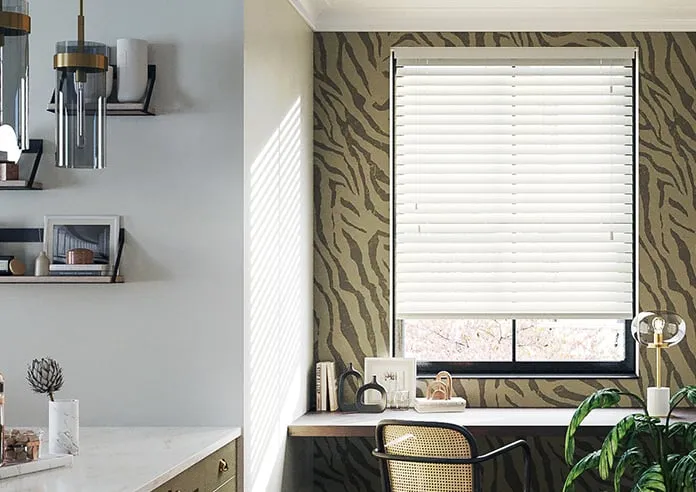
Ecowood Venetian Blinds
at 247 Blinds
An Ecowood faux-wood venetian from 247 Blinds that shrugs off damp better than real timber.


Wooden Venetian 50mm Blinds
at Blinds 2go
A 50mm wood-look venetian from Blinds 2go with a deep slat.

Wooden Venetian 50mm Blinds
at So Easy Blinds
A premium wood-look venetian from So Easy Blinds.
Pick details
Ecowood Venetian Blinds
at 247 Blinds
An Ecowood faux-wood venetian from 247 Blinds that shrugs off damp better than real timber.
The Ecowood Deluxe from 247 Blinds is the most accessible entry point in this guide, with an entry price of £11.65 for a small made-to-measure window. Its 12 finishes cover the core faux-wood palette - whites, creams, and greys - with most available in both Fine Grain and Satin surface textures. That distinction is worth paying attention to: Fine Grain gives the more timber-like surface, while Satin has a smoother, slightly more contemporary finish. If you're fitting in a room where you want the blind to read clearly as a wood-look venetian, Fine Grain is the appropriate choice; for a more neutral modern look, Satin may suit better.
The colour range is deliberately practical. Cottonwood, Devon Cream, Beachwood, and Chenille are warm neutrals that sit alongside most interior colour schemes; Blizzard Grey, Chic Grey, and Silverwood cover the grey side; Absolute White and Brilliant White address the market for bright-white venetians in both texture variants. This isn't a palette for rooms where you want the blind to be a statement, but it covers the most common requirements without unnecessary complexity.
Compared to the Metropolitan and Starwood, the Ecowood Deluxe is the pick when budget is the primary consideration. For a bathroom, utility room, or kitchen where you want a moisture-tolerant venetian at a low entry price, it does what faux wood is supposed to do without the cost of a more premium range.
Wooden Venetian 50mm Blinds
at Blinds 2go
A 50mm wood-look venetian from Blinds 2go with a deep slat.
The Metropolitan from Blinds 2go takes a different approach to the Ecowood Deluxe: rather than offering individual slat colours, it sells the blind as a coordinated two-tone combination - slat colour paired with tape or ladder colour. Seven combinations are available: Snow & Parchment, Snow & Stone, Classic Oak & Oatmeal, Classic Oak & Buff, Midnight & Onyx, Thunder Grey & Stone, and Vanilla & Oatmeal. The result is a range where the design decision is partly made for you, and where the ladder tape is visible as a design element rather than something to minimise.
This is worth understanding before ordering: in a standard venetian the ladder cord is functional and relatively unobtrusive; in the Metropolitan, the contrasting tape is a deliberate visual feature. It reads as a more considered, designed blind rather than a purely functional one. Whether that suits your room depends on how prominent you want the tape detail to be against the slat.
The entry price of £18.36 sits between the Ecowood Deluxe and the Starwood. For a 50mm faux-wood venetian where you want a specific two-tone combination and the coordinated tape look, the Metropolitan is the pick. It suits living rooms and dining rooms where the blind is part of the room's visual scheme. For utility rooms or bathrooms where function matters more than the tape detail, the Ecowood Deluxe at a lower price is the more appropriate choice.
Wooden Venetian 50mm Blinds
at So Easy Blinds
A premium wood-look venetian from So Easy Blinds.
The Starwood from So Easy Blinds is the highest entry price of the three picks at £42.43, and its eight finishes - Bali, Glacier, Pavilion, Soho, Volt, Empire, Marlin, Divine - are named abstractly rather than describing a colour or timber tone directly. This signals a range positioned around a particular aesthetic rather than a broad palette: the names suggest a curated selection where each finish has been chosen for a specific effect.
The Starwood is the range to consider when the blind is a visible focal point and you want a faux-wood venetian with a noticeably different finish quality from the value end of the market. At this entry price, the retailer is offering something that reflects the cost difference - the slat weight, finish, and overall construction are what distinguish a premium range from a value one in this category. That difference is most legible in a living room or bedroom where the blind is at eye level and the slat surface is closely visible; in a bathroom or utility room, you're unlikely to see a meaningful return on the price premium over the Ecowood Deluxe.
The Starwood's entry price is a from-price for a small window; at larger dimensions it will scale accordingly, and the cost gap relative to the other picks will widen. If budget is a constraint and the room is a functional one, the Ecowood Deluxe is the more straightforward recommendation. If you're fitting in a main living space and the blind forms part of the room's intended finish, the Starwood warrants consideration.
What we didn't include
This guide focuses on faux-wood venetians rather than real-wood venetians, and that distinction matters. Real-wood venetians - typically basswood slats - are available from many of the same retailers and often sit at similar or higher price points than faux wood. We addressed faux wood specifically because the moisture-tolerance question is the most common reason buyers choose it over real wood, and covering both categories in one guide would dilute the clarity of that recommendation. If you're fitting in a dry room and want the most convincing timber look, a real-wood venetian is worth comparing directly against the Starwood.
We kept the list to three ranges. Ready-made faux-wood venetians in fixed sizes are available from various sources, but they fall outside the made-to-measure focus of this guide. If you're measuring a non-standard window, a made-to-measure range gives you considerably more control over fit and finish.