
A conservatory without blinds is fine for about three weeks a year. From late April onwards, south-facing glass roofs turn the space into a greenhouse; in winter, an uninsulated glass box loses heat fast. The right blinds address both problems, but a conservatory has three quite different glazing challenges - the overhead roof, the full-height side windows, and the frame-mounted fixed panes - and each calls for a different product. This guide covers all three, using only the ranges we've looked at in detail.
What "conservatory blinds" actually covers
The phrase gets used loosely, so it's worth unpacking before you shop.
Roof blinds are the specialist product. Conservatory roofs are usually made up of multiple angled glass or polycarbonate panels in a Georgian or Edwardian frame. Blinds for these panels have to fit shaped sections at a slope, often without a flat wall to mount a bracket against. Most are pleated or accordion-folded fabric that runs in side channels to stay taut at any angle. They are significantly more expensive than standard window blinds, and fitting them is more involved.
Side window blinds for a conservatory are, in most cases, standard blinds fitted to standard windows - the glazing just happens to be in a conservatory. Vertical blinds are common here because conservatory side windows are often wide, floor-to-ceiling spans that suit a vertical track better than a roller or venetian. The real difference from a living-room window is that conservatory side glazing gets more direct sun and more temperature fluctuation, so fabric choice matters more.
Perfect-fit blinds clip into the rubber gasket of UPVC double-glazed windows without drilling. They suit conservatory side frames well because many conservatories are built entirely in UPVC, the clip-in fitting is clean and reversible, and the no-drill approach avoids any risk to the frame seals.
Thermal performance deserves its own note. Cellular or honeycomb blinds - where the pleated fabric forms sealed air pockets between layers - offer measurably better insulation than a single layer of fabric. For a conservatory that's cold in winter, that structure makes a real difference. For summer heat, the most useful property is light colour: lighter fabrics reflect more solar energy than dark ones. No blind type eliminates heat gain through glass entirely, but the combination of reflective colour and thermal structure helps.
What to look for
Roof compatibility. If your conservatory has a glazed roof, roof blinds need to be matched to the frame manufacturer and glazing bay shape. Some ranges list specific compatibility (Dakstra, Fakro, Rooflite are common roof-window manufacturers). Measure each panel individually - conservatory roofs are rarely uniform. Check the retailer's minimum and maximum dimensions carefully; odd-shaped or very large panels sometimes fall outside the standard range.
Thermal vs light-blocking trade-off. These aren't the same thing. A blackout roof blind stops light and some heat. A thermal blind with a structured honeycomb construction reduces heat loss in winter. For a conservatory used year-round, the ideal answer involves both - a roof blind that handles summer glare and side blinds that help retain warmth in winter. If you're prioritising one season, let that drive your choice.
Perfect-fit fitting for UPVC frames. The perfect-fit system clips directly into the rubber seal of a UPVC double-glazed unit. It sits flush with the glass, leaves no gap at the edges, and doesn't require a single drill hole. For conservatory side frames this is often the cleanest option - UPVC frames are usually deep enough for the clip-in bracket, the fit is snug, and you're not committing to any permanent fixings. The limitation is that perfect-fit only works on UPVC with the right rubber gasket profile; wooden-framed conservatories need a conventional fitting.
Vertical blinds for wide side windows. A standard conservatory side wall might run 2-3 metres wide with a floor-to-ceiling drop. A roller blind at that width becomes heavy and awkward to operate; a venetian at that width is a cleaning problem. Vertical blinds handle wide spans well - the vanes slide along a top track and rotate to control light, and the mechanism scales up to wide openings without the weight issues a fabric roller would have.
Fabric durability in direct sun. Conservatory glazing concentrates UV. Cheaper roller fabrics fade faster in direct sun than purpose-made conservatory fabrics. Polyester holds up better than cotton or linen in this respect. If you're fitting side blinds in a south-facing conservatory, it's worth checking whether the retailer notes anything about UV resistance in the product description rather than assuming a standard roller fabric will last as long as it would in a north-facing bedroom.
Colour and heat. For the roof, lighter colours (ivory, chalk, grey) reflect more solar radiation than darker ones. If summer heat is the main problem, a cream or grey fabric will perform better than a navy or brown one at the same structural spec. This is a meaningful practical difference, not an aesthetic one.
Our picks


Duoshade Thermal Pleated Blinds
at Blinds 2go
A thermal perfect-fit blind from Blinds 2go for the side frames.

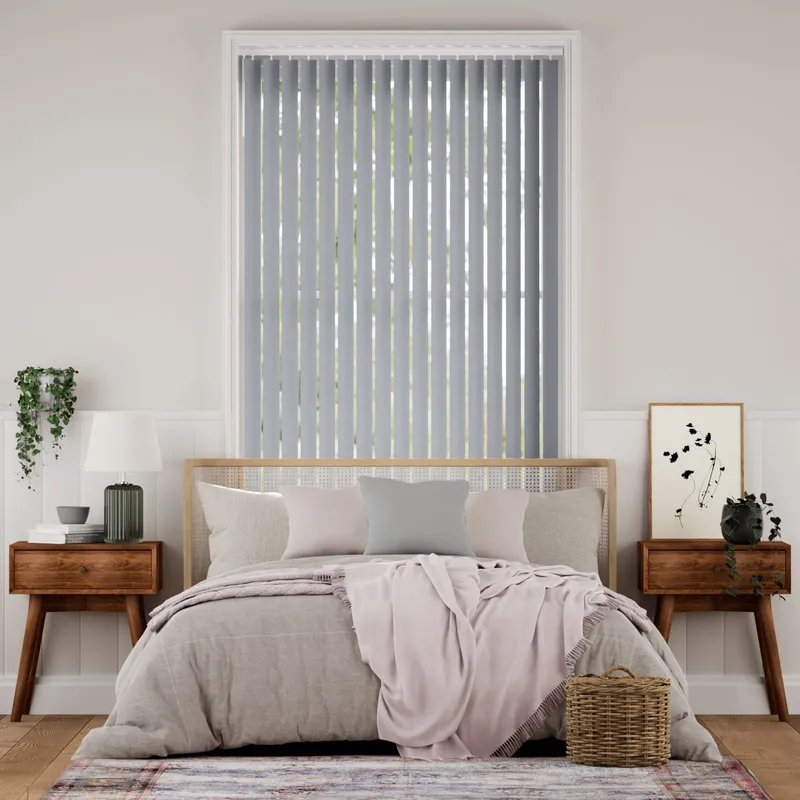
Sevilla Vertical Blinds
at Blinds 2go
A broad vertical range from Blinds 2go for the full-height side windows.
Pick details
Duoshade Thermal Pleated Blinds
at Blinds 2go
A thermal perfect-fit blind from Blinds 2go for the side frames.
The Perfect Fit Duoshade Thermal Blind from Blinds 2go is the thermal pick for conservatory side frames. "Duoshade" refers to the two-layer construction - a light-filtering layer and a blackout layer that can be positioned independently, giving you a choice between privacy with light, full blackout, or (when both layers are raised) an open window. That flexibility is more useful in a conservatory than a simple blackout roller would be, because conservatory use changes dramatically between seasons and times of day.
The "Thermal" designation refers to the backing construction rather than a basic lined roller. The retailer describes it as offering improved insulation compared to a standard single-layer blind - useful in a glass-walled room that tends to lose heat quickly in winter. This is the strongest thermal argument in the three picks, and it fits the specific challenge of a conservatory side frame.
The perfect-fit clip-in system suits UPVC conservatory frames well. There's no drilling, no visible bracket on the wall, and the blind sits flush within the glazing unit rather than projecting into the room. At 15 finishes across 20 variants - from Chalk and Ivory at the lighter end to Graphite and Anthracite at the darker end, with a Plume (purple-grey) option for those wanting something less neutral - the colour range is practical without being exhaustive. Prices start from £26.50 per blind.
The one trade-off is that perfect-fit is UPVC-specific. If your conservatory side frames are timber or aluminium, this fitting system won't work and you'd need a conventionally-fitted blind instead.
Sevilla Vertical Blinds
at Blinds 2go
A broad vertical range from Blinds 2go for the full-height side windows.
The Sevilla Vertical Blind from Blinds 2go is the pick for the full-height side windows that are common in conservatory side walls. At 25 finishes across 25 variants, it's the broadest colour range of the three picks, covering everything from Candyfloss pink and Kingfisher teal through to Brilliant White Blackout and Simply Black. Several finishes are explicitly labelled blackout - River Rock Blackout, Ink Blackout, Tranquility Twilight Blue Blackout, Tranquility Stone Blackout, Slate Blackout, Grey Blackout, Brilliant White Blackout, and Crisp White Blackout - which is a wider blackout selection than many vertical ranges offer.
Verticals suit conservatory side windows because of the width. A conservatory side wall often spans the full width of the structure, potentially 2-4 metres, with a floor-to-ceiling drop. A vertical blind's top track handles wide spans comfortably, and the vanes rotate to adjust light angle without needing to raise the whole blind - useful when the sun is low and you want to cut glare from one direction while keeping the view. The vanes on most vertical blinds have a small chain linking the bottoms to prevent swinging in draughts; this matters in a conservatory where opening doors and windows creates through-draughts more often than in a typical living room.
Starting from £9.40, this is the most accessible price point of the three picks. Vertical blind pricing scales with width, so a full conservatory side wall will cost more than that base figure, but the starting point reflects that verticals - as a category - are generally more affordable per square metre than specialist roof or perfect-fit products.
What we didn't include
We focused on three distinct conservatory glazing challenges - overhead roof panels, thermally-critical side frames, and broad side windows - because those are the decisions most people face when fitting out a conservatory from scratch. We didn't include smart or motorised blinds: they work well in conservatories where the roof is hard to reach manually, but the price and installation step-up puts them in a separate buying decision.
Plantation shutters are sometimes fitted to conservatory side windows and do provide useful light and privacy control, but they're a fixed installation rather than a blind, and the cost is substantially higher. If you're comparing shutters to blinds for a conservatory, the decision involves more than fabric choice - it's a renovation question rather than a blind-shopping question.
We also didn't include cellular or honeycomb blinds for the side windows. They perform well thermally on vertical glass, but the range we've covered in detail for the side-window slot is the perfect-fit thermal option, which handles most of the same use cases for UPVC-framed conservatories. For a conservatory with non-UPVC frames where thermal performance on the sides is the priority, a cellular blind is worth considering alongside conventional fittings.
Price by your window
All three picks are made-to-measure, so your actual price depends on the dimensions of each glazing panel or window bay. The roof blind starts from £53.51 per panel, the thermal perfect-fit from £26.50 per blind, and the Sevilla vertical from £9.40. Use the per-product size tools on each retailer's page to get an accurate quote for your specific window dimensions before comparing across the picks.