
Bifold doors are among the harder window fittings to cover with a blind. Standard roller and venetian blinds are made to hang flat and raise vertically - neither works on a folding door, where each panel moves as the door opens and needs a blind that moves with it. This guide covers three picks designed specifically for bifold doors, all from the click-fit range at Blinds 2go: a standard pleated blind, a voile pleated blind, and a slimline aluminium venetian. All are made-to-measure and designed to be fitted per panel rather than across the full door width. If you're fitting standard casement windows or sliding patio doors, separate guides cover those.
What makes bifold blinds different
A standard made-to-measure blind assumes a fixed, non-moving frame. You mount the brackets, hang the blind, and it stays where it is. Bifold doors don't work that way - the door folds back on itself when opened, meaning any blind fitted to the glass or to the door frame needs to be attached to each individual panel and fold with it.
The solution most specialist bifold blinds use is a click-fit system: a slim frame or track is fixed directly to the door panel, and the blind clips into it. When the door folds, the blind folds with it. Each panel gets its own blind, fitted to the panel's width. The result, when done well, is a blind that operates per-panel - you can lower one section and leave others up, or lower all of them simultaneously.
This is meaningfully different from fitting a standard blind across the full door width (which only works when the door is permanently closed) or relying on a curtain on a track in front of the door. Per-panel click-fit blinds are the cleaner, more practical solution for doors that are actually used.
What to look for
Fitting method. Confirm the specific fitting approach before ordering. The picks in this guide use a click-fit frame that attaches to the door panel - you'll need to fasten small brackets to the door itself. That's straightforward but worth understanding upfront, particularly on composite or painted doors where you'd prefer to avoid drilling. Check the retailer's fitting instructions before committing.
Measuring per panel. Because each blind is fitted to a single door panel, you measure the width of each panel individually, not the full door opening. Panels on a bifold door are not always identical in width - the outermost panels (which don't fold) can differ from the inner ones. Measure every panel separately and order accordingly.
Drop. Standard bifold door blinds run floor-to-ceiling or glass-height. The drop you order should reflect the glazed area of the panel, not the full panel height including the frame. Most retailers guide you on this in their measuring instructions, but it's worth double-checking since an overlong drop on a door blind causes bunching at the bottom rail rather than hanging clear.
Opacity and light control. Bifold doors typically connect a living room or kitchen to a garden. In that setting, most people want light filtering or privacy rather than blackout - full blackout means you can't see the garden, which defeats much of the point of the doors. The pleated and venetian picks here give you a choice: the opaque pleated blind blocks light moderately, the voile version lets a lot of light through while softening it, and the venetian gives adjustable tilt control so you can angle light without raising the whole blind.
Colour palette. Bifold door blinds are more constrained in colour choice than standard window blinds - the mechanism takes priority over fabric variety, and the ranges tend to run to neutral palettes. All three picks here are in grey-white-beige territory. If you need a bold colour, these specific ranges won't deliver it.
Wipe-clean practicality. Bifold doors onto a garden or terrace collect more dust and weather-grime than interior windows. Fabric pleated blinds are vacuumed or spot-cleaned; aluminium venetian slats can be wiped down more thoroughly. If cleanliness under outdoor conditions is a priority, the venetian has a practical advantage.
Our picks

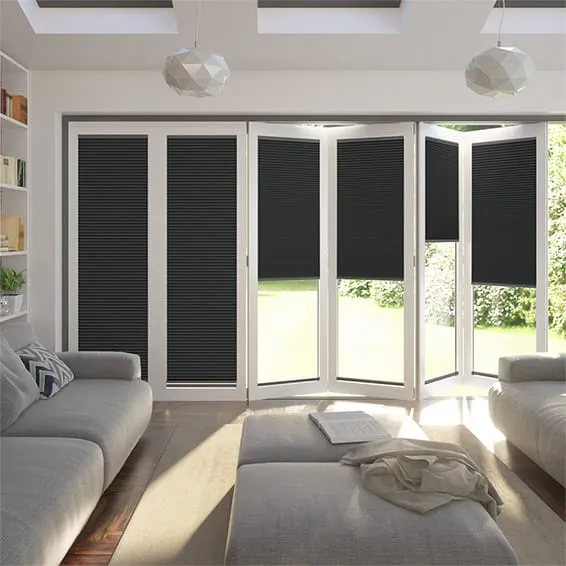
Bifold Clickfit Pleated Blinds
at Blinds 2go
A click-fit pleated blind from Blinds 2go made to track with each bifold panel.
Bifold Clickfit Pleated Blinds
at Blinds 2go
A voile version of the click-fit pleated blind from Blinds 2go for softer light.

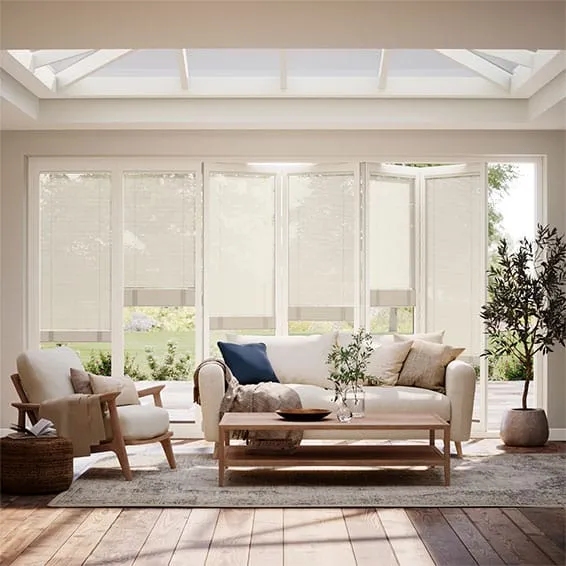
Bifold Venetian Blinds
at Blinds 2go
A slimline 16mm bifold venetian from Blinds 2go for tilt control on doors.
Pick details
Bifold Clickfit Pleated Blinds
at Blinds 2go
A click-fit pleated blind from Blinds 2go made to track with each bifold panel.
The Bifold Clickfit Pleated Blind is the most versatile of the three picks for a bifold door that connects to an outdoor space. The pleated fabric construction folds compactly when the blind is raised - more compactly than a roller, and with less bulk at the top than a Roman blind - which matters when the door is in regular use and you want the blind out of the way cleanly.
The range runs to 13 finishes, covering the key neutral families: whites (Pure White, Bone White, Cream), greys (Palest Grey, Dove Grey, Silver Grey, Storm Grey, Slate Grey, Charcoal), and a small group of warmer tones (Cocoa, Latte, Oatmeal) plus a single Royal Blue. That's a broad enough selection to match most kitchen-diner and garden-room colour schemes without forcing a compromise.
The pleated fabric has moderate light-blocking properties - it dims the room noticeably when lowered, though it isn't a blackout product. For most garden-door settings, that's appropriate: enough privacy and shade for daytime use without turning the room dark. Starting from around £18 per panel, it's the more affordable of the two pleated options, which matters when you're ordering several panels.
If you're choosing between this and the voile version below, the decision comes down to how much light you want to pass through. The standard pleated fabric dims more than the voile; the voile softens without blocking. Neither is a blackout blind.
Bifold Clickfit Pleated Blinds
at Blinds 2go
A click-fit pleated blind from Blinds 2go made to track with each bifold panel.
The Bifold Clickfit Voile Pleated Blind uses the same click-fit frame and pleated mechanism as the standard pleated pick above, but the fabric is a voile construction - sheer enough to let a high proportion of light through while diffusing its direction and softening the view from outside.
The range is available in nine finishes, all in a tight grey-white palette: Parchment, Classic White, Frost White, and a sequence of grey tones running from Soft Grey and Powder Grey through Warm Grey, Natural Grey, Graphite Grey, and Charcoal Grey. There are no warm neutrals or colour options here - the palette is deliberately understated, matching the delicate character of a voile fabric.
The voile is positioned at rooms where privacy matters during the day but you want to preserve as much natural light as possible - a south-facing garden room or a kitchen with bifold doors onto a bright terrace, for instance. It won't offer meaningful dimming, and it provides privacy from outside only by scattering the view rather than blocking it. In low light or at night with interior lights on, a voile provides very little visual privacy from outside.
Compared to the standard pleated blind, the voile is slightly more expensive per panel (starting around £20 compared to around £18), for a noticeably different visual result. Both use the same fitting system, so the choice is purely about the fabric's opacity.
Bifold Venetian Blinds
at Blinds 2go
A slimline 16mm bifold venetian from Blinds 2go for tilt control on doors.
The Bifold Venetian - 16mm Slat is the pick for adjustable light control - specifically for anyone who wants to tilt the blind's slats to manage sunlight angle and glare without raising the whole blind. That's a useful capability on a south-facing bifold door through summer, where the light comes in low in the morning and evening rather than from directly overhead.
The 16mm slat width is notably slimmer than the 25mm, 50mm, and 63mm slats more common in standard venetian blinds. That's a deliberate choice for bifold fitting: slimmer slats mean less bulk when the door folds, and a lower-profile blind that competes less with the glazing area. The trade-off is that 16mm aluminium slats are relatively delicate - thinner slats are more prone to bending under accidental contact than wider ones, which matters on a door that's in regular daily use.
Eight finishes are offered: Matte Black, Matte White, Classic White, Silver, Dove Grey, City Grey, Charcoal, and Stone. That covers the cool neutral spectrum well. There are no warm tones or colour options, which reflects the utilitarian material - aluminium in this slat size is a functional rather than decorative choice.
Aluminium slats are among the easier blind materials to keep clean: a damp cloth and mild detergent removes most marks. On a door that opens regularly onto a garden, that's a practical consideration alongside the aesthetic one.
What we didn't include
This guide is limited to blinds specifically designed for bifold door panels - products with a fitting system built for the way a bifold door moves. Standard blinds fitted across the full door width only work when the door is kept closed; we've excluded them because they don't address the fundamental challenge of a folding door. Similarly, plantation shutters and curtains on tracks in front of bifold doors are genuine alternatives for some homes, but they're sufficiently different in cost, fitting, and function that they belong in separate buying decisions rather than alongside these picks.
We've also kept to a single retailer here - all three picks are from Blinds 2go's bifold range. That's not a limitation we set out to impose; it reflects the fact that dedicated click-fit bifold blind ranges are a specialist product, and Blinds 2go's range across pleated, voile, and venetian covers the main practical choices for most bifold door configurations.