
White keeps a room bright and goes with everything, and a Roman blind is one of the softest ways to wear it. Where a roller lays white flat and a venetian breaks it into slats, a Roman gathers its fabric into folds as it lifts, so the white reads as soft furnishing rather than a flat panel. This guide is for anyone who has settled on white and on a Roman, and now wants to know which white, which opacity and which retailer. It spans a value plain, a blackout and a clean plain white, drawn from three different UK retailers.
What white brings to a room
White is the brightener. Of every blind colour it does the most to keep a room light, reflecting daylight back in rather than absorbing it - the obvious choice for a small room, a north-facing room, or anywhere short of natural light. A white Roman softens that brightness with a little texture and fold, so it reads warmer and more dressed than a flat white panel, which suits a bedroom or a living room where you want light without coldness.
The catch with white is that "white" is not one colour. A brilliant or pure white is crisp and cool, sharp against a bright white wall but slightly clinical in a warm room. A soft, chalk or oatmeal white carries a hint of cream or grey and feels gentler, sitting more comfortably against magnolia walls, natural wood or a period interior. A Roman in a soft white is especially forgiving, since the folds catch shadow and give the white some depth. Hold a brilliant white next to a soft white on your wall to see which the room wants.
White shows marks more than a darker colour, so in a busy room a wipe-clean finish helps - though a Roman, sitting higher and handled less than a roller chain, tends to stay clean longer. Aspect matters: a north-facing room reads a cool white as almost grey, a south-facing room warms it.
What to look for
Pattern or plain. A white Roman is usually chosen plain or lightly textured, to brighten and recede. A subtle white-on-white or a fine print keeps the brightness while adding interest, but the default here is a clean plain.
Blackout vs light-filtering. A Roman's standard lining filters light, which suits a living room. For a bedroom, look for a blackout lining - usually an upgrade on the same blind - and note a blackout white still reads bright by day.
Chain side and safety. Roman blinds raise on a cord or chain, and most retailers let you choose the side. In a child's room, pick a cord-safe option in line with UK requirements.
Recess vs face-fix. Inside the recess looks neat; a face-fix mount gives a tighter light seal and makes a short window look taller. For a bedroom white where you want darkness, face-fix is the better choice.
Stacking. A Roman gathers into a stack of pleats at the top when raised, so it always covers a band of glass. On a short window this costs daylight, and a lined white stacks a little deeper than an unlined one.
How we chose
We wanted three honest routes into a white Roman rather than three near-identical blinds, so each pick answers a different brief and comes from a different retailer: a low-cost plain for an everyday window, a blackout for a bright bedroom, and a clean plain white for a simple, considered finish. Across the three you get a spread of white tone and three suppliers to compare.
Our picks

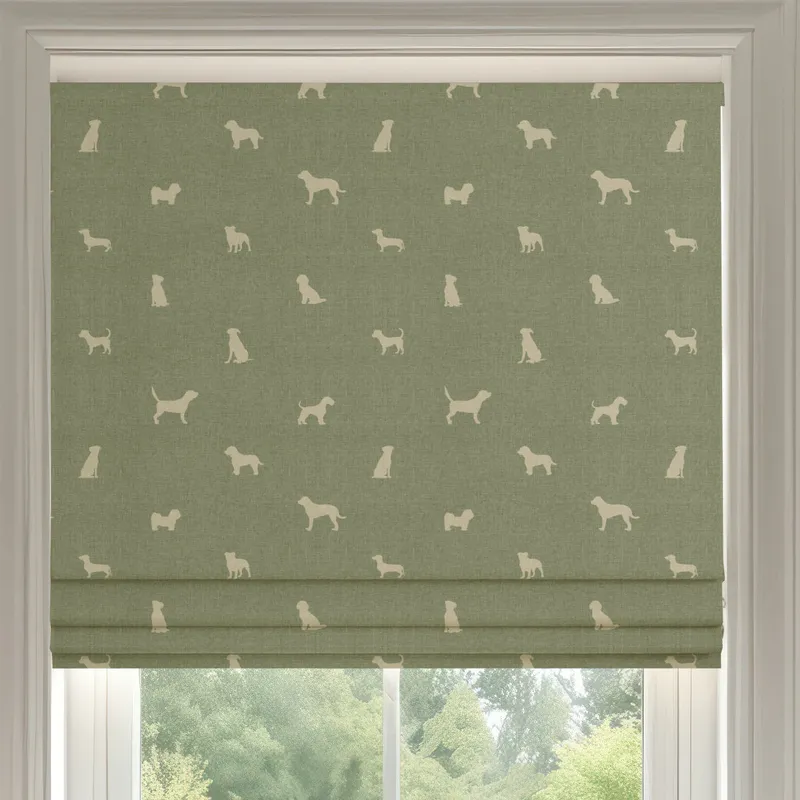
Ante Decor Roman Blinds
at Terrys Fabrics
A low-cost plain Roman from Terrys Fabrics across white and soft-neutral tones.

Melrose Roman Blinds
at 247 Blinds
A blackout soft-white Roman from 247 Blinds for a bright bedroom.

Saffron Roman Blinds
at Make My Blinds
A clean plain white Roman from Make My Blinds.
Pick details
Ante Decor Roman Blinds
at Terrys Fabrics
A low-cost plain Roman from Terrys Fabrics across white and soft-neutral tones.
For a plain white Roman at the lowest sensible price, the Ante Decor range at Terrys Fabrics is our value pick. It is a generic base cloth rather than a designer print, carrying white and soft-neutral tones at an entry price well below the designer options - the sensible choice when you want a bright, calm backdrop and are dressing more than one window. As a plain it works best where the colour and pattern in the room come from elsewhere and the window is there to lift the light.
Melrose Roman Blinds
at 247 Blinds
A blackout soft-white Roman from 247 Blinds for a bright bedroom.
When the white needs to black the room out - a bright bedroom, a nursery - the Melrose at 247 Blinds is our blackout pick. The blind is built to block daylight rather than dim it, in a soft white that still reads bright and clean by day, so you do not trade the light scheme for the darkness. It sits at a low-to-mid entry price for a blackout Roman, the sensible choice when a bedroom needs genuine darkness in a soft finish. Pair it with a face-fix fit for the tightest seal. As a different retailer from the value pick, it is also worth comparing on price and fit.
Saffron Roman Blinds
at Make My Blinds
A clean plain white Roman from Make My Blinds.
For a clean plain white without a print or a budget base cloth, the Saffron at Make My Blinds is our plain pick. It is a straightforward, frost-white Roman - a calm, flat panel of white that folds softly as it lifts - which makes it the most pared-back of the three. That simplicity is the point: where the value pick spreads across many tones, the Saffron is the pick when you know you want a clean white and a tidy finish from a third retailer. Check a swatch against your light, since a plain white shows aspect more honestly than a textured one.
What we didn't include
We have kept this guide to white, and to a value plain, a blackout and a clean plain. We have not covered other colours - cream, grey, green and the brighter shades each have their own guides. We have also not treated blackout beyond the dedicated pick: on most ranges a blackout lining is an order option on the fabric you choose, so for a bedroom ask about it on whichever white you prefer and pair it with a face-fix fit.