
Panel blinds - also called sliding panel blinds - are the blind built for width. Where a roller or a venetian struggles past a metre or two, a panel system spans patio doors, bi-fold doors, and full-wall glazing by dividing the cloth into broad flat panels that glide along a track and stack neatly to one side. If you have a wide opening to dress, or you want a blind that doubles as a room divider, this is the category to look at. This guide covers three made-to-measure ranges across two retailers, picked for value, colour choice, and blackout performance.
What panel blinds actually are
A panel blind is a set of wide, flat fabric panels suspended from a multi-channel track at the top of the opening. Each panel is a single rigid-hanging section - typically somewhere between 45cm and 90cm wide - weighted at the base so it hangs straight. To open the blind, you slide the panels along their channels so they overlap and stack, clearing the glass; to close it, you draw them back across the opening so they sit edge to edge.
That sliding action is the whole point. A roller or vertical blind covering a patio door has to be lifted or drawn aside as a single unit; a panel blind parts like a curtain and stacks into the width of one or two panels, so you can walk through the door without fighting the blind. The same mechanism makes panels a popular room divider - hung from a ceiling track, a run of panels closes off a space and slides away when you want it open.
Panels use the same fabrics as roller and vertical blinds, so you choose opacity the same way: a light-filtering cloth softens daylight and gives daytime privacy while staying bright, and a blackout cloth blocks light for a bedroom, media room, or a south-facing wall of glass. The fabric is the light-control decision; the panel format is purely about how the blind handles width.
What to look for
Number of panels and track channels. A panel blind's track has several channels, and each panel rides in its own channel so they can pass and overlap when stacked. More channels mean each panel is narrower and the stack is tidier, but the headrail is correspondingly deeper. Most domestic openings are dressed with three to five panels; the retailer sizes this for your width.
Maximum width. This is the reason to choose a panel blind, so check the range actually spans your opening. Panel systems comfortably cover patio and bi-fold doors and run on to full-wall widths that no single roller could manage. Measure the full opening, including any frame you want covered, before comparing ranges.
Opacity. Decide what the blind is for. Light-filtering panels keep a room bright while screening it from outside and are the natural choice for a living room or kitchen-diner with wide glazing. Blackout panels are the pick for a bedroom, a media wall, or any large expanse of glass facing strong sun, where the priority is shutting light out.
Stack direction. Panels can be set to stack to one side, or to split and stack to both sides of the opening. For a patio door you tend to use from one end, a one-way stack keeps the clear side clear; for a central feature window, a split stack is often tidier. Confirm the option when ordering.
Operation and child safety. Panel blinds are usually moved with a wand or a cord-and-baton system. A wand-operated, cord-free mechanism is the safer choice in a room used by young children, and UK regulations require a cord-safe solution where a hazard exists - confirm the operation type before ordering.
Fitting clearance. The track top-fixes to the ceiling or to the wall above the opening, so you need clearance above the glass for the headrail, and enough flat run to one side for the panels to stack. A panel blind that has nowhere to stack defeats the point.
Our picks

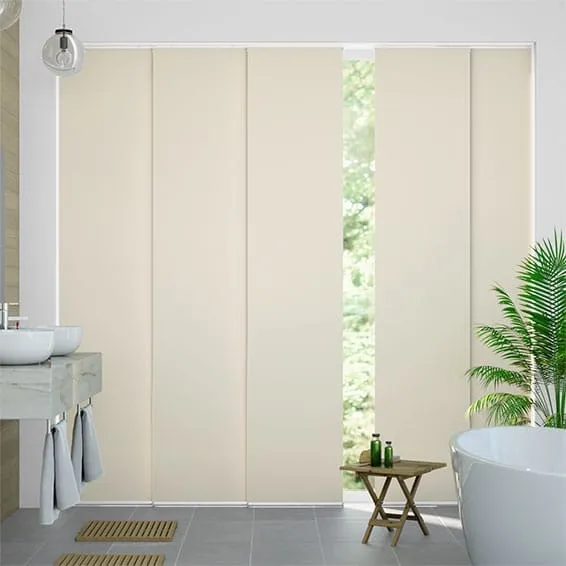
Eclipse Panel Blinds
at Blinds 2go
A low-cost blackout panel blind from Blinds 2go for wide windows and patio doors.


Splash Panel Blinds
at So Easy Blinds
A light-filtering panel system from So Easy Blinds with the widest colour range.


Como Panel Blinds
at So Easy Blinds
A blackout panel blind from So Easy Blinds for darkening a large glazed opening.
Pick details
Eclipse Panel Blinds
at Blinds 2go
A low-cost blackout panel blind from Blinds 2go for wide windows and patio doors.
The Eclipse from Blinds 2go is our value pick, and the headline is the entry price: at £21.82 it is by some distance the cheapest made-to-measure panel blind in this guide, despite being a blackout cloth. For a wide opening - a patio door, or a bedroom window that runs most of a wall - that combination of low cost and genuine light exclusion is hard to better.
The Eclipse comes in seven colourways, which is a working palette rather than a vast one: enough to find a neutral that suits the room without the choice becoming a project in itself. Being a blackout fabric, it is the pick for a bedroom or a media room where the job is to shut daylight out across a large pane, and it does that at a price closer to a mid-sized roller than to the premium panel systems.
Panel from-prices reflect a minimum panel set at a small size; a real patio-door width will cost more, and panel pricing scales with the track width and the number of panels. Even allowing for that, the Eclipse is the range to start with if budget is the deciding factor and you want darkness rather than a particular colour.
Splash Panel Blinds
at So Easy Blinds
A light-filtering panel system from So Easy Blinds with the widest colour range.
The Splash from So Easy Blinds is the choice pick, and the number that makes the case is 48 - the colour count across the range, far more than any other panel blind here offers. If you are matching a panel blind to a considered interior, or you simply want the blind to be a colour rather than a default neutral, this is the range with the room to do it.
Splash is a light-filtering fabric, which suits its likely home: a living room, kitchen-diner, or garden room with wide glazing, where you want to keep the space bright and screened during the day rather than blacked out. Across a large run of glass, a light-filtering panel diffuses strong daylight into something softer without darkening the room.
The trade-off is price. So Easy Blinds positions its panel ranges well above the Blinds 2go entry point - the Splash starts at £96.87 - and that gap is the real cross-retailer story in this category: Blinds 2go is the budget route, while So Easy charges a premium but backs it with a far deeper catalogue of panel fabrics and colours. If choice and a light-filtering finish matter more than the lowest price, the Splash earns the difference.
Como Panel Blinds
at So Easy Blinds
A blackout panel blind from So Easy Blinds for darkening a large glazed opening.
The Como, also from So Easy Blinds, is the pick when you want a blackout panel but not the bare-minimum palette. It pairs genuine light exclusion with 18 colourways, so it sits between the Eclipse (cheap blackout, limited colour) and the Splash (broad colour, light-filtering) - blackout performance with real choice over the finish.
At £109.18 it is the most expensive pick here, and the same caveat applies as for the Splash: So Easy's panel pricing is premium, and the figure rises with the width of the opening. Where the Como justifies it is a large glazed bedroom or a media wall that you want both to darken and to look deliberate, rather than dressed in whatever neutral was available.
If your only goal is to black out a wide window at the lowest cost, the Eclipse reaches that more cheaply. The Como is the pick when the blind needs to darken the room and suit the scheme.
What we didn't include
We kept this guide to three ranges across the two retailers with the deepest panel catalogues. Swift Direct Blinds also offers a small number of panel blinds - a paper-textured panel and a blackout option - which are worth a look as a third price point, but the range is too narrow to compare on choice. Blinds 2go additionally lists wood-effect and natural-textured panels (oak and linen finishes) for anyone wanting a panel that reads as a material rather than a plain colour; they sit above the Eclipse on price.
We have not covered motorised panel tracks. Electric panel systems exist and make sense on very wide or high openings that are awkward to reach, but they add cost and a separate set of considerations - motor, remote, power - that sit outside the core decision of which panel fabric and opacity to choose. If motorised operation is a requirement, treat it as a separate choice from the range itself.