
Geometric blinds sit somewhere between purely decorative and functional window dressing. Whether you want the clean diamond repeat of a day and night blind or the structural grain of a faux wood venetian, the term covers a wide range of pattern types and blind mechanisms. This guide covers four curated picks across different blind types - roller, roman, venetian, and day and night - to help you match a geometric look with the practical requirements of your window.
What makes a blind "geometric"
In the context of blinds, "geometric" can mean two different things. The first is literal pattern: a repeat of triangles, diamonds, chevrons, or grid motifs printed onto a roller or roman fabric. The second is structural geometry - the visual lines created by the slats of a venetian blind or the alternating stripes of a day and night blind, which produce a repeating geometric rhythm even when the fabric itself is a plain colour.
Both count, and both attract the same search query. When shoppers look for geometric blinds, they are often after either a patterned roman or roller for a feature window, or a venetian or day and night blind where the geometry is built into the mechanism rather than printed on.
The distinction matters for buying decisions. A printed geometric pattern on a roman blind will read very differently at a distance than the structural repeat of a 50mm venetian slat. One is decorative; the other is architectural. Neither is better - they suit different rooms and intentions.
What to look for
Blind type and how it operates
The four main types in this guide - roller, roman, venetian, day and night - each handle light and privacy differently. A roller blind gives you flat, simple light control with the full pattern visible when down. A roman blind folds into horizontal pleats when raised, which means the pattern can compress at the top; this is worth considering if you want the geometric motif to read clearly at various positions. A venetian blind gives you slat-angle control, letting you admit light without fully raising the blind. A day and night blind shifts between sheer and opaque bands, so light filtration is continuous but genuine blackout is not achieved.
Slat width for venetians
For venetian blinds specifically, slat width is a meaningful aesthetic choice. A 35mm slat produces a finer, more linear repeat than a 50mm slat. Narrower slats suit smaller windows where a wide slat would look disproportionate; wider slats have a more confident, contemporary look on larger spans. Both are available in faux wood, which is moisture-tolerant and suitable for most rooms including kitchens and bathrooms.
Fabric opacity for patterned blinds
Geometric-patterned roman and roller blinds vary in opacity. A light-filtering fabric will let some daylight through, which softens the room but reduces privacy. A dimout or blackout-backed fabric blocks more light - useful in bedrooms - but in a roman blind can add visible bulk to the fold stack at the top. Check the retailer's specification for each finish rather than assuming the opacity from the pattern alone.
Colour coordination with the pattern
Geometric patterns are heavily colour-dependent. A bold trellis in fuchsia reads very differently to the same trellis in duckegg or deep navy. The finishes across the picks in this guide range from the neutral oak and white grains of the faux wood venetians to the illustrated botanical prints of the Sara Miller roman range. Consider the existing colour temperature of the room before committing to a finish.
Made-to-measure sizing
All four picks in this guide are made-to-measure. That means you specify your exact window dimensions within the range's minimum and maximum. Standard UK convention is width first, then drop (vertical dimension). If you are fitting inside the recess, measure the recess width and the full drop from the top of the recess to the sill. Outside the recess, add enough width to overlap the wall on each side for better light blocking.
Cord safety
UK regulations require blinds sold for domestic use to include cord-safe mechanisms. If you are fitting in a children's room, look specifically for cordless or wand-operated options, which remove the hazard entirely. Check the individual range specification if this matters for your installation.
Our picks


Faux Wood Venetian 50mm Blinds
at English Blinds
English Blinds 50mm faux wood venetian delivering structural geometry through wide horizontal slats, with 17 finishes from Alabaster to Mara Grain from £7.35.

Sara Miller Roman Blinds
at Blinds By Post
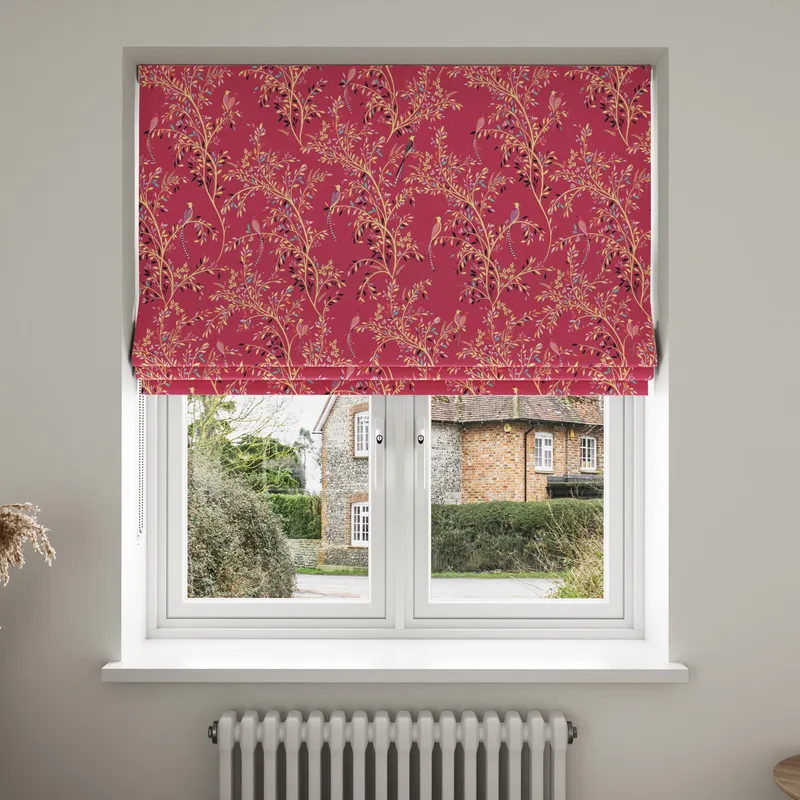
Sara Miller roman from Blinds By Post with 58 finishes including Birds and Trellis Duckegg and Linear Bamboo Dark Green, from £20.57.


Faux Wood Venetian 35mm Blinds
at English Blinds
English Blinds 35mm faux wood venetian with a finer, denser geometric repeat than the 50mm version, across 14 finishes from £7.22.


Diamond Day Night Day and Night Blinds
at 247 Blinds
247 Blinds Diamond Day Night Blind with diamond-cut sheer bands and 3 grey-tonal finishes - Raven, Platinum, and Silver - from £28.69.
Pick details
Best geometric roller
Faux Wood Venetian 50mm Blinds
at English Blinds
English Blinds 50mm faux wood venetian delivering structural geometry through wide horizontal slats, with 17 finishes from Alabaster to Mara Grain from £7.35.
This pick from English Blinds is a 50mm faux wood venetian - a structural geometric in the truest sense, where the geometry comes from the repeating horizontal lines of the slats rather than any printed motif. Faux wood means PVC moulded to replicate a wood grain finish: it is moisture-tolerant, which makes it a practical choice for kitchens and bathrooms, and holds its shape better over time than real wood in humid conditions. The 50mm slat width creates a confident, wide geometric repeat - well-suited to larger windows where a narrower slat would read as fine and somewhat underwhelming.
The range includes 17 finishes running from pale neutrals - Alabaster, Cream, White - through warm wood tones such as Natural Oak, Warm Oak, and Nordic Oak, and into more characterful grain options like Mara Grain and Oriana Grain. The grain finishes add surface texture to the geometric repeat, giving the slat a more naturalistic quality than a plain-painted alternative. Prices start from £7.35, making this one of the more accessible entry points across the picks in this guide.
The structural geometry here is worth emphasising. There is no printed pattern on these slats; the geometric quality comes from the repeated horizontal lines of the slat stack and the angular shadow between each slat when tilted. If you want a geometric effect without a surface print, this is the mechanism that delivers it most cleanly.
Best geometric roman
Sara Miller Roman Blinds
at Blinds By Post
Sara Miller roman from Blinds By Post with 58 finishes including Birds and Trellis Duckegg and Linear Bamboo Dark Green, from £20.57.
The Sara Miller range from Blinds By Post is a very different kind of geometric. Where the faux wood venetian picks rely on structural line, this is an illustrated botanical print range with a strong repeating composition. The collection spans a broad palette - deep navy and teal blues, fuchsia and soft pinks, forest greens and smoky blues - with pattern names like Birds and Trellis Duckegg, Peacock Filigree Sage Green, and Linear Bamboo Dark Green.
The trellis and filigree options are the most directly geometric: they use a repeating lattice or grid as a visible structural element within the composition, giving the blind a pattern logic that reads as geometric even when the subject is botanical. Linear Bamboo Dark Green is a notable option - a repeating vertical structure that aligns closely with what many visitors mean when they search for geometric roman blinds.
With 58 finishes available, this is by far the widest selection of the four picks in this guide. Prices start from £20.57. The roman format means the fabric folds into horizontal pleats when raised; if you are choosing a specific pattern for a feature window and want it to read clearly at all positions, factor in how the pleating will affect the print at mid-raise.
One practical note: the Sara Miller range is a licensed print collection, so the designs are distinctive and carry a recognisable illustrative character. They are not neutral backdrop prints; they will be a visible feature in the room. That makes the colour coordination decision particularly important - a fuchsia Birds of Paradise blind will dominate a neutral room, which may be exactly what you want, but requires consideration.
Best geometric venetian
Faux Wood Venetian 35mm Blinds
at English Blinds
English Blinds 35mm faux wood venetian with a finer, denser geometric repeat than the 50mm version, across 14 finishes from £7.22.
Where the 50mm pick produces bold horizontal lines, this 35mm faux wood venetian from English Blinds creates a finer repeat. The narrower slat width means more slats across the same drop, which gives the blind a denser, more linear geometric quality - closer to the look of a louvred shutter than the wide, emphatic bands of a 50mm blind. This makes it a better fit for smaller windows or rooms where a 50mm slat would look oversized.
The material and moisture-tolerance are the same as the 50mm pick - PVC faux wood, suitable for bathrooms and kitchens. The finish range runs to 14 options, including Alabaster, Cream, White, Natural Oak, Warm Oak, Mara, Oriana, and both grain and plain versions of several. The overlap with the 50mm range is significant; the main differentiation is the slat width and the resulting visual scale of the geometric repeat.
Prices start from £7.22 - marginally lower than the 50mm option. If you have already decided on faux wood venetian styling and the question is whether 35mm or 50mm suits your window better, consider the window width and the height of the room. A narrow, tall window in a smaller room tends to suit 35mm; a wide window or a room with strong horizontal lines suits 50mm.
Best geometric day and night
Diamond Day Night Day and Night Blinds
at 247 Blinds
247 Blinds Diamond Day Night Blind with diamond-cut sheer bands and 3 grey-tonal finishes - Raven, Platinum, and Silver - from £28.69.
The Diamond Day Night Blind from 247 Blinds is the structural geometric of this group - its entire visual character comes from the repeating diamond-shaped cut across the alternating sheer and opaque stripes. Day and night blinds work by aligning or staggering two layers of striped fabric: align the stripes and the sheer bands let light through; stagger them and the opaque bands overlap the sheers, reducing light. The diamond cut here gives the sheer bands a pointed, geometric shape rather than a straight horizontal band, which changes the visual effect noticeably.
The range comes in 3 finishes: Raven, Platinum, and Silver. These are all grey-tonal options - Raven being a near-black, Platinum a mid grey, and Silver a lighter cool tone. This is a focused palette without warm tones or neutrals; the range suits rooms already carrying a grey or monochrome scheme, and the diamond structure gives it a contemporary quality that a plain-stripe day and night blind lacks.
A practical note on day and night blinds in general: they are not blackout in any position. The staggered configuration reduces light significantly but does not fully block it. If your priority is darkness - for a bedroom or shift worker's sleep window - this type is not the right fit. Where it excels is as a living room or home office blind that gives privacy control without heavy light blocking, and where the geometric pattern itself is part of the appeal.
At £28.69 from price, this is the most focused pick in terms of both palette and mechanism, and it is best understood as a style-led choice within a specific room type rather than a general-purpose window covering.
What this guide did not include
This guide focuses on blinds where geometric character is either printed or structurally inherent to the mechanism. Plantation shutters also produce strong geometric lines through their louvre structure, but they belong in a separate buying decision given the fixed installation and significantly higher cost than made-to-measure fabric blinds.
The guide covers four pick categories. Vertical blinds and pleated blinds can carry geometric patterns, but their visual character in everyday use is quite different from the picks above. The picks here were chosen because they represent the four types where geometric character is most commonly sought and most clearly realised across different room contexts.
Prices by your window size
All four picks are made-to-measure, so the price you pay reflects your specific window dimensions rather than a fixed list price. Each pick's page includes a price grid showing what the blind costs at a standard set of common widths and drops. Use those grids as a realistic guide to your actual cost before deciding between picks.
Independent. We have no affiliate relationships with any retailer mentioned here. How we work.