
Black is the most decisive colour you can hang at a window, and a roller is the cleanest way to wear it. Where a Roman softens its fabric into folds and a venetian breaks it into slats, a roller lays the colour flat against the glass as a single sharp panel - which is exactly what a graphic colour like black wants. This guide is for anyone who has settled on black, and on a roller, and now needs to know which finish, which opacity and which retailer. It spans a value plain, a true blackout and a more textured option, drawn from three different UK retailers.
What black brings to a room
Black is a statement and a frame at the same time. As a statement it reads modern, confident and graphic - the natural partner to a contemporary, industrial or monochrome scheme, and a sharp counterpoint to white walls, pale wood or exposed brick. As a frame it does something quieter: a black roller draws a clean dark line around a window and, half-raised, sits like a border over a view rather than competing with it.
The thing to weigh with black is weight. In a bright, generous room a black blind grounds the scheme and looks deliberate; in a small or north-facing room the same blind can close the space down, especially across a run of windows. The trick is contrast - black earns its place where there is light wall, pale floor or metal and glass to play against, and feels heavy where everything around it is already dark.
Light and aspect matter too. A south-facing window in strong sun will fade a cheap black fabric over years, so a quality dyed cloth is worth the small premium where the sun is direct. And because black absorbs rather than reflects light, it does not bounce daylight back into a room the way a white blind does - a fair trade for the drama, but worth knowing if the room is already short of light.
What to look for
Opacity. This is the first decision and it changes the blind completely. A standard or light-filtering black roller screens the room and softens daylight while staying a touch translucent; a dimout cuts most light; a blackout fabric is coated to block it almost entirely. For a bedroom or a media room, a true blackout black is the pick; for a living room or kitchen, a standard fabric is usually enough.
Fabric and finish. Black comes plain, textured, and as a wipe-clean PVC. A flat plain is the cheapest and the most neutral; a textured weave reads as more considered and catches the light gently; a PVC or moisture-resistant black is the one for a kitchen or bathroom window where steam is a factor.
Operation and safety. Rollers run on a side chain as standard, with cordless spring and motorised options on many ranges. Choose the chain side to suit the room, and in a child's room pick a cord-safe or cordless mechanism in line with UK requirements for domestic blinds.
Recess vs face-fix. Inside the recess looks neat but leaves a small light gap each side; a face-fix mount above the window overhangs the reveal and gives a tighter seal. For a blackout black in a bedroom, face-fix is the better choice for darkness.
Width. A single roller has a maximum width; very wide windows or patio doors are better served by two blinds or a vertical. Check the range's maximum against your opening before ordering.
How we chose
We wanted three honest routes into a black roller rather than three versions of the same blind, so each pick answers a different brief and comes from a different retailer: a low-cost plain for an everyday window, a true blackout for a bedroom or media room, and a more textured option for a room where the blind should look deliberate. Across the three you get a spread of opacity, finish and price, and three suppliers to compare on fit and delivery.
Our picks


Andromeda Roller Blinds
at 247 Blinds
A low-cost plain black roller from 247 Blinds for an everyday window.
Tradechoice Roller Blinds
at Blinds By Post
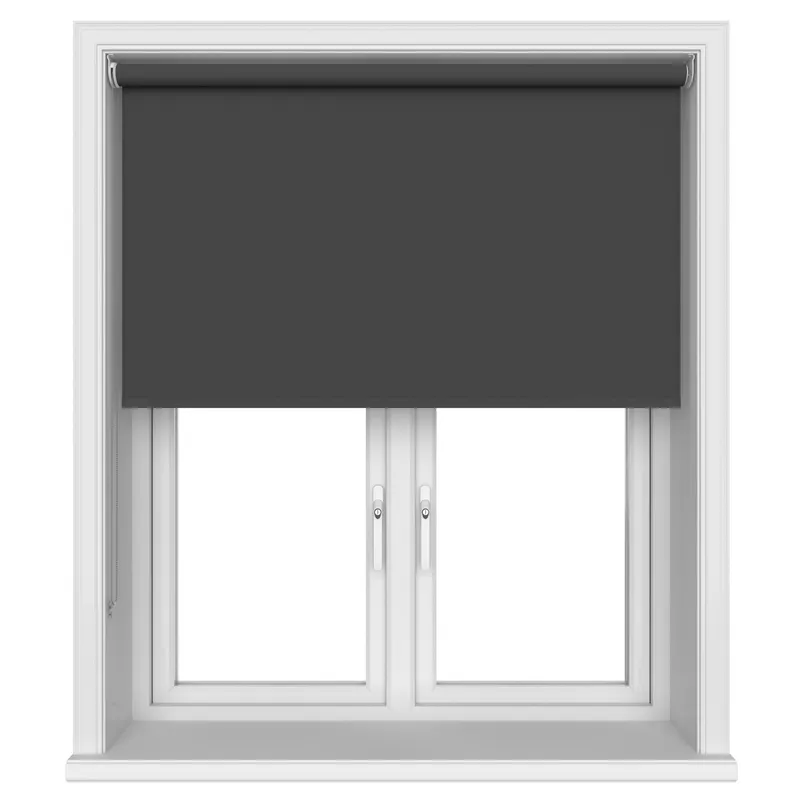
A blackout black roller from Blinds By Post across several black shades.

Gala Roller Blinds
at English Blinds
A textured black roller from English Blinds for a more deliberate look.
Pick details
Andromeda Roller Blinds
at 247 Blinds
A low-cost plain black roller from 247 Blinds for an everyday window.
For a plain black roller at the lowest sensible price, the Andromeda at 247 Blinds is our value pick. It is the everyday route: a clean, flat black panel for a window that needs screening and a tidy finish rather than a design statement, at an entry price close to the cheapest made-to-measure rollers on the market. Its black sits at the room-darkening end rather than full blackout, which suits a living room, study or hallway where you want to cut glare and gain privacy without blacking the room out.
As a value plain it does the obvious job well and leaves budget for the rest of the room. If you are dressing several windows in black, this is the range that keeps the total down, and 247 Blinds' standard made-to-measure process covers the usual recess and face-fix options.
Tradechoice Roller Blinds
at Blinds By Post
A blackout black roller from Blinds By Post across several black shades.
When the black needs to shut light out - a bedroom, a nursery, a room with a television - the Tradechoice Blackout at Blinds By Post is our blackout pick. The fabric is coated to block daylight rather than merely dim it, and the range carries black across more than one shade, so you can choose the depth of black rather than taking the only one on offer.
It sits at a low entry price for a blackout, which makes it the sensible choice when darkness is the actual requirement rather than a nice-to-have. Pair it with a face-fix fit for the tightest seal, since even a true blackout fabric leaks a little light at the edges of a recess mount. As a different retailer from the value pick, it is also worth comparing on price and delivery if you are ordering more than one blind.
Gala Roller Blinds
at English Blinds
A textured black roller from English Blinds for a more deliberate look.
For a black that should look considered rather than purely functional, the Gala at English Blinds is our pick for finish. It is a textured black rather than a flat plain - a woven cloth with a little more depth and a softer hand, which reads as more deliberate in a room where the blind is part of the scheme rather than just covering the glass.
It carries a higher entry price than the two plains above, and that is the trade: you are paying for the fabric quality and the finish rather than the bare function. It is the pick for a living room, dining room or bedroom where a black blind is a design choice, and where a flat budget plain would undersell the rest of the room. English Blinds is the third retailer here, so it also gives an alternative source if the others' shades or fit options do not suit.
What we didn't include
We have kept this guide to black, and to the choice between a value plain, a blackout and a textured finish. A couple of notes on the gaps.
We have not covered other colours. Grey, white, green and the warmer end of the palette each behave differently at a window and have their own guides - if you are still deciding on colour, start there. We have also not made a separate pick of motorised or PVC black rollers: motorised operation is an option on many of these ranges rather than a different product, and a wipe-clean PVC black is the one to ask about specifically if the window is in a kitchen or bathroom.