
An ombre blind carries a graduated fade from one tone to another across its drop, so the colour shifts gradually from top to bottom rather than sitting as a single flat shade. The effect borrows from fashion and interiors, where ombre means a soft blend that moves from light to dark or from one colour into a neighbouring one. People search for it when a plain blind feels too quiet and a busy pattern feels too much - the fade gives a window real character while still reading as a single, calm gesture. This guide covers how the look works, where it suits, and three picks spanning the formats UK retailers actually offer it in.
How ombre works and where it suits
The defining quality of an ombre blind is the gradient. Rather than a printed motif that repeats, the fabric carries one continuous transition - say from a pale cloud at one end through to a vivid blue at the other - so the eye reads movement and depth without any pattern at all. Because the fade runs the length of the drop, it is at its best on a blind that hangs as one clean plane, which is why the look lives almost entirely on rollers and Romans.
Which way the fade runs is a matter of preference. Hung darker-at-top, the blind grounds the window and lets light feel as though it lifts towards the sill; hung lighter-at-top, it reads brighter and airier overhead. Neither is more correct, and the better choice depends on the room and on how much daylight you want the upper portion of the glass to carry.
An ombre blind is a statement, contemporary look rather than a neutral backdrop. It works as a feature wherever you want the window itself to do the decorating - a living room where the blind anchors the scheme, a bedroom where a soft blue-to-cloud fade feels restful, or a bathroom where a brighter graduation lifts a small space. Because the colour does the work, an ombre blind tends to suit rooms that are otherwise fairly plain, where a single graduated window can carry the whole look.
What to look for
Which way the fade runs. Decide whether you want the darker tone at the top or the bottom, because it changes how the blind reads as it moves. Lowered fully, you see the complete graduation; raised partway, only part of the fade is on show, so a darker-at-top blind keeps its richest tone in view while a lighter-at-top one shows the lighter end. Picture the blind at the heights you will actually use it.
Roller or Roman. The format changes the character of the fade. On a roller, the graduation runs down a smooth, flat plane, so the transition is uninterrupted and at its most gradual. On a Roman, the horizontal folds break the same fade into bands of tone, which gives a softer, more textile feel. Both are valid ombre looks; the roller is the cleaner, more graphic reading and the Roman the more dressed one.
Opacity and lining. As with any blind, the fabric's opacity sets how much light it filters, and a Roman in particular may offer a lining that adds weight and improves light control. The lighter end of an ombre fade will always pass a little more light than the darker end, so consider the paler tone when judging how much shade you will get.
The graduation is fixed. Ombre is printed or woven into the fabric, so the fade is a permanent feature of the cloth rather than something you can adjust. You are choosing a specific colour journey, not a setting - which makes getting the tones and the direction right at the point of order more important than on a plain blind.
Recess or exterior fit. As with any made-to-measure blind, decide between a recess fit, sitting the blind inside the window reveal, and an exterior fit, mounting it on the wall or frame above. A recess fit frames the fade neatly within the reveal; an exterior fit lets the full graduation sit proud of the window and can make a small window look larger.
How we chose
Ombre is a niche look, offered by only a couple of UK retailers, so this is a guide shaped by what is genuinely available rather than by a long shortlist. Instead of ranking many near-identical products, we have chosen three picks that span the formats you can actually buy an ombre blind in: a velvet Roman, a roller and a standard Roman. That way the guide reflects the real choice in front of a UK shopper - which format suits the room - rather than pretending the category is broader than it is. Each pick sits at a mid entry price for its retailer, so the deciding factor is the look and the format, not a large gap in cost.
Our picks


Ombre Velvet Roman Blinds
at 247 Blinds
A velvet ombre Roman with a graduated fade from cloud to vivid blue, from 247 Blinds.

Ombre Roller Blinds
at Blinds 2go
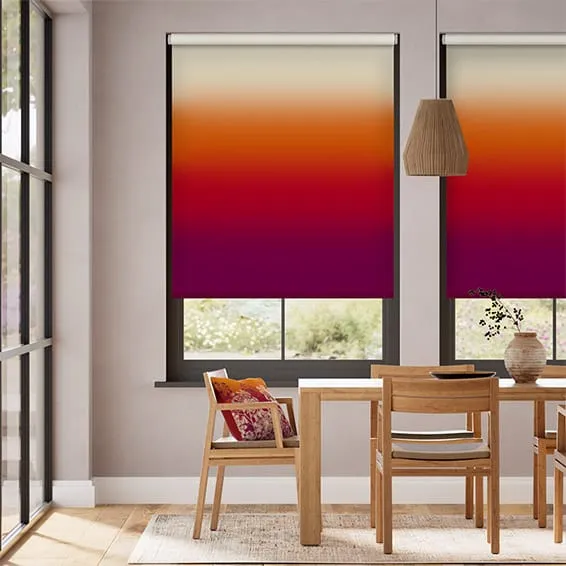
A graduated-colour roller in heather, teal and sunset - the simplest ombre format.
Ombre Roman Blinds
at Blinds 2go
An ombre Roman in sunset, midnight and storm, the folded-fabric take on the fade.
Pick details
Ombre Velvet Roman Blinds
at 247 Blinds
A velvet ombre Roman with a graduated fade from cloud to vivid blue, from 247 Blinds.
For an ombre blind with the most depth, the velvet ombre Roman from 247 Blinds is our pick. The velvet pile gives the fade extra richness - light catches the texture differently along the drop, so the graduation reads with more depth than it would on a flat cloth. It runs through shades such as Cloud, Sky, Vivid Blue and Silver, a soft, cool journey that suits a calm living room or a restful bedroom.
The combination of a velvet texture and a graduated fade is what sets this one apart. Where a flat fabric shows the transition cleanly, the velvet adds a tactile, almost lit quality that makes the colour feel deeper at the dark end and softer at the light end. It sits at a mid entry price for the retailer, so the velvet finish does not carry a steep premium over a plainer ombre. Choose it where you want the fade to feel dressed and substantial rather than purely graphic, and where the room is otherwise quiet enough to let a textured, graduated window lead.
Ombre Roller Blinds
at Blinds 2go
A graduated-colour roller in heather, teal and sunset - the simplest ombre format.
For the cleanest take on the look, the ombre roller from Blinds 2go is our pick. A roller is the simplest, flattest ombre format - the fade runs straight down a smooth roller fabric with nothing to interrupt it, so the graduation is at its most gradual and uninterrupted. That makes it the most graphic reading of ombre, where the colour does all the work on a single clean plane.
It comes in shades such as Heather, Midnight, Teal and Sunset, a range that spans soft and bold, so you can pitch the blind as a gentle wash or a confident statement depending on the tone you choose. At a mid entry price, it is an accessible way into the look. Choose the roller where you want the fade itself to be the whole point, in a contemporary room that suits a flat, modern blind. It is the format to pick when a Roman's folds would feel like too much texture and you want the transition to read as one continuous, unbroken gradient.
Ombre Roman Blinds
at Blinds 2go
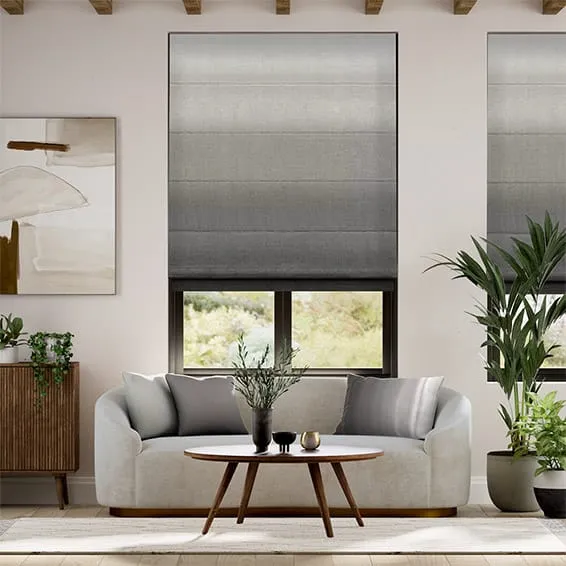
An ombre Roman in sunset, midnight and storm, the folded-fabric take on the fade.
For the folded-fabric take on the fade, the ombre Roman from Blinds 2go is our pick. Where the roller keeps the graduation flat, the Roman's horizontal folds break the fade into bands of tone, so the same transition reads as a series of soft steps rather than one continuous wash. That gives the look a more dressed, textile feel - closer to a soft furnishing than a graphic panel.
It runs through shades such as Sunset, Midnight, Teal and Storm, a palette that leans towards richer, more atmospheric tones well suited to a living room or bedroom where you want the window to feel warm and considered. At a mid entry price, it sits alongside the roller rather than above it, so the choice between them is about format, not cost. Choose the Roman where you want the ombre to feel soft and tailored, and where the folds breaking the fade into bands is a feature you like rather than one you would rather avoid.
What we didn't include
We have kept this to three picks because genuine ombre is uncommon in the UK, and stretching the guide further would mean inventing choice that is not really there. A few words on what sits outside it, and why, are worth setting down so you know where else to look for a related effect.
We have not included a dedicated ombre vertical or an ombre wood blind, because those simply are not offered - the graduated look lives on rollers and Romans, where a single continuous plane of fabric can carry the fade. We have also left out striped and dip-dye fabrics: a stripe is a repeating block of colour and a dip-dye is a harder edge between two tones, both of which are a different effect from a true gradual ombre fade. And plain single-colour blinds, even in a deep or unusual shade, are not ombre at all - if a flat colour is what you are after, the colour guides are the right place to look rather than this one.