
Black is the colour that turns a Venetian blind from a piece of window hardware into part of the room's design. Where a white or neutral Venetian recedes, a black one asserts itself: it frames the view like a picture, throws the glass into sharp relief, and ties a window into the dark metalwork, matt fittings and pared-back palettes that define so much contemporary decorating. It suits anyone after a modern, slightly dramatic look - a black-framed industrial scheme, a minimalist living room, a kitchen where the joinery is dark - rather than a blind that blends quietly into the wall. This guide covers what a black Venetian gives you, what to check before ordering, and three picks spanning aluminium, real wood and faux wood across three UK retailers.
What a black Venetian blind offers
Black reads as deliberate. On a Venetian, with its horizontal lines of tilting slats, the colour does two things at once: it draws a crisp dark edge around the daylight, and it sets a tone for the whole room. Against a pale wall it is graphic and high-contrast; against exposed brick, dark cabinetry or steel-framed glazing it disappears into the scheme and lets the architecture lead. Either way it pairs naturally with industrial and minimalist interiors, where black metal, concrete and muted colour already do the work and a black blind simply completes the line.
The character of that black, though, depends entirely on the material - and this is the first decision to make. The three materials give three different blacks.
Aluminium gives the sleekest, most modern black: slim 25mm slats, a hard-edged metallic surface, and a finish that can be matt for a soft, light-absorbing black or gloss for a sharper, more reflective one. It is light, moisture-tolerant and the most affordable way into a black Venetian, which makes it the natural choice for kitchens and bathrooms as well as modern living spaces.
Real wood gives a warmer, more textured black. At 50mm the slats carry genuine grain beneath the dark finish, so the black has depth and a slight softness that metal cannot match - closer to dark-stained furniture than to a painted surface. It is the most decorative of the three, and the most expensive, and it belongs in dry rooms.
Faux wood gives the wood look in black without real timber's vulnerability to damp. A moulded 50mm slat in a true-black satin finish reads as dark wood from across the room, but shrugs off the steam and splashes that would warp the real thing - so it bridges the gap between a wet room and the wood aesthetic.
Matt versus gloss, and how black frames a view
With a black Venetian the surface finish matters as much as the material. A matt black absorbs light, sits quietly and feels contemporary and understated - it is the safer choice in a room with a lot going on, because it does not fight for attention. A gloss black reflects light, catches highlights along each slat, and makes more of a statement; it suits a sleeker, more polished scheme but shows dust and fingerprints more readily. Aluminium ranges most often offer the choice between the two; wood and faux-wood blacks tend toward a satin or matt finish that flatters the grain.
However the slats are finished, black frames a view in a way paler colours do not. When the slats are tilted open, the dark horizontal lines become a border around the daylight rather than part of it, so the outlook reads more sharply. Closed, a black Venetian is a clean dark plane - a strong, simple block of colour that anchors the wall. That is why black works so well in industrial and minimalist rooms: it behaves like a deliberate design element, not a soft furnishing.
What to look for
Slat size, by material. Black aluminium Venetians are typically 25mm - the slim profile reads as modern and crisp, and suits smaller or narrower windows. Black wood and faux-wood Venetians are usually 50mm, a bolder, more architectural line that carries the grain and suits larger windows. The slat width follows the material, so choosing the look largely sets the slat size.
Tilt and lift controls. A Venetian has two actions: a tilt (a rod, wand or cord that rotates the slats together) and a lift (a cord that raises the whole stack). On a black blind the controls are usually colour-matched, so the cords and wand do not break the dark line. For a child's room, choose a cord-safe option in line with UK requirements.
Ladder tapes. Wider 50mm wood and faux-wood Venetians can be ordered with ladder tapes - fabric strips that run down the front of the slats, hiding the route holes and adding a decorative band. On a black blind a tape is a styling choice: a matching black tape keeps things uniform, while a contrasting tape becomes a feature. Tapes are less common on slim aluminium Venetians.
Moisture suitability. This is the dividing line between the materials. Aluminium and faux wood are moisture-tolerant and belong in kitchens, bathrooms and utility rooms. Real wood is not - repeated humidity warps and discolours it, so a black real-wood Venetian is for dry rooms only. Match the material to the room before the colour.
Weight of wider wooden slats. A 50mm real-wood Venetian is the heaviest of the three. At larger widths the stacked slats become a substantial load to lift, and a very wide window may need an intermediate slat support to stop the slats sagging. Aluminium is the lightest; faux wood sits between the two.
How we chose
We picked one black Venetian in each of the three materials, from three different retailers, so the guide spans the real choice a buyer faces rather than three versions of the same blind. A value aluminium pick covers the affordable, moisture-tolerant, sleek-and-modern end. A real-wood pick covers the warmer, more textured, more decorative black for dry rooms. A faux-wood pick covers the wood look in damp rooms where real timber cannot go. Across the three you get the full range of black Venetian - the slimline metal black, the warm grained black and the practical wood-look black - so the right pick is the one that matches your room and your budget rather than the one we rank highest.
Our picks


Aluminium Venetian Blinds
at Make My Blinds
Matt and gloss black aluminium slats at a lower entry price.

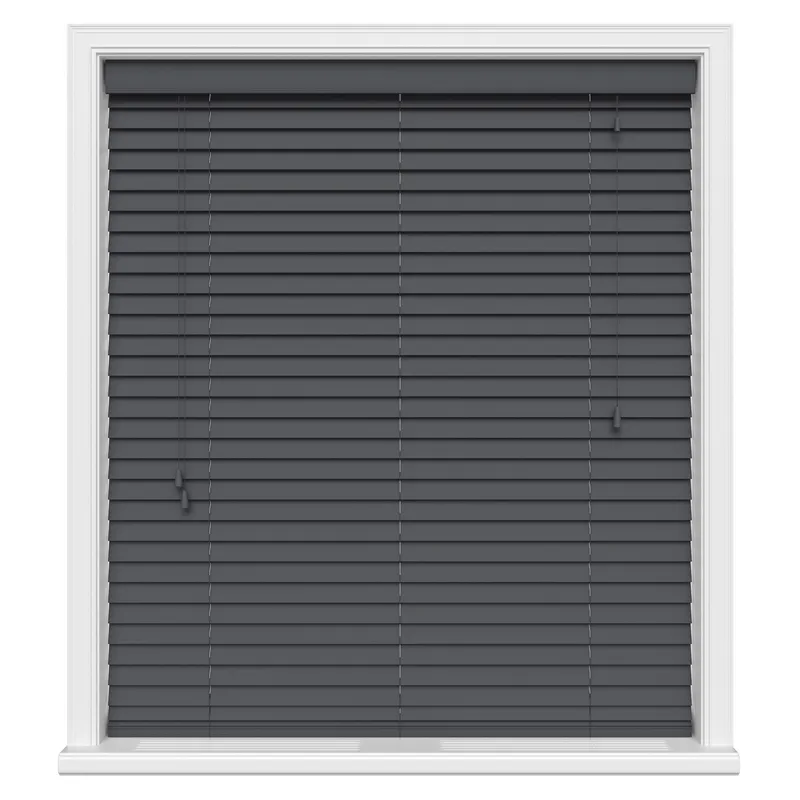
Wooden Venetian 50mm Blinds
at Blinds By Post
Carbon-black real-wood 50mm slats for a warmer black.

Faux Wood Venetian 50mm Blinds
at 247 Blinds
Ecowood true-black satin, a moisture-tolerant wood look.
Pick details
Aluminium Venetian Blinds
at Make My Blinds
Matt and gloss black aluminium slats at a lower entry price.
For an affordable black aluminium Venetian, the pick from Make My Blinds is our value choice. It comes in slim 25mm slats and offers black in two finishes - Matt Black for a soft, light-absorbing black that sits quietly in a modern room, and Gloss Black for a sharper, more reflective black that catches the light along each slat. That choice between matt and gloss is the useful part: it lets you tune the black to the scheme rather than taking whatever single black a range happens to offer.
It sits among the more affordable entry prices for a made-to-measure black Venetian, so it is the easiest way into the look. Aluminium is sleek and modern by nature, and it is moisture-tolerant, which makes this the pick for kitchens and bathrooms as well as living spaces - it handles the steam and splashes that would warp wood. The trade-offs are the usual aluminium ones: the thin slats can dent if knocked, and metal offers no insulation. For a crisp, contemporary black at a low entry price, though, it is the natural starting point.
Wooden Venetian 50mm Blinds
at Blinds By Post
Carbon-black real-wood 50mm slats for a warmer black.
For a warmer, more textured black, the real-wood 50mm Venetian from Blinds By Post is our pick. It offers black in two genuine-timber finishes - Carbon Black and Volt Black - and because the slats are real wood, the black carries grain and depth beneath the finish. The result is closer to dark-stained furniture than to a painted surface: a softer, more decorative black than metal can give, with the substance of a 50mm slat behind it.
This is the choice when the blind is meant to be part of the decor rather than a purely functional fitting. The wider slat suits larger windows and draws a bolder horizontal line across the glass. Two caveats come with real wood. It sits at a higher entry price than aluminium, which reflects the genuine timber. And it is less suited to very humid rooms - repeated moisture warps real wood - so it belongs in dry living rooms, bedrooms and studies rather than bathrooms or steamy kitchens. For a dry, decorative room where you want a black with warmth and texture, it is the standout.
Faux Wood Venetian 50mm Blinds
at 247 Blinds
Ecowood true-black satin, a moisture-tolerant wood look.
For the wood look in a room too damp for real timber, the faux-wood 50mm Venetian from 247 Blinds is our pick. It uses an Ecowood slat in a True Black Satin finish, which reads as dark wood from across the room - the same bold 50mm line and satin black surface as a real-wood blind - without real wood's vulnerability to moisture. The satin finish flatters the moulded grain and avoids the fingerprint-prone shine of a full gloss.
The appeal is that it gives the black wood look at a lower price than real timber, and it is more tolerant of moisture, so it goes where real wood cannot. That makes it the sensible pick for bathrooms and kitchens, where steam and splashes would warp a genuine-wood Venetian but leave faux wood unaffected. It is heavier than aluminium and a touch less convincing than real timber up close, but for a wet room that still wants the warmth of dark wood rather than the hard edge of metal, the True Black Satin Ecowood is the answer.
What we didn't include
We have kept this guide to black, and to three picks across the three materials. A few notes on the edges.
We have not covered other colours here. Greys, whites, woods and brights each have their own character and their own guides; this one is about black specifically, and where the black Venetian look comes from in each material. If your room wants a different colour, the dedicated colour and type guides are the place to start.
We have also not treated perfect-fit framing as a separate pick. A frame that clips into a uPVC window is an ordering option on many Venetian ranges rather than a different blind, so it sits alongside the material choice rather than competing with it. And we have not picked a black Venetian for a very wide window: at large widths the stacked slats - real wood especially - become heavy, and a very broad window may need an intermediate slat support, which is a measuring and ordering consideration rather than a different product.